
 ~10m1:46:13
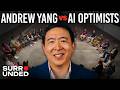
AI Realist vs 20 AI Optimists (ft. Andrew Yang) | Surrounded
Sep 27, 2026
Read: ~10m · You save: 96 min
AI Realist vs. 20 AI Optimists (ft. Andrew Yang) | Surrounded
Andrew Yang debates 20 AI optimists on AI's impact: Will it create opportunity or inequality? Explore UBI, job loss, and human dignity.
The rapid advancement of artificial intelligence (AI) presents a complex landscape of potential benefits and significant challenges. This discussion, featuring entrepreneur Andrew Yang and a panel of AI optimists, delves into critical questions surrounding AI's impact on opportunity, inequality, employment, and human dignity. The core of the debate centers on whether AI will democratize opportunity or accelerate inequality, eliminate jobs faster than they can be created, necessitate universal basic income (UBI), and ultimately prioritize productivity and profit over human dignity.
Democratizing Opportunity or Accelerating Inequality?
Andrew Yang's opening claim posits that AI will not democratize opportunity but will instead accelerate inequality on an unprecedented scale. He argues that capital, AI, data, and processing power are converging into a "multi-trillion dollar vortex" that will consolidate value, benefiting a select few—shareholders, employees of AI firms, and investors—while leaving many others behind.
Christina, an AI safety specialist, offers a nuanced perspective, suggesting that AI simultaneously democratizes capability for consumers by enabling individuals to start businesses, build apps, or access tutoring and therapy services. However, she concedes that AI also concentrates power at an unprecedented level.
Ivon Drago, an entrepreneur with a spiritual growth app called "Holy Habits," counters that AI can foster a renaissance for small businesses by leveling the playing field, allowing smaller teams to achieve expert-level output. He believes AI reduces the output gap and effort required, enabling small businesses to compete with larger entities.
Yang acknowledges the spirit of small business and agrees that AI will enable some small businesses to succeed. However, he maintains that the primary beneficiaries will be holders of large datasets and major AI models, whose valuations have benefited from massive investments in data infrastructure. He draws a parallel to e-commerce, where a "winner-take-all" dynamic led to giants like Amazon, making it difficult for smaller players to compete.
Essie Magic, owner of Zam Jewelry, presents data indicating an influx of business registrations since the launch of ChatGPT in 2022, suggesting AI is fostering entrepreneurship. She highlights AI's role in democratizing access to services like legal and accounting advice, previously prohibitively expensive for many.
Yang, however, points out that while AI may help small businesses save costs, it also represents a zero-sum game for those who would have provided those services. Furthermore, he notes that businesses can grow with fewer employees due to AI, citing his own company's reduction in hiring needs for junior engineers and data analysts.
Val, a beauty and makeup content creator, argues that AI democratizes intellectual ideas, providing access to legal, health, and tutoring resources. Yang counters that while AI offers expert advice, it also leads to the outsourcing of cognitive processes, potentially impacting younger generations' critical thinking skills. He cites early evidence of young people struggling with tasks like writing first drafts and a significant drop in economics students' scores when AI tools are removed.
Nikquil, a software engineer at Facebook, emphasizes the availability of open-source AI models that allow users to control their data and run local models. Yang acknowledges the utility of open-source models for engineers but disputes the notion that entry-level coder wages haven't declined, citing media reports and career placement officer accounts. He asserts that Americans' data is being sold for over $300 billion annually without compensation, with Meta being a primary beneficiary. Nikquil proposes opening up technology and fostering more open-source models as a solution to democratize AI.
AI and Job Displacement
Yang's second claim is that AI will eliminate millions of jobs faster than new ones can be created. Theo, co-founder of the media startup MTS, supports this by highlighting that common job categories like clerical, administrative, retail, food service, truck driving, and manufacturing are vulnerable to AI and automation. He estimates 2.9 million Americans in call centers could be significantly impacted, as AI bots can now handle a substantial portion of customer service issues. He also points to the 2 million Uber drivers and 2.5 million in the insurance industry as potentially affected.
Sophia Doo, also from MTS, argues that AI integration leads to job transformation rather than outright elimination. She uses the example of radiology, where AI has augmented radiologists' work, increasing demand and allowing them to focus on more human-centric aspects of patient care.
Yang, however, argues that the pace of AI advancement is far more rapid than previous technological shifts. He cites companies like Block, Oracle, and Meta laying off thousands of workers, explicitly citing AI as a reason. He believes this transition is happening in real-time, not over years.
Sophia counters by referencing Jevon's paradox, suggesting that increased AI productivity could lead to increased demand and new job creation, particularly in areas requiring uniquely human traits like taste and judgment. Yang acknowledges the potential for new jobs but argues they may be inaccessible to many displaced workers, leading to a "K-shaped economy" where the wealthy benefit disproportionately.
Skip Rizzo, a professor at USC, presents a different perspective, citing World Economic Forum statistics suggesting a net gain of 170 million jobs created by AI by 2030, despite 90 million being lost. He uses his startup, Sidekick, an AI conversational agent for veterans, as an example of AI filling gaps where human therapists are insufficient.
Yang, while agreeing that new jobs will be created, believes the ratio will be severely imbalanced, leading to job polarization with a handful of high-end jobs and many low-end jobs, decimating middle-tier professions. He cites CEOs planning significant workforce reductions due to AI and the increasing investment in data centers over office buildings as evidence of this trend.
Vern argues that current unemployment rates (3-4%) do not reflect the reality of underemployment and declining labor force participation, with one-third of working American men no longer in the workforce. He suggests that AI's impact is not about job elimination but disruption, similar to past revolutions, and that policy and institutions can adapt.
Yang refutes this, stating that the labor force participation rate is at a 20-year low and that the ease with which companies can avoid hiring new workers, as seen with junior roles, contributes to underemployment. He estimates millions of layoffs directly or indirectly due to AI.
Universal Basic Income (UBI) as a Necessity
Yang's third claim is that UBI will become necessary as AI reduces the need for human labor. Sophia expresses interest in the mechanisms and flavors of UBI, advocating for more research into measuring AI-driven unemployment. She suggests incremental policies like wage insurance as a potential bridge.
Yang agrees that UBI is necessary now, citing the use of American data to create AI models that generate billions in revenue without compensating individuals. He proposes paying people for their data as a solution.
Jason, an entrepreneur, supports UBI, arguing that many current jobs are "soul-sucking" and that AI can automate undesirable tasks. He believes productivity gains from AI will eventually lead to new, meaningful work and advocates for a focus on "Gross Happiness Product" over GDP.
Yang agrees that AI will significantly increase GDP per person and argues that this generated value should be distributed to address societal needs, preventing a decline in trust and a shift towards scarcity.
Damian Lillard expresses skepticism about UBI's mathematical feasibility, estimating that 2 trillion annually, impacting essential services. He favors a Universal Basic Services (UBS) model, investing in infrastructure and public services.
Yang acknowledges the potential inefficiencies of government institutions in delivering services but argues that the increasing GDP per capita necessitates wealth distribution. He points out that a significant portion of current government spending already goes to benefits and that investing in people yields returns in health, education, and reduced incarceration.
Sean, a former underwriting analyst and single father, asserts that UBI is already necessary, citing widespread job losses and housing unaffordability even before AI's full impact. He agrees that funding is available, referencing stimulus checks during the pandemic.
A debater referencing a World Economic Forum report suggests 170 million jobs will be created by 2030, negating the need for UBI. Yang counters that this report did not account for the disproportionate impact on certain industries and that the incentive to replace expensive American workers with AI is higher. He also questions the validity of some job postings, suggesting they are for data collection or to project company health.
Market Optimization: Productivity vs. Human Dignity
Yang's final claim is that the market will optimize for productivity and profit, not human dignity. James, representing the Consumer Choice Center, argues that consumers effectively "vote with their feet," influencing companies to balance profit with human dignity. He expresses caution about government setting parameters for human dignity, preferring individual agency and entrepreneurship.
Yang pushes back, stating that consumer behavior often prioritizes cost over values, citing Walmart's success over local businesses. He argues that the market rewards capital holders and data controllers, leading to increased inequality.
James counters with platforms like Etsy, where AI connects consumers with small businesses, suggesting AI can facilitate human dignity. He believes human agency and entrepreneurship are key to dignity.
Yang argues that the market's primary purpose is not to employ people but to achieve its core objective, such as Uber's goal of transportation. He suggests that if AI can achieve these objectives more efficiently, the market will reward it, regardless of human impact.
Mna, a software engineer at Google, argues that AI platforms provide equal access to information, democratizing preparation for tasks like debates. Yang concedes this point but reiterates that the value generated by AI will primarily benefit capital holders, leading to job displacement and undignified circumstances for many.
Nathan, a software engineer, suggests that while AI can be used for pro-social purposes by institutions like universities, the market will ultimately optimize for profit. He believes this will lead to the rich getting richer and a negative impact on the average person.
Donnie, a psychotherapist, argues that if AI severely impacts human dignity, a backlash will occur, forcing a change. Yang agrees that a societal shift is needed but believes the current political system is ill-equipped to facilitate it, suggesting a need for modernization.
Jeremiah, a psychotherapist, argues that AI may not replace professions requiring significant human interaction, like therapy, and that displaced workers can find dignity in understaffed helping professions. Yang agrees that the market under-rewards these professions and that the market does not adequately reward human dignity.
Conclusion
The debate highlights a fundamental tension between the potential of AI to drive unprecedented progress and the risk of exacerbating existing societal inequalities. While optimists emphasize AI's democratizing potential, job creation, and ability to augment human capabilities, realists like Andrew Yang caution against overlooking the concentration of power, the potential for mass job displacement, and the market's inherent drive for profit over human well-being. The discussion underscores the urgent need for thoughtful policy and societal adaptation to navigate the transformative era of artificial intelligence.
AI and Inequality: Democratization vs. Concentration of Power
Andrew Yang introduces his claim that AI will accelerate inequality, not democratize opportunity. Christina, an AI safety specialist, argues that AI democratizes opportunity for consumers by enabling new business creation and skill development, but simultaneously concentrates power. Yang counters with the 'winner-take-all' dynamic seen in e-commerce, predicting a similar outcome for AI applications.
- Andrew Yang's claim: AI will accelerate inequality on an unprecedented scale.
- Christina's argument: AI democratizes opportunity for consumers (e.g., starting businesses, learning) but concentrates power.
- Yang's counter-argument: Compares AI's potential to e-commerce's 'winner-take-all' dynamic.
- The debate touches on the value generated by AI converging with capital, data, and processing power.
Small Business vs. Big Tech in the AI Era
Drago, an entrepreneur, argues that AI can create a renaissance for small businesses by leveling the playing field, allowing them to compete with larger entities due to reduced effort for expert-level output. Yang acknowledges the spirit of small business and agrees AI can help some succeed but maintains that primary beneficiaries will be data holders and major model creators. He uses Verizon's layoffs and AI adoption as an example of how large corporations can benefit disproportionately.
- Drago's perspective: AI can foster a small business renaissance by lowering output barriers.
- Yang's counter: Major beneficiaries will be data holders and large AI model creators.
- Example: Verizon laying off workers while investing in AI for customer service.
- The discussion highlights the existing inequality in the American economy (top 10% control 67% of wealth).
AI's Impact on Entrepreneurship and Skill Development
Essie Magic, a jewelry brand owner, presents data showing increased business registrations post-ChatGPT, arguing AI democratizes access to services like legal and tax advice, bridging gaps for average individuals. Yang acknowledges the surge in business formations but questions the long-term viability and job creation, suggesting many are side hustles rather than full-time employment. Val, a content creator, agrees AI lowers barriers but raises concerns about outsourcing cognitive tasks and potential negative impacts on young people.
- Essie Magic's data: Increased business registrations and product launches since ChatGPT.
- Argument: AI democratizes access to professional advice (legal, tax) for lower-income individuals.
- Yang's concern: Business formations may not translate to sustainable jobs or hiring.
- Val's point: AI can lead to outsourcing cognitive tasks, potentially harming young people's skills.
Open Source AI, Data Ownership, and the Job Market
Nikquil, a software engineer, argues that open-source AI models and self-hosting provide control and access, democratizing AI. Yang disputes claims of declining entry-level coder wages, citing media narratives but acknowledging objective data and personal accounts of job placement issues. He emphasizes that Americans are not paid for their data, which is a significant revenue source for companies like Meta. The discussion shifts to solutions like paying people for data or opening up AI technology.
- Nikquil's argument: Open-source AI and self-hosting democratize access and control.
- Yang's counter: Cites concerns about declining entry-level coder wages and job placement rates.
- Key issue: Americans' data is sold for billions, with no direct compensation to individuals.
- Proposed solutions: Paying people for their data or promoting open-source AI development.
AI's Job Displacement Potential and the Future of Work
Theo, a media startup co-founder, predicts significant job contraction in sectors like customer service, transportation, and white-collar roles due to AI and automation, citing specific numbers. He argues AI is different from past automation due to its cognitive capabilities. Jeremiah, a psychotherapist, suggests AI might fill gaps in helping professions like mental health and elder care, potentially improving displaced workers' dignity. He also highlights issues with military contracts for therapy.
- Theo's prediction: AI will significantly contract jobs in customer service, transportation, and white-collar sectors.
- Argument: AI's cognitive abilities make it fundamentally different from past automation.
- Jeremiah's perspective: AI could fill gaps in understaffed helping professions (mental health, elder care).
- Concerns raised about military contracts and therapist notes.
Job Creation vs. Job Displacement: The AI Debate
Skip Rizzo, a professor, cites World Economic Forum stats suggesting a net gain in jobs due to AI (170M created vs. 90M lost). Yang counters with 'job polarization,' predicting decimation of middle-tier jobs and citing CEOs planning significant layoffs due to AI. He highlights the shift in spending from office buildings to data centers, suggesting servers are replacing humans. Vern argues that current low unemployment rates and historical job creation trends suggest disruption, not elimination.
- Skip Rizzo's stat: World Economic Forum predicts a net gain of 80 million jobs by 2030 due to AI.
- Yang's counter: Predicts 'job polarization' with decimation of middle-tier jobs.
- Evidence: CEOs planning significant layoffs, increased spending on data centers over office buildings.
- Vern's argument: Historical trends show job creation outweighs elimination, citing low current unemployment.
Universal Basic Income: Necessity, Mechanisms, and Meaningful Work
Sophia D., a media tech host, argues that AI can provide access to information and services, potentially bridging gaps and fostering human dignity. She believes UBI is necessary, proposing mechanisms like sovereign wealth funds or universal basic dividends. Yang agrees UBI is necessary, emphasizing that Americans' data is being used to generate massive wealth without compensation. Jason, an entrepreneur, hopes for UBI to shift focus from 'jobs' to meaningful work and happiness, citing David Graeber.
- Sophia D.'s proposal: UBI is necessary, with potential mechanisms like sovereign wealth funds.
- Yang's argument: Americans' data generates wealth for AI companies without compensation.
- Jason's view: UBI could shift focus from 'soul-sucking jobs' to meaningful work and happiness.
- Discussion on Gross Happiness Product vs. GDP.
UBI vs. UBS: Feasibility and Economic Impact
Damian, a basketball player, questions the mathematical feasibility of UBI, estimating a $1,000/month UBI for 200 million Americans would cost $2 trillion monthly, impacting other essential spending. He favors Universal Basic Services (UBS) like infrastructure investment. Yang acknowledges the potential for UBS but notes American institutions' inefficiency in delivery. He argues that increased GDP from AI necessitates wealth distribution, citing the potential for UBI to boost the economy and foster entrepreneurship.
- Damian's concern: UBI's mathematical feasibility and potential impact on federal budget.
- Preference: Universal Basic Services (UBS) like infrastructure investment.
- Yang's counter: American institutions' inefficiency in delivering UBS.
- Argument: AI-driven GDP growth necessitates wealth distribution; UBI can boost economy and entrepreneurship.
The Existing Need for UBI and Dignity in Helping Professions
Sean, a single father and former insurance underwriter, asserts UBI is already necessary, citing pre-AI homelessness and unaffordability. He agrees with Yang that funding is possible, referencing stimulus checks. Jeremiah argues that AI-displaced workers can find dignity in understaffed helping professions like healthcare and education, suggesting increased funding for these sectors. Yang agrees that the market under-rewards these professions and that UBI could provide a cushion for such transitions.
- Sean's assertion: UBI is already necessary, pre-dating AI's impact.
- Funding argument: Cites stimulus checks as precedent for government funding.
- Jeremiah's proposal: Displaced workers can find dignity in understaffed helping professions.
- Yang's agreement: Market under-rewards helping professions; UBI can facilitate transitions.
AI Job Market Realities and Global Perspectives
A participant references the World Economic Forum report predicting 170M jobs created by 2030, suggesting AI jobs are increasing. Yang counters that some job postings may not be genuine and that the US, being more expensive, has a higher incentive for AI adoption, leading to greater job displacement. He argues that AI's impact is not just about job creation but also about the quality and accessibility of those jobs, and that most Americans feel excluded from AI's benefits.
- Counter-argument: WEF report predicts net job creation due to AI.
- Yang's rebuttal: Job postings may be misleading; US has higher incentive for AI-driven job cuts.
- Key issue: Most Americans feel excluded from AI's benefits.
- Global perspective: Other countries may rely on US/China for AI technology.
Market Optimization: Profit vs. Human Dignity and Flourishing
Nathan, a software engineer, argues that AI is being used for human dignity and pro-social purposes in academia (e.g., biology, drug discovery). Yang agrees that AI can achieve great things but sharply disagrees that the market will optimize for human dignity over profit. He believes AI will primarily benefit capital holders, leading to increased inequality. He proposes a market optimized for human flourishing through health, wellness, arts, and education, funded by new currencies.
- Nathan's argument: AI is used for pro-social purposes in academia and research.
- Yang's counter: Market prioritizes profit over human dignity, leading to inequality.
- Proposed solution: A market optimized for human flourishing (health, arts, education).
- Concept: Getting paid to go to the gym as an example of a human-dignity-focused economy.
Backlash Against AI's Impact and the Role of Political Systems
Donnie argues that if AI negatively impacts human dignity too severely, a backlash will force change, preventing complete market optimization for profit. Yang agrees that a backlash is possible but believes the current political system is ill-equipped to manage it, suggesting a need for modernization. Jeremiah, a psychotherapist, believes AI-displaced workers can find dignity in understaffed helping professions, but Yang argues the market under-rewards these fields, making UBI a necessary cushion.
- Donnie's prediction: Severe negative impact on human dignity will cause a backlash, forcing change.
- Yang's view: Current political system is inadequate for managing such change; modernization needed.
- Jeremiah's proposal: Displaced workers can find dignity in helping professions.
- Yang's counter: Market under-rewards helping professions; UBI is a necessary cushion.
AI's Equalizing Information Access vs. Market-Driven Inequality
Sophia argues that AI provides equal access to information, preparing individuals for debates and opportunities. Yang concedes this but distinguishes it from the market optimizing for profit over dignity, which he believes will accelerate inequality. He emphasizes that the value generated by AI accrues to capital holders, not average individuals. He proposes a shift from scarcity to abundance through AI-driven value creation and equitable distribution.
- Sophia's point: AI provides equal access to information and preparation tools.
- Yang's distinction: Equal access to information is different from market optimization for profit over dignity.
- Core issue: Value generated by AI benefits capital holders, not average individuals.
- Goal: Shift from scarcity to abundance through equitable distribution of AI-generated value.
Optimism vs. Realism in the Age of AI Transformation
In the final debate, Sophia argues that optimism is necessary for navigating AI transformation and that pessimism can disempower individuals. Yang agrees personal optimism is beneficial but stresses the need for clear-eyed realism about AI's challenges and potential negative impacts on society. He believes the current political system is not designed to solve these problems and that the winners of the AI era must share the benefits to avoid societal discord.
- Sophia's claim: AI optimism is necessary for navigating technological transformation.
- Yang's nuance: Personal optimism is good, but macro-level realism about AI's challenges is crucial.
- Critique: Current political system is not equipped to solve AI-related problems.
- Call to action: Winners of the AI era must share benefits to avoid societal discord.