
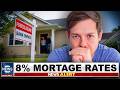
The Housing Market Is Completely F*d
Mortgage rates are soaring, and Treasury yields are at 20-year highs! Is the housing market about to crash? Discover the forces at play.
Mortgage rates have surged to nearly 7.5%, with long-term Treasury yields reaching levels not seen in over two decades. This sharp increase in borrowing costs has made it significantly more expensive to obtain loans. Concurrently, rising interest rates on government bonds now offer a higher return than investors can typically achieve from rental properties. This presents a scenario where the risk and effort associated with property ownership, including tenant management, property taxes, insurance, repairs, and leverage, may not be adequately compensated compared to the passive income from government debt. A widespread shift in investor sentiment towards this perspective could have substantial economic repercussions.
Factors Driving Interest Rate Increases
The current rise in interest rates is primarily linked to dynamics within the Treasury bond market. When the U.S. government needs to borrow funds, it issues Treasury bonds, which are essentially loans with a fixed interest rate. These are generally considered a low-risk investment due to the government's creditworthiness. However, recent trends indicate a decline in bond prices, which, conversely, leads to an increase in bond yields.
Bond prices and yields move in opposite directions. When investor demand for bonds is high, prices rise, and yields fall. Conversely, when investors sell bonds, prices drop, and yields increase to attract new buyers. For example, a bond priced at 5 in interest yields 5%. If demand drives the price up to 5 interest payment, the yield drops to 4%. Conversely, if demand is low and investors offer only 5 interest payment, the yield rises to 6.25%. Therefore, rising yields signify that investors are selling government bonds, leading to lower prices and necessitating higher yields to incentivize purchases.
This situation is a warning sign for the broader economy. When the safest borrower globally must offer higher returns, all other economic sectors must adjust. Investors earning over 5% from government bonds may question the rationale for investing in stocks, rental properties, or other businesses unless those investments offer substantially higher returns.
The Impact on the U.S. Economy and National Debt
The United States is the world's largest borrower. As interest rates rise, the cost of servicing the national debt increases significantly. Each time maturing debt is refinanced, it is replaced with new debt at current higher interest rates, exacerbating the national debt. This necessitates higher returns demanded by investors to compensate for the perceived additional risk, creating a potentially unsustainable cycle.
The current bond market collapse is driven by investors' unwillingness to lend at previous interest rates. Factors such as inflation, elevated oil prices, government spending, and rising deficits, coupled with the substantial volume of debt requiring refinancing, contribute to this.
Three specific forces are currently impacting the bond market and, by extension, housing values:
- Persistent Inflation: Inflation has remained above 2.5% for 65 consecutive months. Oil prices have surpassed 150. This environment compels the Federal Reserve to implement aggressive measures to control rising prices.
- Rising Oil Prices: Oil prices exceeding $100 per barrel are compounded by geopolitical tensions, such as the stalled negotiations to open the Strait of Hormuz and anticipated further conflict post-midterm elections. These factors could drive oil prices, inflation, and interest rates higher.
- Government Debt: The U.S. government is experiencing annual deficits of approximately $2 trillion, spending significantly more than it collects. This requires the Treasury to continuously issue new debt to fund expenditures. Simultaneously, buyers are demanding higher returns, creating a situation where the U.S. is attempting to offload debt at a time of low demand, forcing yields to increase.
As yields rise, pressure mounts on the housing market, stock market, banks, and the government's own budget, potentially escalating from a bond market issue to a full-blown financial crisis.
Impact on the Housing Market
The rapid increase in mortgage rates has initially led to a decline in home sales rather than immediate price drops. Homebuyer demand has fallen to unprecedented levels, with mortgage applications reaching lows not seen since the early 1990s. Redfin reports a 53% surplus of sellers over buyers, the largest gap in their recorded data. In markets like Nashville, Miami, Houston, Orlando, and Las Vegas, there are more than two sellers for every buyer. Consequently, nearly half of sellers in these areas are offering concessions, and 38% of home builders have reduced prices. The average price of a new home has fallen by 8.8% year-over-year.
While national median home prices are still up 2.1% year-over-year, this is largely because homeowners are reluctant to sell at a loss. However, when adjusted for inflation (currently at 3.4%), home prices are effectively declining, albeit more subtly.
The danger lies in sustained mortgage rates above 7% or further increases. This could make homeownership unattainable for the average person with an average income. Furthermore, landlords may find it more lucrative to invest in government treasuries than manage rental properties, potentially increasing market inventory and driving down prices. For a buyer's monthly payment to remain consistent with earlier this year, home prices would need to decrease by approximately 14% to offset higher interest rates.
Broader Economic Implications: The Debt Spiral
Higher interest rates have far-reaching consequences beyond the housing market, re-pricing the entire economy.
- National Debt: The U.S. national debt surpassed 39 trillion. In the first 11 months of the fiscal year, interest payments exceeded 3 billion daily and is projected to increase. A significant portion of this debt, issued at lower rates, is due for refinancing at current higher rates. A 1% increase on the 320 billion in annual interest costs, potentially fueling a cycle of more debt, money printing, inflation, and higher rates.
- Retirement Accounts: Traditionally, bonds have been considered a safe asset for retirees. However, long-term treasury funds have reached historic lows, down over 50% from their 2020 peak. For many clients, the bond portion of their portfolio is the only segment experiencing losses.
- Bonds Compete with Stocks: With Treasury yields offering returns comparable to or exceeding the expected earnings from the S&P 500, investors face a decision between potentially higher but riskier stock market returns and guaranteed returns from U.S. government debt.
- Bonds Compete with Rental Properties: Lending money to the government is now more profitable than investing in rental properties. For instance, a 26,000 annually, while a similar investment in real estate, factoring in risks and expenses, might yield $24,000. Real estate investment has reportedly fallen by half over the past four years, suggesting that sustained high rates necessitate price reductions for real estate to remain competitive.
Potential Scenarios and Outlook
Two primary scenarios are possible:
- Best Case: A diplomatic resolution to open the Strait of Hormuz leads to falling oil prices, reduced inflation, and less pressure on the Federal Reserve to raise rates. This could lead to a gradual return to normalcy.
- Worst Case: Oil prices remain elevated, geopolitical conflicts escalate, and the Federal Reserve further increases interest rates, potentially pushing mortgage rates to 8%. This scenario could severely impact the housing market, stock market, and retirement accounts.
While a nationwide housing collapse is not definitively predicted, sustained high mortgage rates (above 7%) would likely cause housing prices to suffer. However, unlike the 2008 crisis, current homeowners generally possess significant equity and low-interest rate mortgages, making them less likely to be forced sellers. Many may opt to wait rather than sell at a loss, potentially leading to longer market times for available properties and increased negotiating power for buyers.
Markets with substantial new construction, a seller surplus, and investors focused on cash flow may experience more significant downturns compared to markets with restricted inventory. The prolonged period of mortgage rates above 7% could lead to increased inventory and price reductions as impatient sellers seek to offload properties. This could eventually rebalance monthly payments for buyers, potentially drawing them back into the market.
The current environment suggests that buyers may have leverage for the first time in a considerable period. Patience and making financially sound offers are advised. The expectation of perpetual home price appreciation should be tempered.
The Surge in Interest Rates and Its Immediate Impact
Mortgage rates have surged to nearly 7.5%, and long-term Treasury yields are at 20-year highs, making borrowing expensive. Investors can now earn more from government bonds than rental properties, raising questions about the attractiveness of real estate investment.
- Mortgage rates have surged to nearly 7.5%.
- Long-term Treasury yields have climbed to levels not seen in over 20 years.
- Borrowing has become dramatically more expensive.
- Returns from government bonds now exceed those from rental properties.
- This situation prompts a re-evaluation of real estate investment risks versus rewards.
Understanding Bond Market Dynamics
The video explains that bond prices and yields move inversely. When investors sell bonds, prices fall and yields rise. This is happening because investors are demanding higher returns due to inflation, oil prices, government spending, rising deficits, and massive debt that needs refinancing.
- Bond prices and yields move in opposite directions.
- When investors sell bonds, bond prices fall and yields rise.
- Current bond market conditions indicate investors are selling off government bonds.
- Yields are increasing to entice buyers.
- Factors driving this include inflation, higher oil prices, government spending, rising deficits, and debt refinancing needs.
The Three Forces Decimating the Bond Market
Three key forces are impacting the bond market and potentially housing values: 1) Inflation is back above 2.5% for 65 months, with oil prices rising. 2) Rising oil prices, exacerbated by geopolitical tensions, further fuel inflation and interest rates. 3) The US government is running large annual deficits ($2 trillion), leading to increased debt issuance and higher borrowing costs.
- Inflation has remained above 2.5% for 65 consecutive months.
- Oil prices are above 150.
- Geopolitical events are contributing to rising oil prices.
- The US is running approximately $2 trillion in annual deficits.
- The Treasury must constantly issue new debt to cover spending, facing low demand and higher yield requirements.
Impact on Housing Sales and Prices
Rising mortgage rates are causing sales to fall first, not home prices. Buyer demand has plummeted, with mortgage applications at early 1990s levels. There are significantly more sellers than buyers, leading to price cuts and concessions, though national median prices are still slightly up year-over-year.
- When mortgage rates rise quickly, sales fall before prices.
- Home buyer demand has fallen to unprecedented levels.
- Mortgage applications have dropped to levels not seen since the early 1990s.
- There are 53% more sellers than buyers.
- In some cities, nearly half of sellers are offering concessions, and 38% of home builders have cut prices.
The Broader Economic Impact: Debt, Retirement, and Investments
Higher interest rates re-price the entire economy, starting with the national debt, which has surpassed $40 trillion. Interest payments alone are over $1 trillion annually. Refinancing maturing debt at higher rates exacerbates the problem, creating a debt spiral. This also impacts retirement accounts, as bond values have fallen significantly, and makes bonds more competitive with stocks and rental properties.
- US national debt has surpassed $40 trillion.
- Annual interest paid on the national debt exceeds $1 trillion.
- Maturing debt must be refinanced at higher current interest rates.
- Long-term treasury funds are down over 50% from their 2020 peak.
- Government bonds are now offering competitive returns compared to stocks and rental properties.
Future Scenarios and Housing Market Outlook
Two scenarios are possible: a best-case where oil prices fall and inflation declines, leading to rate stabilization, or a worst-case where oil prices remain high, conflict escalates, and rates rise further, potentially destroying the housing and stock markets. The presenter believes a nationwide housing collapse is unlikely due to homeowner equity and low-rate mortgages, but prices may suffer, especially in markets with high inventory.
- Best-case scenario: Oil prices fall, inflation declines, Fed rates stabilize.
- Worst-case scenario: Oil prices stay high, conflict escalates, Fed raises rates further, potentially destroying markets.
- A nationwide housing collapse like 2008 is unlikely due to homeowner equity and existing low-rate mortgages.
- Homeowners may choose not to sell, or wait longer, giving buyers more negotiating power.
- Markets with high inventory and more sellers than buyers will be hit harder.