
 ~9m1:06:13
“I Will Not Niche Myself” | Instagram Poetry and the Freedom to Change with David Gate
Nov 18, 2026
Read: ~9m · You save: 57 min
"I Will Not Niche Myself" | Instagram Poetry and the Freedom to Change with David Gate
Poet David Gate on Instagram fame, refusing to niche himself, charismatic faith, milling flour, and how neighbors came together after Hurricane Helene in North Carolina
Elizabeth Oldfield, host of The Sacred, a podcast produced by the think tank Theos in partnership with Comment Magazine, speaks with poet David Gate about his life before poetry, his views on abolition and faith, the growth of his Instagram audience, and his experience of Hurricane Helene in North Carolina.
What Is Sacred
Gate was asked what is sacred to him. He identified food, drink, and music as universal sacred practices. He described these as communal activities that people have shared and made beautiful. He values good food, good drink, good people, and music, and notes that these are communal when practiced properly.
Gate says that turning 40 prompted a re-evaluation of his life. He asked what he values and what he wants to give his life to. He concluded that he wanted to write work that expressed his beliefs and that would shape the world he wants to leave to his children and future generations.
Abolition and Liberatory Practice
Gate identifies abolition as a value he has chosen to work toward. He describes it as liberatory practice in religious, political, and social contexts, with specific application in the United States.
In its broadest form, he explains, abolition means dismantling systems and institutions that inflict violence. He names four areas:
- The military.
- The police. Gate describes American policing as militarized and out of control.
- Prisons. He calls for re-evaluating how society handles crime and criminals and for moving toward restorative practices.
- Borders. He argues that a border requires violence. Enforcing a nation-state border means that people who attempt to cross face punishment.
Gate states that he does not have all the answers. He does not imagine a utopian society. He imagines one that inflicts less harm on people.
Gate argues that most people accept violence. They support militaries and police to protect them and prisons to confine dangerous people. In his view, the central question concerns who carries out violence and who suffers it. Individuals do not directly face the violence that the systems they participate in produce.
Christian Faith and Charismatic Evangelicalism
Gate grew up in a charismatic evangelical church and movement in northwest London. He was taught early that the way of Jesus and his teachings are foundational for how to live. He took this seriously. He became frustrated and disappointed that these teachings were constantly compromised within his movement, particularly in how it justified its worship, priorities, and politics. He felt that the Sermon on the Mount should guide the values of the church.
Defining the Terms
Gate explains that he was part of the Anglican Church, a broad communion spanning the full political spectrum and every style of worship, from casual to high church. He worshipped at the casual, low-church end. Dress was informal, though women were expected to dress modestly. He served primarily through music, using contemporary styles with guitars, drums, keyboards, and singers. He describes this as an evangelical, low-church environment for roughly 20 years.
"Charismatic" refers to belief in the work and gifts of the Holy Spirit, and in the present-day movement of the Spirit. Practitioners seek to live out what scripture describes, particularly prophecy and speaking and singing in tongues. Gate says the movement did not practice snake handling.
Gate notes that prophecy typically takes the form of a person praying for someone and then reporting that God has given a message. The message is usually vague enough to limit risk, though sometimes it feels specific and accurate. Gate states that prophecy has real worth and beauty, and that it can be helpful, but he also acknowledges that it can seem unusual to outsiders.
Embodied Spirituality
Gate says these practices gave him an engaged, embodied spirituality rather than one centered on theology, though theology was part of it. He practiced at home with candles, worship music, and a Bible, having similar experiences privately. He values this embodied and emotional dimension. He argues that people who omit emotional and physical practice from their spiritual lives miss something. He acknowledges the risks of communal religious settings, including manipulation, and says these dangers warrant serious concern.
Career in Worship Ministry
Gate worked as a professional worship leader for a long time, in London and then in Belfast. He began with Soul Survivor, a youth organization near where he grew up. He started writing songs as a teenager and later led worship at its events and conferences. He moved to Northern Ireland shortly after his marriage in 2003, at age 22, and lived in Belfast and Carrickfergus for three years.
In Belfast, Gate says he came to understand British colonialism and the colonial history of Ireland, which he had not learned in school. He had known about the Troubles but had not understood their context. He worked there as a guitar and singing teacher and earned his living that way while his partner worked for a church as a children's worker.
He then moved to Cheltenham, where he worked for five years as worship pastor at Trinity Cheltenham. In 2011, he moved to Jacksonville, Florida.
Gate says he left Cheltenham because he had reached the natural end of his time there. He was frustrated that his role required him to create the same experience of the Holy Spirit in worship every Sunday. He wanted more communal activity and more creative freedom. He also described frustration with the British class system within the Church of England. He said he had watched mediocre upper-middle-class white men advance, and he concluded that the wider church ecosystem was underdeveloped emotionally, psychologically, intellectually, and creatively.
In Jacksonville, he served at a church planted from St. Mary's Bryanston Square in London. He was connected to that church through friends, and it had previously led worship in London. The church had previously hired British worship pastors. The family, with three children and a fourth on the way, moved for what they expected to be two to three years, possibly five. They stayed five years.
Early Writing and Poetry
Gate wrote lyrics as a teenager and kept notebooks of ideas that did not fit conventional worship songs. When blogging emerged, he wrote there, and he later wrote sermons and devotionals. He began to take poetry seriously after he turned 30 and moved to America.
Early on, he believed poetry had to resemble the early twentieth-century work he had studied, such as that of T. S. Eliot and Ezra Pound, and be serious in tone. He wrote in iambic pentameter and followed strict formal rules. He describes this formal training as valuable: in any discipline, one must learn the rules before breaking them.
He cites Picasso and Miles Davis as examples. Davis was a classical trumpeter before he helped invent jazz trumpet, and Picasso was a strong portrait artist before he deconstructed and broke the form.
Gate states that the internet age has reduced the practice of learning rules before breaking them. He values the democratization of creative work but says rules generally exist for reasons. He later turned to Mary Oliver and Wendell Berry, whose pastoral poetry, in both senses of the word, felt more achievable and more connected to the living world. He notes that Berry died shortly before the interview.
Leaving Church Work
In 2016, Gate and his partner decided to leave Florida. They started a house church in Asheville, North Carolina, with a few people who joined them from Florida. For eight years, the group prayed, worshipped, and ate together. It had no ambitions for growth, property, or staff. Its purpose was to be a community that looked after one another and belonged to one another. The group stopped in 2024 because Gate and his partner had been organizing and hosting it and could not find someone to take it on.
Food, Farming, and Work
Gate describes himself as radicalized by the American food system. He argues that capitalism produces similar food systems everywhere, and that the American system is hyper-capitalistic. He points to excessive plastic, chemicals, and unnecessary additives, and to bread that lasts three months. He says consumers pay more for a worse product that damages the earth.
In 2016, he read Wendell Berry's The Unsettling of America. His partner had long wanted chickens, goats, and vegetables. Gate says the book convinced him that the family should take this step for moral reasons and for the good of their souls, to connect more closely with their food and its origins, and to act in ways that reduced their environmental impact.
In 2020, Gate's income from sports writing for an American sports website about Liverpool Football Club declined sharply. Gambling ads, which became legal in many states that year, were displayed on the sites that referred traffic to him, and some referring sites could not carry them. He decided to write a book and worked on it for three weeks in February 2020. COVID-19 then intervened. His children were at home for 18 months, and the book was not finished.
By November 2020, the family had no money. Gate took a job at Echo View Fiber Mill, which processed angora rabbit fiber, wool, sheep wool, and alpaca wool into yarn. He describes the work as creative and says that it gave him a job with his hands and no email, Slack, or Zoom. The business later closed after the economy collapsed. Gate then began writing the poetry he posted online. He next took a job as a miller at a nearby flour mill, where he learned to mill flour.
Growth of an Instagram Audience
Gate began posting poems on Instagram, initially about one a week, to friends. The first year brought modest growth. He describes this period as valuable because it allowed him to develop his work without pressure. Instagram differs from submitting to magazines or collecting poems in a book. Each poem must fit one square, which imposes limits on length, size, and the ability to hold a scrolling reader's attention. He treated these constraints as a useful training ground, though he experienced significant self-doubt and impostor syndrome.
In the second year, his work began to go viral, his follower count grew, and celebrities shared his poems. He says he never tried to become an influencer, and that his words, not his personal image, attracted his audience. This allowed him to remain a writer, which he had always wanted to be. He now earns his living from poetry, which he describes as a dream realized. He says he did not become a talking head who pivoted to writing, a path many people now take.
Gate's Approach to Niche and Identity
Gate's poem "I Will Not Niche Myself" expresses his philosophy. He says the easiest way to grow online is to find a niche and serve it. He does not want to follow that advice, because he believes work that fulfills him requires teaching the audience that he will pivot and follow his interests. He argues that this builds trust, because people engage with a real human being, and people long for that connection.
He states that he deliberately sometimes provokes people online. He does not want to be seen only as cheerful or positive. He says a person contains multiple dimensions, including politics, religion, faith, culture, and entertainment, and that he wants his online presence to reflect that. He suggests that people may follow him for his faith or for his politics, and that his range of interests may attract a broader audience.
Gate says the phrase "I'm not your pastor" recurred in his work in America. His house church sought an egalitarian structure without hierarchy, which he found difficult in a context shaped by centralized, savior-figure expectations. He says the poem also reflects his shift from church-oriented work to non-church writing, from music to poetry. He cites Beyoncé's willingness to pivot between albums as an influence.
Poetry, Accessibility, and the New York Times Review
Gate discusses a New York Times review of his book. He says the review reflected a cultural image of poetry as difficult and dark, valued for obscurity. He notes that Instagram poetry has revived the form, which has prompted debate about whether it is the same kind of poetry. The review described Instagram poetry as built on radical simplicity and therapeutic bromides, and it presented the author as an Instagram poet, a category it treated as separate. The reviewer also said he enjoyed the work.
Gate argues that poetry shares a cultural position with classical music. It carries heritage, roots, and links to classical works. Many readers therefore assume that serious poetry must be dark, heavy, and difficult. He says the difficulty itself often becomes the point, and readers are surprised when a simple piece moves them. He identifies lyric tradition as the origin of the work he does and names Kendrick Lamar as among the best poets working today.
He says Instagram is viewed as frivolous, but it is where people spend their time. He notes that readers do not spend much time in newspapers or literary magazines, and he argues that poets should go where readers are. He describes the platform as democratic: a poet can post work, and readers can share it. A poem need not have a cultural goal beyond affecting one person.
Elizabeth Oldfield notes that Gate's shorter, joyful, earnest poems on friendship and enthusiasm have travelled furthest. Gate says he embraced earnestness in his forties. He describes earnestness as viewed with suspicion in critical circles, where readers often want distance between art and artist and want to feel clever. He argues that simple work that anyone can understand is often devalued for that reason. He says he wants to feel clever too, but that he also wants to be moved by simple lines.
Gate says he was delighted by the review. He describes it as a legitimizing step as he moves from Instagram writing into the literary world. The headline, "Instagram poet that has a hint of darkness," pleased him. He notes that his reputation in church circles is for cynicism and direct criticism, not positivity. He says the book is structured so that its more positive poems appear first, and its harder material comes later.
Hurricane Helene and Community Response
Gate discusses Hurricane Helene, which struck western North Carolina in September 2024. The storm dropped enormous quantities of water. The French Broad River rose 25 feet, and dams broke. Creeks and rivers across the region flooded.
The official death toll stands in the 500s. Gate believes that, if the figure covers the whole affected area, the total is closer to 1,000. Friends found bodies in their yards and gardens. Businesses and homes were destroyed.
Gate's property sustained little damage, but every bridge around his home was lost, leaving the area isolated until the bridges were rebuilt. Power was out for about a week, and internet service was also lost. Running water was unavailable for 12 weeks, and drinking water for 14 weeks. Gas was not available. For at least the first few weeks, helicopters were the only access route. Residents spread across mountains and hills were cut off, and some could not obtain insulin.
Gate says the community did not turn to self-protection. Residents came out of their homes, helped each other, and shared what they needed. He describes the neighborhood as politically mixed, but political differences did not matter on the street. He cites a neighbor who supports Donald Trump and displays a flag honoring Charlie Kirk. This neighbor used his chainsaw and truck to clear roads, and Gate's household provided eggs, flowers, and yarn in return.
Gate says the transgender community was the most prepared group. Many members are anarchist or left-wing and anti-capitalist, and they had built mutual aid networks. They set up funds that people could donate to online, and the money reached people in need within a short time. Aid included practical support as well as money. Gate says local trans activists kept the city functioning for a week or two, until churches organized, FEMA arrived, and World Central Kitchen reached the area. He says most communities in the region were not organized as communities. Residents were organized around gyms, school PTAs, and similar activities, but not around their neighborhoods. Gate observes that when the internet fails, group chats are of little use, and residents must know where their neighbors live.
Gate describes lasting trauma. Residents feel anxious during heavy rain and stock up on supplies. He argues that the disaster also showed that people can live in a more connected way and can value human dignity for its own sake, across differences in politics, faith, race, and religion. He asks whether people can reach that state without a crisis. He expects environmental crises to increase.
Oldfield raises the idea that being capable has dignity. Gate agrees, but he says the capacity must serve the community, not one's own status.
Convenience and Formation
Gate reads a poem about convenience. In it, he argues that modern life has made people helpless. People drive through coffee shops, pharmacies, and banks because conversation is inconvenient. They buy furniture made of chipboard that goes to landfill because creation is inconvenient. They buy new clothes instead of mending seams, and they choose fast fashion because craft is inconvenient. They build playlists and podcasts for spiritual nourishment because church is inconvenient. The poem concludes that people sacrifice much for convenience, yet everything remains almost impossible.
Faith
Gate says the story Oldfield initially projected onto him, of a well-trodden path from church to disillusionment and departure, does not fully describe his position. He rejects "deconstruction" as a description of his process. He describes it as composting.
He grew up in Harrow, North London, in a multicultural setting. His school was not predominantly white or Christian, and he grew up among Hindus, Muslims, and Jews. In religious education classes, pupils were taught that every road leads to God. Gate says he rejected that claim during his evangelical years and has since become more open to it as a concept.
He says he carries forward mystical practices from his twenties, liberation theology from his thirties, and Black and queer liberation theology. He describes these as compost that produces energy and new growth. Some new shoots resemble earlier influences, and others feel new. He is still haunted and inspired by the work and teaching of Jesus, he says, and he is open to other ways of practicing that faith. He rejects the view that the form of faith inherited in childhood is the best form, a view he considers common and sad in Christian circles.
Gate closes the interview with a final poem, "I Fear God," which he had not previously read publicly:
I fear God in the way I fear beauty, in the way I fear vulnerability, in the way I fear getting what I want, in the way I fear being helpless, in the way I fear being loved unconditionally.
What Is Sacred and Abolitionist Values
Gate reflects on what is sacred to him at midlife: food, drink, music, and communal life, alongside abolitionist and liberatory values.
- Gate turned 40 and had a typical midlife re-evaluation, asking what is most sacred to him.
- He names food, drink, and music as universal sacred practices, which are communal when done properly.
- He wants to move from snarky online comments to building and writing that expresses his beliefs.
- Abolition, as he understands it, means ending systems that inflict violence: the military, the police, prisons, and harmful borders.
- He says he does not imagine a utopian society, only one that inflicts less harm.
- He argues most people accept violence and the question is whose violence and who suffers it.
Upbringing in Charismatic Evangelical Church
Gate describes his upbringing in a charismatic evangelical church in northwest London and the practices he found there, and how they shaped his embodied, emotional spirituality.
- He grew up in a charismatic evangelical church and movement in northwest London.
- He was part of the Anglican church, on the casual, low-church end of its spectrum.
- Charismatic practices he describes include prophecy, speaking in tongues, and singing in tongues.
- He says the practices gave him an embodied, emotional spirituality not focused on theology, practiced at home with candles, worship music, and a Bible.
- He says he still prays in tongues today.
- He describes prophecy as often vague but sometimes uncannily specific, which he calls 'bonkers' yet valuable.
Career as Worship Leader and Moves
Gate traces his career as a professional worship leader across several cities, including Soul Survivor, Belfast, Cheltenham, and Jacksonville, Florida, and why he left church work.
- He started with Soul Survivor, a youth organization near where he grew up, writing songs as a teenager and leading worship at its events and conferences.
- He moved to Northern Ireland after marrying at 22 in 2003 and lived in Belfast and Carrickfergus for three years.
- In Belfast he learned about British colonialism and Irish history, which was not taught in his schools.
- He worked at Trinity Cheltenham for five years as a worship pastor.
- He moved to Jacksonville, Florida in 2011, joining a church planted from St Mary's Bryanston Square in London.
- He left church work because he was frustrated with same-experience-every-Sunday expectations, lack of community, and the British class system within the Church of England.
Writing Poetry and Influences
Gate describes how he started writing poetry, his early formalist approach, and the influence of Mary Oliver and Wendell Berry.
- He wrote lyrics as a teenager and kept notebooks of ideas that did not fit worship songs.
- He turned to blogging, sermons, and devotionals before taking poetry seriously after turning 30 and moving to America.
- He initially wrote in strict forms such as iambic pentameter, influenced by early twentieth-century poets like T.S. Eliot and Ezra Pound.
- He argues you must learn all the rules before breaking them, citing Picasso and Miles Davis.
- He was later drawn to Mary Oliver and Wendell Berry, whom he says recently died a couple of days before the recording.
- In 2016 he and his partner decided to leave Florida and start a house church in Asheville, North Carolina, which ran for eight years and stopped in 2024.
Food Systems, Income, and Milling Flour
Gate explains his shift to farming, food systems, and milling, his income loss from sports writing, and his job at a flour mill.
- He was radicalized by the American food system's plastics, chemicals, and additives, and by bread that lasts three months.
- In 2016 he read Wendell Berry's book The Unsettling of America, which confirmed his interest in growing food and raising animals.
- He wrote sports content about Liverpool Football Club for an American website until gambling ads reduced his income in February 2020.
- He spent three weeks writing a book in February 2020, but COVID-19 and home-schooling prevented its completion.
- In November 2020, after running out of money, he took a job at Echo View Fiber Mill processing angora, wool, sheep wool, and alpaca wool into yarn.
- The fiber mill later closed after the economy crashed, and he then became a miller at a nearby flour mill, where he found creative space and no email, Slack, or Zoom.
Instagram Poetry and Going Viral
Gate discusses how his Instagram poetry started with friends, then took off in its second year after going viral and being shared by celebrities, and why he never aimed to be an influencer.
- He posted poems on Instagram, initially at about one poem a week, reaching only friends at first.
- The Instagram format of one square forced limitations on space, size, and capturing attention while scrolling.
- In the second year his work went viral, his followers grew, and celebrities began sharing it.
- He says he was never trying to be an influencer and that his words, not video content, brought in his audience.
- He says this let him stay a writer, which he says is what he wanted to spend his life doing.
- Elizabeth Oldfield notes that many people now pivot from video talking-head content to writing, but Gate did not.
Podcast Context and the Poem 'I Will Not Niche Myself'
The host introduces the podcast's aim and Gate reads his poem 'I Will Not Niche Myself', explaining the origin of the phrase 'I am not your pastor'.
- The Sacred podcast started nearly a decade ago with a focus on politicians, journalists, and cultural producers, and has increasingly included people with large online followings.
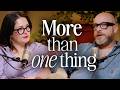
- Gate reads 'I Will Not Niche Myself', which says he is not one thing and will write, paint, dance, scroll, and sculpt.
- The poem's line 'I am not your poet or your pastor or your prophet' came from repeatedly telling people in his American house church he was not their pastor.
- He wanted an egalitarian, non-hierarchical house church and was inspired by Beyoncé's career pivots.
- Elizabeth Oldfield notes that niching is the classic advice to build a following, while the podcast's varied guests are hard for YouTube to categorize.
Why the Work Connects and Critical Reception
Gate says his audience trusts him because he shows a real, multifaceted human being, not only happiness and positivity, and discusses the New York Times review of his book.
- Gate says a narrow niche is the easiest way to grow online, but fulfilling work requires teaching the audience you will take left turns.
- He says trust builds over time because people engage with a real human, and he sometimes deliberately provokes people online.
- He says 'we contain multitudes' and that people may tolerate his faith while being interested in his politics, or vice versa.
- The New York Times review called him an 'Instagram poet' with a hint of darkness and said Instagram poetry 'pedals in radical simplicity and therapeutic bromides'.
- Gate was pleased by the review, which he sees as a legitimizing step from Instagram writer to the literary world.
- Gate says his book is structured so the more positive poems come first and it gets harder as it goes on.
Poetry, Instagram, and Earnestness
Gate and Oldfield discuss poetry's cultural image, Instagram as a platform, and why joyful earnestness is often undervalued as serious art.
- Gate says poetry is culturally associated with weight, darkness, and difficulty, and that people feel it is not good if it is not.
- He argues Instagram is often viewed as trivial, yet it is where people actually spend their time, so poets should go where people are.
- He names Kendrick Lamar as one of the best poets today, a Pulitzer Prize-winning lyricist.
- Gate says his creative change in his 40s was to embrace his earnestness, and that critical circles view earnestness with suspicion.
- He says people sometimes devalue work anyone can understand because it does not make them feel clever.
- Oldfield notes the New York Times reviewer said he loved the poet most when he was dark.
Hurricane Helene and Community Response
Gate describes Hurricane Helene's devastation in western North Carolina in September 2024 and how neighbors and a trans mutual aid community responded with solidarity rather than survivalist panic.
- Hurricane Helene dumped vast amounts of water on western North Carolina in September 2024, breaking dams.
- The French Broad River rose 25 feet, and creeks and rivers flooded the area.
- The official death toll is in the 500s, but Gate estimates about 1,000 across the whole area.
- Bridges were gone, isolating residents; the only access for weeks was by helicopter.
- His household lost power for about a week and running water for 12 weeks, with drinking water unavailable for 14 weeks.
- Gate says neighbors, regardless of politics, came out to help each other, with a Trump-supporting neighbor clearing roads with his chainsaw and truck.
- Gate says the trans community, with existing mutual aid funds, kept the city afloat for a week or two until churches, FEMA, and the government arrived.
Capability, Convenience, and Faith as Composting
Gate reflects on the value of being capable and offering something to community, reads a poem about convenience, and discusses his faith as composting rather than deconstruction.
- Oldfield says she thinks a lot about becoming someone who is capable during a crisis, and Gate agrees about dignity in contributing to community.
- Gate reads a poem arguing that in the name of convenience, people have lost conversation, creation, craft, and church.
- Gate says he prefers the term 'composting' to 'deconstruction' for his faith.
- He was raised in Harrow, North London, in a multicultural and multi-faith school, where he was taught every road leads to God.
- He says he is still haunted and inspired by the work and teaching of Jesus, and is open to different ways of practicing faith.
- He reads a final poem, 'I Fear God', and the episode ends with reflections on needs being met and a society geared toward human flourishing.