
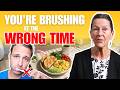
 ~5m23:06
Should You Brush Your Teeth Before or After Breakfast?
Sep 19, 2026
Read: ~4m · You save: 19 min
Should You Brush Your Teeth Before or After Breakfast?
Discover the science behind brushing before or after breakfast! Dr. Ellie reveals why nighttime care is key for a healthy mouth and how to optimize your oral microbiome
The timing of oral hygiene practices, specifically brushing teeth in relation to breakfast, is a subject of ongoing debate. Dr. Ellie, a dentist with over 55 years of experience, proposes a system focused on nurturing oral health through biochemical adjustments rather than solely mechanical cleaning. Her approach emphasizes the importance of the oral microbiome and aims to prevent dental issues proactively.
Dr. Ellie asserts that her personal dental history, spanning 55 years, includes no fillings, repairs, crowns, root canals, or gum disease treatments. Furthermore, she has not undergone dental cleanings for the past 45 years. This personal success, along with that of her children, grandchildren, and numerous patients, forms the basis of her advocacy for her system. She highlights that her strategies have been proven over time through saliva testing and patient testimonials, with hundreds of reviews available for her book on Amazon.
The core of Dr. Ellie's philosophy is a "forward-looking approach" to oral health, contrasting with what she describes as the "retroactive" methods prevalent in American dentistry. She contends that most dentists are trained to identify and treat existing problems, such as cavities and gum disease, rather than focusing on spontaneous improvement of oral health. Her system aims to shift the oral microbiome from an unhealthy to a healthy state, enabling beneficial bacteria to defend the mouth from decay and disease. These beneficial bacteria, numbering in the hundreds, are credited with protecting against tooth sensitivity, improving tooth color, and preventing disease.
The Critical Role of Nighttime Oral Care
Dr. Ellie identifies acidity and mouth dryness as primary threats to oral health. These conditions are exacerbated during sleep when saliva flow significantly decreases, leading to a drier mouth. This nighttime period is described as a "nightmare time for teeth" due to the reduced protective capacity of saliva. Consequently, preparing the mouth before sleep is presented as the most crucial step in daily oral care. This preparation, termed "preparing" rather than "cleaning," involves establishing a biofilm of healthy bacteria that can protect teeth and gums throughout the night.
The "Before or After Breakfast" Debate: A Scientific Perspective
The question of brushing before or after breakfast is addressed by considering the natural cycle of bacterial colonization on tooth surfaces. Research suggests that it takes approximately 12 to 15 hours for bacteria to establish a significant presence on clean teeth. Dr. Ellie's system, when used before sleep, aims to create a protective environment that lasts through the night. The subsequent use of her system, ideally around 12 hours later, falls within this critical window, often coinciding with breakfast time.
However, Dr. Ellie strongly advises against brushing immediately before eating breakfast and then consuming food and drink. She argues that this practice negates the benefits of the oral care system by immediately coating newly cleaned teeth with food particles and potentially polluting saliva with acidic beverages like coffee or energy drinks. Instead, she recommends eating breakfast first, followed by the use of her system.
The Importance of Mouth Resting
A key component of Dr. Ellie's system is "mouth resting," a period of 1 to 2 hours after using her oral care system or consuming xylitol. During this time, no eating or drinking is advised, allowing saliva to work undiluted. This period is crucial for mineralizing teeth and enabling healthy bacteria to reform their protective biofilm. Saliva is highlighted as a vital, yet often underappreciated, tool for oral health, delivering minerals and repairing enamel. Constant sipping and snacking throughout the day are identified as detrimental because they interrupt saliva's natural healing processes and can lead to a thinned, less effective saliva.
Broader Health Implications
The benefits of mouth resting extend beyond oral health. A prolonged period of mouth resting (60 to 90 minutes, or up to two hours) can facilitate the production of nitric oxide. This occurs when beneficial bacteria on the tongue react with nitrates in saliva. Nitric oxide has been linked to cardiovascular health, lung function, and brain health. Nasal breathing during mouth resting is also suggested as a way to enhance nitric oxide production.
Application to Children
The principles of Dr. Ellie's system are also applicable to children, with nighttime protection being particularly important. The use of xylitol, such as a few mints before bedtime, is recommended to support healthier bacteria and create a more protective oral environment during sleep. Studies suggest that maternal xylitol use during pregnancy can also confer benefits.
In summary, Dr. Ellie advocates for a proactive approach to oral health, emphasizing nighttime preparation and a subsequent "boost" around breakfast time, followed by a period of mouth resting. This strategy, she posits, leverages the natural healing capabilities of saliva and the oral microbiome to maintain healthy teeth and gums, moving away from a reactive model of dental care.
Introduction: The Breakfast Brushing Debate
The video begins by questioning the common practice of brushing teeth before breakfast, suggesting it washes away benefits by immediately exposing teeth to food. It introduces the concept of healthy mouth bacteria protecting teeth and hints at a system that doesn't rely on mechanical cleaning but rather a 'spa treatment' for teeth. The speaker, Dr. Ellie, a dentist of 55 years, aims to scientifically unpack the debate and address issues like cavities, gum disease, and bad breath.
- Brushing before breakfast and immediately eating/drinking negates the benefits.
- Healthy mouth bacteria can protect teeth from harmful bacteria.
- The speaker, Dr. Ellie, has 55 years of dental experience and claims no fillings or dental treatments for herself in 45 years.
- The video aims to scientifically explain the 'before or after breakfast' debate.
- The content may help individuals with cavities, gum disease, or bad breath.
Dr. Ellie's Philosophy: Nurturing Oral Health
Dr. Ellie shares her extensive experience and success in maintaining excellent oral health for herself and her family without traditional dental cleanings for 45 years. She emphasizes her 'system' which focuses on nurturing mouth health and adjusting oral biochemistry, contrasting it with the 'retroactive' approach of most dentists who focus on finding and fixing problems after they occur. Her method works with the oral microbiome to shift from unhealthy to healthy bacteria.
- Dr. Ellie has not had a filling, repair, crown, root canal, or gum disease treatment in 55 years.
- She gave up dental cleanings 45 years ago.
- Her children and grandchildren also enjoy excellent oral health.
- Her success is attributed to strategies based on nurturing mouth health and working with the oral microbiome.
- The goal is to change the oral microbiome from unhealthy to healthy and maintain it.
- A stable oral microbiome defends against cavities and gum disease.
The Importance of Nighttime Oral Care
The video explains that the most crucial time for mouth protection is not in the morning, but before sleep. During sleep, saliva flow decreases, leading to mouth dryness and acidity, which are detrimental to oral health. Preparing the mouth before bed is essential to protect teeth throughout the night. Saliva is compared to the ocean protecting a coral reef, delivering minerals and repairing enamel, but its flow significantly drops during sleep.
- The most important time to clean the mouth is not in the morning.
- Saliva flow increases upon waking, washing and nurturing the mouth until eating/drinking begins.
- Acidity and mouth dryness are the primary threats to oral health.
- During sleep, saliva flow slows dramatically, leading to mouth dryness and increased acidity.
- Nighttime is identified as a 'danger zone' or 'nightmare time' for teeth.
- Preparing teeth before sleep is crucial for protection during the night.
- Saliva delivers minerals and repairs tooth enamel, but its flow is reduced during sleep.
Preparing vs. Cleaning: The Nighttime Routine
The speaker clarifies that 'preparing' the mouth before sleep is different from 'cleaning' it. Her system involves creating a biofilm of healthy bacteria that makes teeth slippery and less prone to food sticking. This preparation, ideally done right before bed, is presented as more important than morning brushing. The video briefly mentions other resources like YouTube videos, books, and a website for more information on the complete mouth care system.
- Preparing the mouth before sleep is distinct from cleaning.
- The speaker's system creates a biofilm of healthy bacteria that reduces food adhesion.
- The system provides a superior clean feeling and prepares teeth for sleep.
- Right before bed is the ideal time to use the system.
- Further information is available on YouTube, in books, and on the website DrEllie.com.
Revisiting Breakfast: The Second Cleaning Window
The video revisits the 'before or after breakfast' question, suggesting that with an effective late-night strategy, the morning mouth should feel clean. If morning breath or coating is present, the nighttime preparation was inadequate. The ideal timing for a second cleaning is about 12-15 hours after the nighttime routine, often around mid-morning. Brushing before breakfast and then eating negates the benefits of the nighttime system by coating teeth with food and polluting saliva.
- An effective late-night strategy should result in a clean mouth in the morning.
- Morning breath or coating indicates inadequate nighttime preparation.
- The ideal time for a second cleaning is 12-15 hours after the nighttime routine, often around mid-morning.
- Brushing before breakfast and then eating cancels the benefits of the nighttime system.
- Food and drinks after brushing can coat teeth and pollute saliva.
The Power of Mouth Resting
The video emphasizes 'mouth resting' for 1-2 hours after using the oral care system, allowing saliva to remineralize teeth. This rest period is crucial for healing and for healthy bacteria to reform their protective biofilm. Constant sipping and snacking throughout the day is identified as a major problem because it prevents saliva from doing its job. Even water can thin saliva, making it less effective. The culture of constant drinking is discouraged in favor of designated drinking times and mouth resting.
- Mouth resting for 1-2 hours after the oral care system is vital.
- This rest period allows saliva to remineralize teeth and bacteria to reform their biofilm.
- Constant sipping and snacking interrupts saliva's healing and protective functions.
- Even water can thin saliva, reducing its effectiveness.
- Designated drinking times and mouth resting are recommended over constant sipping.
Acidity, Sugar, and Constant Sipping
The video discusses the role of acidity and sugar in oral health, arguing that acidity is a bigger problem than sugar, which merely feeds harmful bacteria. Healthy bacteria can prevent plaque. The speaker advocates for her system or xylitol, followed by mouth resting, to manage plaque. Constant sipping and snacking are detrimental as they give rogue bacteria continuous food without control. Saliva is thinned by liquids, making it impotent. The culture of carrying drinks all day is highlighted as a stressor on the body and mouth.
- Acidity is a greater problem for teeth than sugar.
- Sugar feeds harmful bacteria, while healthy bacteria can protect teeth.
- Using the speaker's system or xylitol, followed by mouth resting, helps manage plaque.
- Constant sipping and snacking prevents saliva from controlling bacteria.
- Liquids, including water, thin saliva and reduce its effectiveness.
- Constant drinking habits can be a stressor on the mouth and body.
Beyond Oral Health: Nitric Oxide and Mouth Resting
The video touches upon the benefits of mouth resting beyond oral health, including the production of nitric oxide, which is beneficial for cardiovascular, lung, and brain health. This process involves good bacteria reacting with nitrates in saliva. Nasal breathing during mouth resting can boost nitric oxide production. Xylitol nasal spray is mentioned as a tool for nasal health and can be used during mouth resting if dryness occurs.
- Mouth resting can lead to the production of nitric oxide.
- Nitric oxide benefits cardiovascular, lung, and brain health.
- Nitric oxide is produced by bacteria on the tongue reacting with nitrates in saliva.
- Nasal breathing during mouth resting enhances nitric oxide production.
- Xylitol nasal spray can improve nasal health and be used during mouth resting.
Oral Care for Children and Pregnancy
The principles discussed apply to children, with nighttime protection being especially important. Using xylitol before bedtime can support healthier bacteria and a protective environment for children. The benefits of xylitol use during pregnancy are also mentioned. The overarching goal is to create the healthiest possible environment before nighttime and utilize afternoon saliva for healing.
- Oral care principles apply to children, with nighttime protection being crucial.
- Xylitol before bedtime can support healthier bacteria in children.
- Xylitol use during pregnancy has shown benefits.
- The goal is to create a healthy environment before nighttime.
- Afternoon saliva aids in healing teeth and gums.
Conclusion: Prioritizing Nighttime Care and Saliva
The video concludes by reiterating that brushing after breakfast is recommended, but it's secondary to the crucial nighttime preparation. The 12-15 hour window allows for a boost to oral health. Saliva is highlighted as an underappreciated tool, but it needs time to work. The speaker encourages viewers to give their mouths time to rest and heal, mentioning xylitol as an alternative if her system isn't accessible. The importance of saliva and mouth resting for overall oral health is emphasized.
- Brushing after breakfast is recommended, but nighttime preparation is paramount.
- A 12-15 hour window exists for a secondary oral health boost.
- Saliva is a vital but underappreciated tool for oral health.
- Mouths need time to rest and heal.
- Xylitol can stimulate saliva flow and is an alternative option.
- Giving saliva time to work is essential for oral health.