
 ~5m1:09:59
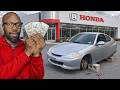
Honda Built a 70 MPG Car… Then Killed It. I Bought One for $350
Nov 22, 2026
Read: ~5m · You save: 65 min
Honda Built a 70 MPG Car… Then Killed It. I Bought One for $350
A $350 Honda Insight that barely runs. Can one non-running 70 MPG hybrid be brought back to life without spending a fortune? The repair story begins.
Background
Rising gas prices prompted a search for a low-cost, fuel-efficient vehicle. The author purchased a 2000 Honda Insight in New Hampshire for $350 from a 70-year-old owner. The car was not running. The seller had listed it on Facebook Marketplace.
The Insight is one of the most fuel-efficient cars sold in the United States. Honda rates it at 70 miles per gallon. Some owners have reported more than 100 miles per gallon with hypermiling techniques, such as taping the windows, removing the mirrors, and driving with a light foot.
The car has an aluminum body, a lightweight structure, a manual transmission, and a hybrid system. The electric motor is a flat "pancake" unit about 2 inches thick. It sits between the engine and the transmission and provides assistance during shifts.
Seller History
According to the seller, her nephew Marcus maintained the car until it stopped running three years earlier. The car then sat unused. When the owner took the car to Honda, the dealership quoted almost $4,000 for repairs. Honda offered to haul the car away at no charge because it had little value.
The author noted that comparable Insights can sell for 7,000 when gas prices are high.
Initial Inspection
- Body: The car was mostly intact. The fenders are plastic over an aluminum inner structure. Both front tires were flat. The wheels are 14-inch units.
- Interior: The interior was clean, and the seats were firm. The author noted that the car's condition was unusually good for its age.
- Drivetrain: The Insight is front-wheel drive. Owners of manual Insights have reported transmission problems, including gears popping out.
- Battery: The high-voltage battery was empty. The battery was reported to be from 2023.
- Fluids: The car had no coolant. The engine oil was very dark and appeared to be long overdue for a change. The car also had a strong fuel odor.
Diagnostic Findings
The author used a 689 BT scan tool. The initial scan returned the following diagnostic trouble codes:
- A misfire in cylinder 1
- An anti-lock braking system (ABS) fault: an open or short in the right front wheel speed sensor circuit
- An integrated motor assist (IMA) fault: an individual voltage input problem in the high-voltage battery system
Clearing the codes did not allow the car to start.
Fuel System Repairs
The author found a cracked fuel line PCV hose that was leaking fuel. The hose was replaced with a new rubber hose. The author later installed a fuel connector sourced from a Honda S2000 after the original connector was found melted.
Priming the fuel pump confirmed fuel pressure. Fuel was present in the tank. The gas gauge read empty, and the author suspected a faulty sending unit. The gauge passed a self-test when reseated, but the input signal from the sending unit was not registering.
The fuel pump circuit was checked at fuse 6, which measured 7.5 amps.
Starting System Diagnosis
The author followed the service manual to confirm the starting system:
- Starter: The starter motor was located under the air box. Jumping the exciter wire caused the starter to engage. This indicated the starter was functional and the start command was missing.
- Ignition switch: The switch was tested for continuity. The off, accessory, and run positions functioned. The start position did not. The switch was determined to be working correctly when continuity was tested again.
- Battery under load: Voltage was 11.9 volts at rest. It measured 11.6 to 11.7 volts in accessory mode. The author concluded the battery was adequate.
- Clutch switch: On manual-transmission cars, the clutch switch signals the starter. The switch was located in a difficult position beneath the car. It was tested with a meter and did not change state when the pedal was pressed. The switch was determined to be faulty.
The clutch switch was bypassed with a jumper wire. The engine started in neutral with the clutch disengaged but did not stay running.
Ground and Wiring Repairs
The car had numerous corroded and loose ground connections. Several grounds were replaced with pre-made grounding straps. One ground was found to be disconnected entirely. After the grounds were replaced, the engine ran and charged normally.
Brake and ABS Repairs
The ABS wheel speed sensor wiring was corroded. A section of the wire was also grounding out. The author installed two new wires from the sensor and connected them to the wiring harness. The repair cost $75 for brake components.
Suspension Repairs
The original shocks were worn and damaged. The author replaced all four shocks at $150 each.
Tires
The author purchased tires for $27 each through eBay. The seller shipped only two tires but refunded the full amount. The tires therefore cost nothing.
Road Test
The first test drive, from the author's shop to Electrified Garage, revealed several problems:
- Second gear produced almost no torque.
- Torque steer was noticeable in first gear.
- The ABS light, brake warning light, and battery warning light all illuminated.
- The car shut off twice while driving.
- Power steering failed intermittently.
The author found that the brakes were not fully functional because of the faulty ABS sensor wiring.
Electrical System Explanation
The Insight has no conventional alternator. The high-voltage battery supplies power through a DC-to-DC converter, which steps the voltage down to the 12-volt system. If the high-voltage battery fails, the converter stops, and the 12-volt system loses power. The 12-volt system also controls the fuel pump. When the 12-volt system dropped, the fuel pump stopped delivering fuel, and the engine shut off.
The scan tool later reported a charge and discharge balance problem. The author concluded that the battery modules were out of balance.
Battery Charging and Cell Balancing
The author bought a grid charger for $175. The charger connects to a standard wall outlet. Charging takes 16 to 20 hours.
The battery specifications are as follows:
- Nominal voltage: 144 volts
- Maximum voltage: 174 volts
Once the battery reaches 174 volts, the charger holds the charge for 2 more hours. Cell balancing then begins. During charging, the battery reached 164 volts at one point. The battery eventually reached approximately 173 volts. The author completed the charging and balancing procedure.
The author stated that this process does not confirm the battery is permanently repaired. The goal was to restore enough capacity for the hybrid system to function.
An alternative method, the BMS bypass, disconnects the IMA system and still charges the 12-volt battery. The author chose the grid charger to keep the hybrid system active.
The grid charger has four wires: two connect to a cooling fan, and two connect to the IMA system. The fan activates when the charger detects 110-volt power, so cooling runs during charging.
Results and Fuel Economy
Before the wheel change, the car achieved 67 to 68 miles per gallon over 32 miles, according to the dashboard. The author then installed lighter Archimoto wheels of the same diameter but narrower width. These wheels improved acceleration, especially in second gear.
Operating Cost
The author's commute is 15 miles each way. The average fuel economy on this commute was 72 miles per gallon.
| Item | Cost |
|---|---|
| Fuel cost, one-way commute | $0.82 |
| Monthly commuting cost | $35 |
| Annual commuting cost | $424 |
| Cost per 10,000 miles | $543 |
Total Cost
| Item | Cost |
|---|---|
| Vehicle purchase | $350 |
| Grid charger | $175 |
| Shocks | $600 |
| Brakes | $75 |
| Tires | $0 (refunded) |
| Total with all repairs | $1,200 |
| Total required to restore operation | $525 |
Honda had stated that a new battery would cost about $4,000. The author stated that the grid charger extended the life of the existing battery. The author estimated that the battery could last two to five years. The author also noted that individual battery modules can be purchased separately and replaced.
Conclusion
The author concluded that the Insight can be restored at low cost. The vehicle achieved approximately 72 miles per gallon on the author's commute. Fuel costs for the commute were $35 per month. The author stated that Honda was correct that the battery needed replacement, but that a grid charger could extend its service life at a much lower cost.
Buying the 2000 Honda Insight
The host explains why he bought a non-running 2000 Honda Insight for $350 while looking for a cheap, fuel-efficient car.
- Host states gas prices are high and he is looking for a cheap, fuel-efficient car.
- Car is a 2000 Honda Insight, one of the most fuel-efficient cars sold in the US, with a claimed 70+ MPG.
- Car was bought for $350 in New Hampshire from a 70-year-old woman.
- Insight has an aluminum body, so it does not rust like a typical car.
- Seller had been quoted almost $4,000 by Honda to fix it; Honda offered to haul it away for free.
- Car had been maintained by nephew Marcus until it stopped running about 3 years earlier.
Initial Inspection and Diagnostics
Initial inspection finds the battery reads good, but there is no coolant, the oil is old, and the car reeks of fuel.
- Car turns on but does not start; a fuel pump is not heard and clicking is heard.
- Battery tests as good, described as the best seen in the shop.
- No coolant in the system; oil is very dark and appears to be years old.
- Strong fuel odor; a fuel leak is found from a cracked fuel line PCV hose, soaked with fuel.
- Scan tool shows misfire in cylinder 1, ABS fault from right front wheel speed sensor open/short, and IMA individual voltage input problem.
- Clearing DTC codes did not start the car; check engine light went off.
Fuel Leak, Starting Circuit, and Clutch Switch
The team repairs the fuel leak and tests the starting circuit, finding that the clutch switch was the problem and that jumping the starter wiring works.
- Starter motor exists; jumping the exciter wire confirmed the starter works and the start command was missing.
- Ignition switch continuity was tested; start position was working.
- Battery voltage under load dropped from about 119 to 116 volts when cranking.
- Clutch switch was located, removed, and tested; it was faulty and was replaced.
- Car briefly ran after jump-starting with the clutch in, then stalled.
- Fuel was found to be mostly water-contaminated; the fuel line was replaced with a new hose.
Fuel Gauge, Connectors, and Grounds
The car runs for longer, but the fuel gauge sender is faulty. Corroded and melted connectors and bad grounds are found and fixed.
- Fuel gauge reads empty; the sending unit wiring and connector were found melted and damaged by mice and previous repairs.
- A replacement connector sourced from a Honda S2000 was installed.
- Spark plugs were inspected and judged fine.
- Ground wires were found disconnected, brittle, and calcified; temporary jumper grounds were used, then pre-made grounding straps were installed.
- After grounds were fixed, the car started, the gas gauge worked, and the car was charging.
- Shocks were replaced all around; each was about $150, and the suspension parts are scarce.
Road Test and Electrical Failures
A test drive reveals loss of braking, ABS, and power steering issues, and the car shuts off on the highway because the 12V system fails.
- Test drive showed the ABS light and red brake light came on, and the car lacked power steering at times.
- Car shut off twice; a 12V battery was used to get home after jumper cables were bought.
- Explanation: the Insight has no standard alternator; the high-voltage battery feeds a DC-to-DC converter that powers the 12V system.
- When the high-voltage battery fails, the DC-to-DC converter stops and the 12V system drops out, which also cuts the fuel pump.
- Corroded ABS wheel sensor wire was found grounding out; it was repaired with two new wires.
- A charge and discharge balance error was reported, and the 12V battery was not the real root cause.
Grid Charger and Battery Balancing
A grid charger is installed to rebalance the high-voltage battery cells, which restores hybrid assist and charging.
- Grid charger cost $175; it is plugged into a wall outlet and takes about 16 to 20 hours.
- Battery nominal voltage is 144 V; maximum is 174 V, followed by a 2-hour rest before balancing.
- Charging and balancing completed at about 173 V, and the IMA light went off.
- Cooling fan activates when the grid charger is plugged in.
- Lighter wheels were installed, reducing weight and improving acceleration.
- Average real-world economy was 67-68 MPG over 32 miles; later about 72 MPG over a 15-mile commute.
Costs, Results, and Conclusion
The host totals the costs and concludes that the car is cheap to run, with commuting costs of about $5 per week.
- Total cost of the vehicle was about 600), brakes (27 each, refunded for two).
- Only the grid charger (525 including the car.
- Commuting cost estimated at $82 for a one-way trip.
- Estimated 424 per year, and $543 per 10,000 miles.
- Battery life may be extended by two to five years; replacing modules is cheaper than a $4,000 Honda battery.
- Host concludes the Insight is an impressive, cheap, and frugal option.