
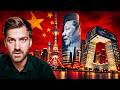
The REAL Reason China Built So Much
Why did China build so fast? Not just dictatorship. Explore the party-state system, Deng's growth incentives, and land financing behind the viral skylines and high-spee
Introduction
Videos of Chinese infrastructure, including a train passing through a building, high-speed rail networks, and dense urban skylines, have circulated widely on social media. Viewers often attribute the speed of this construction to authoritarian rule. This article examines the political and economic system behind these developments, including the role of the Chinese Communist Party, the local-official incentive structure, the land financing model, and the limits of the growth model.
Is China Communist?
China's economy combines state ownership with a large private sector.
- State-owned sectors: oil, airlines, and telecommunications.
- Private sector: major companies include Huawei and Alibaba.
- Land: All land is publicly or collectively owned. Individuals and developers can lease land, and they can own factories, houses, and apartments built on it.
- Strategic investment: The government has invested heavily in electric vehicles, batteries, solar energy, semiconductors, and artificial intelligence.
- Market-driven sectors: Many successful companies, such as WeChat's developer Tencent, operate without comparable government support.
The economic system differs from the Soviet model, in which the state owned businesses and land and determined production. It also differs from a market economy, in which private owners generally hold businesses and property and the market determines output. Ordinary Chinese citizens earn salaries, hold bank accounts, shop at private businesses, buy cars and homes, and invest money.
The most distinctive communist element is political rather than economic. The Chinese Communist Party (CCP) controls the state.
The Chinese Communist Party
The CCP has roughly 100 million members, about 7 percent of a population of approximately 1.5 billion. Membership functions as a club rather than a job. Members join for ideological reasons, to serve the country, or to gain career advantages, since party membership is woven into public and private institutions.
From this membership, the party recruits a smaller group of professional officials. The party operates as a hierarchical organization, similar to a corporation.
Party-State Structure
China's government has levels that match most countries, including the State Council, provincial, municipal, county, and township governments. A parallel party structure runs alongside each government level. Every town government has a corresponding town party committee.
Party leaders hold the decision-making authority at each level. A city party leader directs decisions, while the mayor implements them. Anyone with significant power in government is typically a party member.
The system is structured as follows:
The general secretary of the CCP, currently Xi Jinping, holds the most powerful position. Xi also serves as president, but the party post carries greater authority.
The term "party-state system" describes this arrangement. Scholars trace the concept to Vladimir Lenin, who argued that a vanguard party should lead the revolution and then control the state. The CCP states that its goal remains communism, a society without classes in which the means of producing wealth are collectively owned.
The national flag reflects this structure. Its four small stars represent the four social classes identified in the 1940s, and they point toward the large star, which represents the CCP.
The Post-Mao Reform Period
The Starting Point
Mao Zedong led China for about 30 years and died in 1976. The country was economically and politically disordered. Deng Xiaoping emerged as leader after a power struggle. Deng was a pragmatist who recognized that poverty threatened the party's survival. He concluded that the party's future depended on economic growth.
Changing Official Incentives
Under Mao, officials gained promotion mainly through revolutionary credentials, including ideological commitment and loyalty to the party. Deng decentralized power and reduced the importance of loyalty to a single leader. He sought younger, better-educated, and more technically competent officials.
Deng changed the evaluation system. Local officials were graded on a sheet with many items, and economic development sat at the top. Officials who increased GDP, tax revenue, and investment were more likely to be promoted. Economic growth became a "hard target," a measurable number. Other goals, such as healthcare, education, and environmental cleanup, were not sufficient for promotion.
Special Economic Zones
Deng created Special Economic Zones, where private companies could invest and operate in a market environment. These zones existed in limited areas rather than across the country.
Fiscal Reform: "Eating in Separate Kitchens"
Under Mao, provinces and local governments sent their revenue to the central government and received a fixed budget in return. Officials called this "eating out of one big pot." The system provided fairness across regions but gave local governments no incentive to raise revenue.
Deng changed the arrangement. Local governments sent an agreed amount of tax revenue to the center each year and kept revenue above that amount. Deng called this "eating in separate kitchens." Local governments and officials both gained a direct financial interest in economic activity.
Township and Village Enterprises
Local governments in rural areas founded Township and Village Enterprises (TVEs). Local governments often owned these factories, selected managers, obtained bank loans, supplied land, and collected revenue from profits. TVEs were highly profitable, and they helped rural farmers become factory workers. The phrase "leaving the land, but not the countryside" describes this shift.
Recentralization in the 1990s
In the 1990s, Beijing changed the fiscal arrangement again. Local governments owed a larger share of tax revenue to the central government and retained less. Because the central government took a larger portion of TVE taxes, these factories became less financially attractive for local governments. Officials turned to other sources of revenue and promotion.
Land Financing
The land system provided that alternative. Urban land is state-owned. Rural land belongs to village collectives, which consist of the residents. Local governments requisitioned rural land and compensated residents, often at amounts below its market value. The state then developed the land, which increased its value through roads and other infrastructure.
The government then leased land-use rights to developers at prices well above acquisition and development costs. The government also used the land as collateral for bank loans, which provided funds for further construction. This model, called land financing, became a major engine of economic growth after the 1994 fiscal changes.
In a conventional market economy, demand mainly determines construction. In China, the act of building also benefited local governments and the officials who worked for them.
Infrastructure Development
Local officials built high-rise buildings, five-star hotels, roads, ports, telecommunications networks, and airports. Officials displayed these projects to superiors as evidence of achievement. Infrastructure also generated land value, economic activity, and jobs, which officials were evaluated on.
National projects, including the Three Gorges Dam and the high-speed rail network, required coordination beyond individual local officials. Rail network expansion between 2008 and 2020 illustrates this. Local officials in cities along each route benefited from station construction because the stations increased land value and economic activity.
Results and Limits of the Model
Economic Results
China's poverty rate fell sharply over roughly four decades. Poverty declined across several countries, including India, Vietnam, and Bangladesh, but China's reduction was among the largest. From 1985 to 2010, China's GDP growth averaged about 10 percent per year. The United States has rarely exceeded 4 to 5 percent.
Uneven Outcomes
Infrastructure development produced uneven results. Guizhou, one of the poorest provinces, has more highways than New York, a state slightly larger than Guizhou's area. Some infrastructure has gone unused. Kangbashi in Inner Mongolia and Zhengdong in Henan province were built at large scale and remained largely empty for years. Later, people moved into many of these places, and bridges and roads came into use. Some projects were built faster than demand, however.
Slowing Growth
The poverty rate approached zero in the early 2010s, and GDP growth began to slow at the same point. Analysts describe this pattern as a one-time shift: the transition from poverty to prosperity can occur once, after which growth slows.
Social Attitudes
Young Chinese people have expressed a sense of stagnation. The term "lying flat" describes disengagement from a competitive economy that no longer guarantees rapid gains in living standards. The government's pandemic response was unpopular and alienated many citizens.
Social Stability and Repression
The Second Evaluation Priority
By the 1990s, officials faced a second metric: "maintaining social stability," which required preventing protests, or "mass incidents," along with crime and terrorism. This metric is a "veto target." Officials either meet it or fail it. Officials cannot offset a failure with strong economic results.
Conflict Between Development and Stability
Construction often requires displacing residents. Many residents received compensation below the land's market value, and some were removed by force. This displacement has caused significant social tension. Officials must build to meet growth targets, but construction can provoke opposition. Local leaders who fail to maintain stability may lose their positions.
Methods of Repression
Scholar Lynette Ong described two common methods:
- Intimidation: Local governments hire groups of young, unemployed people to intimidate residents during demolition and land acquisition. Officials then claim that these people are unaffiliated individuals causing trouble.
- Social pressure: Retirees who hold community roles and command respect persuade neighbors to sign relocation agreements. Residents who refuse become socially isolated.
Visitors rarely encounter such repression. Chinese citizens, however, know it occurs. It affects a minority of people, but most citizens know someone who has experienced it.
Security Expansion
Under Xi Jinping, who has held power for nearly 15 years, the security apparatus has expanded substantially. China had an estimated 30 million surveillance cameras around 2013. A 2019 study estimated more than 200 million.
The Political Bargain
Scholars describe a long-standing bargain in China. The party provides growth, prosperity, stability, and security. Citizens do not choose who governs them. The central question is whether the party can sustain this bargain as growth becomes harder to achieve.
Under Xi, GDP growth has become less central to party evaluations, while loyalty and ideology have gained weight. Xi has cited the overbuilding and speculation produced by the earlier growth focus as reasons for this shift.
Conclusion
The construction seen in recent videos reflects a 40-year system of incentives created under Deng Xiaoping. Officials were rewarded for economic growth, which they pursued through land financing, infrastructure, and state-backed enterprises. The same system produced overbuilding, displacement, and social tension.
Authoritarianism alone does not explain these outcomes. Some democracies have developed extensive rail networks, and some autocracies have not. The core factor is the set of incentives facing those in power. In China, the incentives originate within the party system. In democracies, accountability to voters shapes incentives. The question that follows is which outcomes a political system chooses to reward.
Introduction: Viral Chinese Megaprojects
Viral videos of Chinese megaprojects prompt the host to ask what system produced them, and his producer Adam joins the investigation.
- Viral videos show massive buildings, a train going into a building, and high-speed rail, prompting the question of how China built them.
- The host's producer is Adam, who researched the topic for the video.
- The host's upcoming documentary series is titled "The Human Element".
- The host initially hypothesized that China builds quickly because it is a dictatorship, which the video later says is not the full answer.
Is China Communist or Capitalist?
Modern China is capitalist in its economy yet communist in its political structure, because the Communist Party runs the state.
- Soviet-style economies had state ownership of businesses and land and state-determined production; market economies have private ownership and market-determined production.
- China has state-owned industries such as oil, airlines, and telecommunications, plus a large private sector including Huawei and Alibaba.
- Land in China is publicly or collectively owned; individuals can lease land and own houses and apartments.
- Max Fisher, former New York Times correspondent and host of the Newpress channel "The Bigger Picture", is cited as a China expert.
- The four small stars on the flag represent the four social classes of the 1940s; the big star represents the Chinese Communist Party.
What Is the Chinese Communist Party?
The CCP is a club of about 100 million members (about 7% of 1.5 billion people) and is organized like a corporation, which the video calls the most communist aspect of China.
- Only about 7% of China's population of roughly 1.5 billion are party members, which is about 100 million people.
- Membership is a club rather than a job, and joining can help careers.
- Professional party officials are recruited from the membership pool and form a hierarchical organization.
- The party is described as the most communist element of China.
The Party-State System
China uses a parallel structure in which the party controls the government at every level, creating a party-state system rooted in Leninism.
- Every government level has a corresponding party committee, from national down to township.
- The party leader holds real decision-making power; the mayor mostly implements decisions.
- Around 200 people sit on the Central Committee, 24 on the Politburo, and 7 on the Politburo Standing Committee.
- Xi Jinping is general secretary of the CCP and also president; the party role is more powerful than the presidency.
- The system is called a party-state system and is a Leninist concept based on a vanguard party.
Deng Xiaoping and the Shift to Growth
Deng Xiaoping replaced Mao's ideological loyalty model with a pragmatic system that rewards economic growth, and lifted hundreds of millions out of poverty.
- Extreme poverty fell dramatically over the last 40 years in countries including India, Vietnam, Bangladesh, and China.
- Mao led China for about 30 years and died in 1976, leaving China economically and politically in chaos.
- Deng Xiaoping, a pragmatist, emerged as leader and believed poverty threatened the Communist Party's survival.
- Under Mao, promotion depended on revolutionary credentials; Deng shifted it toward younger, educated, technically competent officials.
- Officials are graded on a sheet with about 100 items, and economic development sits at the top.
Fiscal Reform and Land Financing
Deng's fiscal and land reforms gave local governments strong incentives to generate revenue, fueling township enterprises and then land financing.
- Special Economic Zones served as sandboxes for capitalism.
- Under the old 'eating out of one big pot' system, local governments sent revenue to the center and received fixed budgets.
- Deng's 'eating in separate kitchens' let local governments keep revenue above an agreed amount.
- Township and Village Enterprises (TVEs) were factories owned by local governments that were highly profitable.
- In 1994, fiscal changes shifted revenue to Beijing, reducing TVE rewards.
- Urban land is state-owned; rural land is village collective land, which the state requisitions, develops, and leases to developers, creating 'land financing'.
- GDP growth became a 'hard target' in the evaluation system, while healthcare, education, and environment were 'nice but not sufficient'.
Building for Promotion and Its Side Effects
Officials compete for promotion by building and boosting GDP, which explains many projects but not nationally coordinated mega-projects like high-speed rail.
- Local officials show off high-rises and five-star hotels to superiors to earn promotions.
- The Three Gorges Dam and nationwide high-speed rail are cited as nationally coordinated projects that local competition alone cannot explain.
- Each city wanted a high-speed rail station because it raises land values and economic activity.
- Guizhou has more highways and bridges than New York despite being poor; its bridges sometimes go to nowhere.
- Ghost cities such as Kangbashi in Inner Mongolia and Zhengdong in Henan were built ahead of demand, though people eventually moved in.
- The system depends on unlimited demand, which is not realistic.
Growth Slows and Malaise Sets In
China's poverty reduction and GDP growth slowed around the early 2010s, reflecting diminishing returns, and the population now shows malaise such as 'lying flat'.
- Poverty in China nearly reached zero in the early 2010s, then slowed.
- GDP growth averaged around 10% per year from 1985 to 2010; the US has rarely reached 4-5%.
- Growth slowed at the same inflection point in the early 2010s.
- Young Chinese people have embraced 'lying flat', disengaging from the rat race.
- Newpress member Vivian, who lives largely in Shanghai, provided perspective; the video notes outsiders often admire China more than citizens.
Stability, Repression, and Xi Jinping
After the Soviet collapse and Tiananmen, the CCP prioritized social stability, using coercion and surveillance, especially under Xi Jinping.
- Soviet collapse and Gorbachev's resignation threatened the CCP, and Tiananmen Square protests were suppressed by the military.
- Social stability became a 'veto target': a yes-or-no measure of protests and crime on officials' scorecards.
- Forced evictions often involve gangsters or retirees who pressure neighbors to sign.
- Surveillance cameras grew from about 30 million around 2013 to over 200 million by 2019.
- Under Xi Jinping, loyalty and ideology matter more than GDP in party evaluations.
- Democracy and capitalism did not bring democracy to China as American policy in the 1990s expected.
Conclusion: Incentives, Not Just Dictatorship
The video concludes that the answer is incentives rather than dictatorship alone, and that voters in democracies shape incentives from the bottom up.
- Dictatorship does not fully explain China's infrastructure, since some democracies have great trains and some autocracies do not.
- China's incentives come from the top party system, while democracies' incentives come from voters.
- The closing question is: what do we choose to reward?