
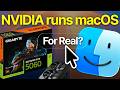
NVIDIA GPU Finally Works on macOS After Decades
Decades of 'impossible' end: A single developer's breakthrough brings modern NVIDIA GPUs to macOS with a real Metal driver! Discover the tech and the journey.
For years, the Hackintosh community operated under a widely accepted premise: modern NVIDIA graphics cards would never function on macOS due to a lack of drivers. This belief was considered an immutable fact until a developer, known online as noob moth, successfully enabled an RTX 5060 to drive the macOS Sequoia desktop with a native Metal driver, overcoming significant skepticism.
The history of NVIDIA and Apple's relationship is crucial to understanding the magnitude of this development. The two companies once collaborated, but their partnership dissolved, leading to the cessation of official NVIDIA driver support for macOS. NVIDIA's web drivers ceased updates after macOS High Sierra, and support for Pascal generation cards was eventually dropped in later macOS versions. Maxwell and Pascal hardware became incompatible with newer operating systems, and subsequent NVIDIA architectures, including Turing, Ampere, Ada, and Blackwell, received no official driver support. Within the Hackintosh community, the consensus, as reflected in resources like the Dortania guides and discussions on Reddit, was that no NVIDIA GPUs were currently supported, and spoofing device IDs was ineffective. Developing a functional driver from scratch was widely considered an insurmountable task for an individual.
Into this environment emerged noob moth, who operates on GitHub as "noob moth" under "noob moth systems" and on Reddit as u/noobmoth. Upon sharing initial progress, noob moth faced considerable ridicule and disbelief from parts of the Hackintosh community, with many dismissing the effort as impossible, fake, a virtual machine trick, or pure software rendering. This intense skepticism stemmed from years of observing failed attempts. Initially, noob moth remained guarded about the intricate technical details, stating that the project required weeks of focused effort and that he intended to complete the core functionality before public disclosure. However, he provided sufficient evidence to demonstrate that the achievement was not a workaround but a genuine driver stack.
This project is distinct from Tiny Corp's Tiny GPU, which emerged concurrently. Tiny GPU is an Apple-signed driver kit extension enabling certain external NVIDIA and AMD cards for compute tasks via Thunderbolt or USB 4, primarily useful for AI inference but lacking full desktop integration or a Metal device for general applications. Noob moth's work is more ambitious, involving the creation of a custom macOS kernel driver based on NVIDIA's open kernel modules. This driver initializes the GPU's onboard management firmware and manages memory, command channels, and interrupts. The graphics card directly drives the monitor, providing a functional framebuffer and cursor. Consequently, the entire macOS desktop, including the window server, dock, Finder, and all open windows and animations, is composited by the RTX 5060.
Underneath the Metal layer, noob moth is running Mesa's NVK driver on macOS, incorporating necessary Blackwell-specific components. This is topped by a complete Metal driver plugin, allowing applications to recognize a standard NVIDIA GeForce RTX 5060 Metal device without awareness of any underlying modifications. The driver boasts extensive feature coverage, including rendering and compute capabilities through Blind's work. Support extends to common texture types (arrays, cubes, 3D textures, block-compressed formats), multi-sample anti-aliasing, argument buffers, heaps, indirect command buffers, function constants, dynamic libraries, and binary archives. Ray tracing pipelines can be constructed and executed, though some edge cases are still being refined. Apple's native frameworks, such as Vision for image classification and optical flow, Core Image, and Metal Performance Shaders, are functional on the card, producing results consistent with CPU paths and genuine Apple GPUs. Hardware video encoding and decoding for H.264 are also operational and integrated with macOS media frameworks, making them accessible to all applications. A custom shader compiler translates shaders from Mac applications without requiring modifications to those applications. Noob moth reported zero rejected shaders after testing against tens of thousands of real shaders, including those from commercial games.
Ongoing development focuses on enhancing stability under heavy loads, broadening application and game compatibility, completing CUDA core support, refining hardware ray tracing, and implementing wireless features. Noob moth has indicated an intention to release the full source code on GitHub once the system achieves sufficient stability for daily use, with an initial release targeted within days of his recent updates. Discussions are also underway regarding a new boot path that could either replace OpenCore or integrate with existing OpenCore configurations. While macOS Sequoia is the primary target, development for macOS Tahoe is already in progress.
In parallel, noob moth released a free, offline hardware scanner named the "1401 probe," available on his GitHub and nolemothsystems.com. This tool is written to a USB stick from Windows, and booting a PC from it generates a privacy-stripped hardware report. Users can upload these reports to assist noob moth in expanding compatibility to a wider range of systems, as he currently lacks the resources to acquire every possible hardware configuration.
The broader implications of this achievement are significant. The long-held assumption that modern NVIDIA support on macOS and Hackintosh systems was permanently unattainable has been fundamentally challenged. A full desktop compositing solution with a genuine Metal implementation represents a substantial advancement over limited compute-only external GPU solutions. This development opens new possibilities for users who require NVIDIA hardware for workloads like CUDA or machine learning while preferring to remain within the macOS software ecosystem. It also underscores the potential of determined reverse engineering to yield significant results, even when both the hardware manufacturer and the operating system vendor have abandoned support for a platform. The ultimate utility for daily use will depend on the stability, expanded hardware support, and continued development post-release. However, the core accomplishment—one developer overcoming community consensus and ridicule to deliver a seemingly impossible solution—is already evident. Further updates and the source code release are expected via noob moth's Reddit account, GitHub profile, and noobmothsystems.com.
The Impossibility Myth
The Hackintosh community long believed modern Nvidia GPUs were incompatible with macOS due to a lack of drivers. This perception was challenged by developer 'noob moth', who created a functional Metal driver for an RTX 5060 on macOS Sequoia.
- The Hackintosh community widely believed modern Nvidia GPUs would never work on macOS.
- Developer 'noob moth' created a functional Metal driver for an RTX 5060 on macOS Sequoia.
- This achievement enables full Mac OS desktop functionality with a real Metal driver.
Historical Context: Apple and Nvidia's Split
Apple and Nvidia's historical partnership collapsed, leading to the cessation of official driver support for Nvidia cards beyond the Pascal generation (High Sierra). Newer architectures like Turing, Ampere, Ada, and Blackwell received no official drivers, reinforcing the Hackintosh community's belief in impossibility.
- Apple and Nvidia's partnership ended, halting official driver support.
- Nvidia web drivers stopped evolving after High Sierra and the Pascal generation.
- Maxwell, Pascal, Turing, Ampere, Ada, and Blackwell GPUs lack official macOS drivers.
- Hackintosh guides and experienced users stated Nvidia GPU support was impossible.
The Skepticism and the Developer
Developer 'noob moth' (u/noobmoth on Reddit, noob moth on GitHub) faced significant skepticism and ridicule from the Hackintosh community when he began sharing progress on an Nvidia driver. Many dismissed his work as fake, a VM trick, or pure software rendering due to past failed attempts.
- Developer 'noob moth' operates under u/noobmoth on Reddit and noob moth on GitHub.
- Initial community reaction to his progress was skepticism and ridicule.
- Many assumed his work was fake, a virtual machine trick, or software rendering.
- Past failed attempts fueled intense skepticism within the community.
Technical Implementation: Beyond Compute
Noob moth's work is distinct from Tiny Corp's Tiny GPU, which offers limited compute capabilities over Thunderbolt/USB 4 for AI tasks but does not provide a full desktop Metal experience. Noob moth's custom macOS kernel driver utilizes Nvidia's open kernel modules to boot the GPU, manage resources, and enable full desktop compositing via a Metal driver plugin.
- Noob moth's project differs from Tiny Corp's Tiny GPU (limited compute, not full desktop).
- He created a custom macOS kernel driver based on Nvidia's open kernel modules.
- The driver boots the GPU, manages memory, command channels, and interrupts.
- The graphics card drives the monitor directly, handling mode setting and frame buffer.
- The entire macOS desktop is composited by the RTX 5060.
Feature Coverage and Compatibility
The driver stack supports extensive features, including rendering, compute, common texture types, multi-sample anti-aliasing, argument buffers, heaps, indirect command buffers, function constants, dynamic libraries, binary archives, and ray tracing pipelines. It integrates with Apple's frameworks (Vision, Core Image, MPS) and supports H.264 hardware video encode/decode.
- Supports rendering and compute via Blind's work.
- Includes common texture types (arrays, cubes, 3D, block compressed).
- Features multi-sample anti-aliasing, argument buffers, heaps, indirect command buffers.
- Supports function constants, dynamic libraries, binary archives, and ray tracing pipelines.
- Integrates with Apple's Vision, Core Image, and Metal Performance Shaders.
- Hardware H.264 video encode and decode is functional.
Shader Compatibility and Future Work
A custom shader compiler translates Mac application shaders without requiring modifications. The stack has been tested against tens of thousands of real shaders, including those from commercial games, with zero rejections. Work is ongoing for stability, broader compatibility, CUDA support, ray tracing polish, and wireless features.
- A custom shader compiler translates Mac application shaders without app changes.
- Tested against tens of thousands of real shaders, including commercial game shaders.
- Reported zero rejected shaders during extensive testing.
- Ongoing work includes stability, broader compatibility, CUDA support, and ray tracing polish.
- Wireless features are also under development.
Release Plans and Community Tools
Noob moth plans to release the full source code on GitHub once the system is stable for daily use, aiming for a release within days. He is also developing a new boot path for OpenCore integration and targeting macOS Sequoia, with work on Tahoe underway. Additionally, he released the '1401 probe', a free offline hardware scanner available on GitHub and his website, to gather community hardware reports for broader compatibility.
- Intends to release full source code on GitHub for daily use.
- Aims for source release within days of recent updates.
- Developing a new boot path for OpenCore integration.
- Primary target is macOS Sequoia, with work on Tahoe underway.
- Released '1401 probe', a free offline hardware scanner.
- Community hardware reports are essential for expanding compatibility.
Wider Significance and Future Outlook
This project signifies a major shift, proving that modern Nvidia GPUs can work on macOS and Hackintosh systems, contrary to long-held beliefs. It opens possibilities for users needing Nvidia hardware for CUDA/ML while staying within the Mac ecosystem and demonstrates the power of determined reverse engineering.
- Challenges the assumption that modern Nvidia support on macOS/Hackintosh is dead.
- Full desktop compositing and Metal implementation are key achievements.
- Creates possibilities for CUDA/ML workloads within the Mac software environment.
- Demonstrates that reverse engineering can yield significant results.
- Future success depends on stability, broader hardware support, and continued development.