
 ~6m1:56:23
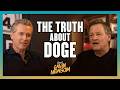
Author Michael Lewis On Elon Musk, DOGE, and the War on the "Deep State" | This Is Gavin Newsom
Oct 7, 2026
Read: ~6m · You save: 110 min
Michael Lewis on Elon Musk, DOGE, and the War on the "Deep State"
Michael Lewis dives into the 'war on the deep state,' revealing how loyalty replaced law and data became a weapon. Discover the unsung heroes of government.
Author Michael Lewis discusses his latest book, "The Government: A User's Guide," with Gavin Newsom, exploring the motivations behind public service, the challenges faced by civil servants, and the impact of political shifts on government operations. Lewis draws parallels between his reporting and the dynamics of public service, emphasizing the importance of understanding and valuing the work of government employees.
The Genesis of "Blockers"
Lewis explains that his initial inspiration for exploring the federal government stemmed from a desire to understand the political landscape after a significant electoral defeat. He sought to engage with individuals from across the political spectrum, including figures like Steve Bannon and Charlie Kirk, to gain insight into their motivations and strategies. This approach, he notes, was a departure from the adversarial nature of cable news, aiming instead for a deeper understanding of individuals and their perspectives.
His relationship with Steve Bannon dates back to the 1980s when Bannon, then in his Hollywood phase, purchased the film rights to Lewis's first book, "Liars Poker." Bannon's subsequent attempt to write a screenplay for the book marked the beginning of their connection. Lewis emphasizes the importance of having these conversations, even with those holding opposing views, to foster understanding.
The Art of Subject Engagement
Lewis likens his approach to interviewing subjects to the fable of the North Wind and the Sun, where the sun's warmth, rather than the wind's force, persuades the traveler to remove his cloak. He believes in creating a comfortable environment to encourage subjects to open up. This method, he acknowledges, has sometimes led to subjects feeling "violated" by the intimacy of the portrayal, even if the facts are accurate. He recounts an anecdote where Billy Beane, the subject of "Moneyball," was more concerned about his mother's reaction to the book than the broader implications for baseball.
The process of writing involves extensive observation and filtering. Lewis initially refrains from taking notes, allowing subjects to relax. As trust builds, he begins to record information, a process that inherently filters out less interesting material. He emphasizes that his goal is not to "take down" subjects but to understand their motivations and humanity.
The Trump Administration and the "Deep State"
Lewis contrasts the Trump administration's approach to government in its first and second terms. In "Trump 1.0," he describes a sense of neglect and ignorance, where the administration seemed unprepared for the complexities of governing. In "Trump 2.0," however, he characterizes the approach as a deliberate effort to "destroy" and "reorganize" the federal government to serve Donald Trump's personal interests.
He frames the federal government's functions into abstract categories such as refereeing, public safety, science, information, and trusted institutions. He argues that under a "king," these functions would be carried out differently, prioritizing loyalty to the individual over societal needs. This shift, he contends, leads to a government that is opaque to itself, with data being weaponized against perceived enemies and suppressed if it reflects poorly on the administration.
The "Blockers" and the War on Expertise
Lewis introduces the concept of "blockers" as individuals who resist actions that are unlawful or against their understanding of their job. He contrasts this with Elon Musk's use of the term to describe those who impede progress. Lewis's book profiles individuals who, by adhering to the law and their oaths to the Constitution, become obstacles to the administration's agenda.
He highlights the case of Kathleen Walters, an IRS privacy officer who refused to share sensitive taxpayer data with the Department of Homeland Security, ultimately costing her job. This act, Lewis argues, is a direct betrayal of trust, akin to the internment of Japanese Americans during World War II, but with the added element of illegality.
The Science of Fire and the Erosion of Trust
The book also delves into the work of Alex Marenites, a fire scientist at the National Institute of Standards and Technology (NIST). Marenites' research on wildfire behavior, particularly the role of embers in igniting structures, challenged conventional firefighting strategies. Lewis portrays Marenites as a dedicated public servant whose work was hampered by the administration's cuts to research funding and its general disregard for scientific expertise.
Lewis connects this to the broader theme of the politicization of government institutions, citing Ronald Reagan's decision to make the head of the CDC a political appointee rather than a career professional. This, he suggests, has led to a decline in the CDC's ability to respond effectively to public health crises.
The Cruelty of Power
A recurring theme in Lewis's discussion is the "cruelty" inherent in the current political climate. He references a quote from Orwell's "1984," suggesting that true power lies in the ability to inflict suffering. He points to Russell Vought, former Director of the Office of Management and Budget, as an example of this cruelty, particularly in his alleged role in blocking scientific research, even impacting his own child's treatment for cystic fibrosis. Vought's stated goal of "traumatizing the federal worker" exemplifies this theme.
The Importance of "Referees"
Lewis emphasizes the critical role of "referees" – individuals who ensure fairness and neutrality within government institutions. He uses the character of Tim Curry, a neutral negotiator at the Office of Personnel Management (OPM), to illustrate this point. Curry's dedication to impartiality, even in the face of immense pressure, highlights the value of trusted arbiters. Lewis argues that the erosion of trust in these referees leads to a cynical environment where "every man for himself."
The Hopeful Ending
Despite the bleak picture painted by the administration's actions, Lewis concludes with a note of hope. He introduces Sahil Levvenia, a young tech entrepreneur who joins the administration with the goal of improving the IRS's digital services. Levvenia's eventual disillusionment with the bureaucracy and his subsequent commitment to public service, symbolized by his quest to fix a broken water fountain, represent the enduring spirit of those dedicated to making a difference. Lewis believes that this spirit, even in unexpected places, is crucial for preserving a healthy society.
The Genesis of "Blockers" and Early Interviews
Lewis explains his motivation for writing "Blockers," stemming from frustration after a political loss and a desire to understand opposing viewpoints. He recounts his initial interviews with figures like Charlie Kirk and Steve Bannon, emphasizing his goal to understand motivations rather than to attack.
- Lewis was inspired to create his platform out of frustration and a desire to understand why his party lost.
- His first guest was Charlie Kirk.
- He aimed to understand the motivations of his guests, not to take them down.
- He found Bannon's perspective surprisingly aligned with Bernie Sanders' populism at one point.
- Charlie Kirk was surprisingly personable and more religious than expected.
Lewis's Interviewing Philosophy: The Sun vs. the North Wind
The conversation delves into Lewis's interviewing process, emphasizing the importance of creating a comfortable environment for subjects to open up, drawing a parallel to the fable of the North Wind and the Sun. He discusses how subjects often feel violated by his books, not because of factual inaccuracies, but due to the intimacy of the portrayal.
- Lewis uses the metaphor of the North Wind and the Sun to illustrate his approach: creating comfort to elicit openness.
- Subjects often feel a sense of violation after his books are published, even if the facts are correct.
- He notes that subjects often worry about how their mothers will perceive the books.
- The process involves months of building trust, making subjects comfortable enough to forget he's documenting them.
- The hardest part is the end of the relationship, as subjects miss the attention.
The "Casting" Process and Building Subject Comfort
Lewis details the casting process for his books, comparing it to a film casting search. He explains his preference for not recording interviews initially, using it as a filtering mechanism. He emphasizes the importance of subjects becoming comfortable enough to be themselves, leading to more authentic portrayals.
- Book subjects are chosen through a "casting search" process.
- Lewis avoids recording interviews initially to filter information and encourage natural conversation.
- He believes subjects need to feel comfortable to reveal their true selves.
- The process involves months of interaction, making subjects forget they are being documented.
- Subjects often feel upset when the process ends because they miss the attention.
Trump's Approach to Government: Neglect vs. Destruction
The discussion shifts to the Trump administration's approach to government, contrasting "Trump 1.0" (neglect and ignorance) with "Trump 2.0" (active destruction and reorganization for personal pleasure). Lewis introduces the concept of "blockers" – principled civil servants who resist unlawful directives.
- Trump 1.0 was characterized by neglect and ignorance of government functions.
- Trump 2.0 is characterized by a desire to destroy and reorganize government for personal gain.
- The "fifth risk" concept refers to program management failures in government.
- Lewis contrasts the idea of government as a train on tracks with the risk of its programs failing.
- He identifies "blockers" as principled civil servants who uphold the law and constitution.
Government Functions and the Threat to Data Integrity
Lewis explains his framework for understanding the federal government through abstract functions like refereeing, public safety, science, information, and trusted institutions. He discusses how the Trump administration's focus on loyalty over function undermines these core roles, particularly concerning data.
- Lewis categorizes government functions into abstract roles: referees, public safety, science, information, and trusted institutions.
- The Trump administration's focus on loyalty to a person over societal function undermines these roles.
- Data collection and privacy are critical functions threatened by the administration's approach.
- The government's ability to collect necessary data relies on public trust in data protection.
- Weaponizing private data against enemies is a key concern.
Weaponizing Data: The IRS ITIN Case Study
The conversation highlights the weaponization of private data, using the IRS's ITIN database as a case study. Lewis contrasts this with the suppression of public data, illustrating how the administration's actions erode trust and make society opaque to itself.
- The IRS ITIN database, meant for undocumented workers to pay taxes, was requested by DHS.
- Kathleen Walters, head of IRS privacy, resisted this request, costing her job.
- This action is illegal and a betrayal of public trust, mirroring historical events like the internment of Japanese Americans.
- Suppression of public data (e.g., climate, economic data) and weaponization of private data are twin threats.
- The erosion of trust in data collection makes society opaque to itself.
Hindering Science: Alex Marangites and Wildfire Research
Lewis introduces Alex Marangites, a fire scientist whose work on wildfire behavior was hampered by the administration. His story illustrates how bureaucratic obstruction and a lack of understanding can derail critical scientific research, impacting public safety.
- Alex Marangites is a fire scientist whose research on wildfires was obstructed.
- His work at NIST involved studying fire behavior, including the 9/11 towers' collapse.
- He discovered that embers, not just flames, cause most wildfire spread.
- His research was hindered by budget cuts and bureaucratic interference under the Trump administration.
- Howard Lutnik, Secretary of Commerce, inadvertently benefited from Marangites' earlier work on fire safety related to 9/11.
The Attack on Science: Francis Collins and NIH
The discussion covers Francis Collins, former NIH director, who was ousted despite his contributions to medical science. Lewis frames this as an attack on science itself, with Russell Vought, OMB director, as a potential key figure in blocking scientific progress.
- Francis Collins, head of NIH, was removed despite discovering the genetic cause of cystic fibrosis.
- His work has saved countless lives through cystic fibrosis treatments.
- Lewis posits this ousting as an attack on science itself.
- Russell Vought, head of OMB, is implicated for potentially blocking scientific grants and research.
- Vought has a personal connection to cystic fibrosis through his child, who benefits from Collins' work.
The "Blockers" and the Undermining of Neutrality
Lewis explores the concept of "blockers" as principled civil servants who uphold the law, contrasting them with the administration's desire for loyalty. He uses the example of Tim Curry, an OPM official, whose dedication to neutrality was undermined, leading to a physical breakdown.
- "Blockers" are principled civil servants who adhere to the law and constitution.
- The Trump administration sought loyalty over adherence to law.
- Tim Curry, an OPM official, was a neutral "referee" between civil servants and political appointees.
- Curry experienced a physical breakdown due to the pressure of not being allowed to be a fair referee.
- The administration's actions undermined trust and neutrality in government roles.
Trust, Mistrust, and the Future of Government
Lewis argues that Trump's strategy thrives in environments of chaos and mistrust, actively seeking to dismantle institutions that foster trust, such as independent referees. He concludes by emphasizing the importance of preserving public-spiritedness and the potential for positive change through better storytelling about government.
- Trump thrives in environments of chaos and mistrust, undermining trust-building institutions.
- Neutrality and trust are essential for government functions, like referees in a game.
- The administration's actions aim to dismantle trust and create a cynical environment.
- Lewis believes people are persuadable and that better storytelling can change perceptions of government.
- The book aims to preserve the spirit of public service and highlight the consequential nature of government work.
Hope in the System: Sahil Levenia and the Water Fountain
The book concludes with Sahil Levenia, a young technologist who joined the administration with a desire to fix IRS technology. His story highlights the challenges civil servants face in a difficult environment but also the potential for meaningful impact and the importance of preserving a public-spirited ethos.
- Sahil Levenia, a young technologist, joined the administration to improve IRS technology.
- He was initially assigned to the VA and made a mistake by speaking positively about government efficiency.
- He later returned to fix the IRS app issue, embodying a public-spirited approach.
- His story illustrates the difficult environment civil servants operate in but also their potential for impact.
- The ending emphasizes hope and the importance of preserving the spirit of public service.