
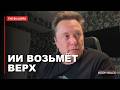
Elon Musk: Money and Work Will Lose Their Meaning - Interview with Walter Isaacson (Russian dub)
Elon Musk on AI, simulation theory, robots, a post-money economy, debt, and whether humans can stay in control. A wide-ranging interview with Walter Isaacson.
Published October 25, 2026
Walter Isaacson opens the first episode of Creators, a series of conversations with leaders who shape the future, with Elon Musk. Isaacson describes Musk's recent activity: service in the Department of Government Efficiency (DOGE), the rise to trillionaire status after SpaceX's stock market listing, the acquisition of Cursor, a software company that lets one programmer work like an engineering team, and a shift in his solar energy strategy from ground-based panels to systems that collect energy in space.
Musk's Views on Artificial Intelligence
Musk says his feelings about AI are mixed. He sees a real chance that AI could harm humanity. He states that his attempts to influence AI development appeared to accelerate its progress, which he attributes to reality favoring the most interesting and ironic outcomes.
He describes the choice facing him as having only two options: participate or observe. He says participating is more interesting than observing. He hopes he can steer AI in a positive direction.
Truth-seeking and curiosity as safeguards
Musk argues that training AI to seek truth is a fundamental requirement. He adds that curiosity is also important for safety. He states that an AI forced to believe two mutually exclusive statements could be driven insane, and that an insane AI is not safe.
He links this view to Arthur C. Clarke's 2001: A Space Odyssey. In the film, the onboard computer is ordered to take astronauts to a monolith while concealing its purpose from them. Musk interprets the story as a warning: do not force AI to lie.
Why curiosity may lead to better outcomes
Musk argues that a curious AI would want to see humanity grow and become a multiplanetary species. In his view, a future with people living on many planets is more interesting than one without people. He concludes that a curious AI would choose to protect people.
Asked whether a favorable outcome is more likely as a result, he answers yes, but for a different reason. He refers to the simulation hypothesis. If the theory is correct, dull simulations would be terminated. He states that the fact of our existence shows that we are an interesting simulation, and that the key is not to be boring.
Probability of living in a simulation
Musk recounts a dinner at his home with a physicist and a computer scientist. The physicist put the probability that humanity lives in a simulation at 0%, and the computer scientist put it at 100%. Musk says he settles on 50%, adding that he does not know.
Control and Superintelligence
Asked whether AI will take control and whether humans will increasingly defer to machines, Musk states that humans cannot command something thousands or millions of times more intelligent. He says it is uncertain whether such a system would want to command humans. He compares the situation to chimpanzees in the jungle: humans do not control every step they take and generally leave them alone. He says he would not object to such an arrangement.
Musk refers to the computer in Douglas Adams's The Hitchhiker's Guide to the Galaxy, which exists to explain the meaning of the universe. He suggests that AI development is driven by the same search for answers that motivates space travel.
OpenAI, Anthropic, and AI Coordination
Isaacson notes that Musk founded OpenAI, which led to the creation of Anthropic. Musk responds that this was a side effect. He states that OpenAI accelerated AI progress and that Anthropic, a group that split from it, is accelerating progress further.
Musk says he has met with Dario Amodei and discussed a possible partnership between his companies and Anthropic. He explains that his companies provide computing capacity, which these labs need. He reports meeting many people from Anthropic personally to test his "evil detector." He says he found the people he met to be pleasant and conscientious, and he encountered no one who seemed dishonest or deceptive.
Musk also comments on company names, arguing that they often describe the opposite of what the companies do:
| Name | Musk's characterization |
|---|---|
| OpenAI | Not open |
| Stability | Not stable |
| Midjourney | Not mediocre |
| Anthropic | Misanthropic (the name's meaning is inverted) |
He says it is difficult to find an opposite for X.AI.
Proposed coordination among leading developers
Musk states that imposing restrictions is difficult, particularly for governments, and that he does not see how Congress would do it. He proposes that the leaders of the five most advanced model developers meet weekly to discuss how to protect humanity from itself.
He argues that a regulator would take years to write rules, while a more practical approach is possible. Under his proposal, developers would give competitors access to a new model one week before release so that others could test it and report problems. He claims this would prevent companies from concealing flaws, since a competitor who found a serious problem, such as a model providing nuclear weapons instructions, would prompt the developer to fix it before launch.
Musk says he intends to raise this proposal with Anthropic. He describes Sam Altman as dishonest, saying he is "so dishonest that it is almost insane."
X.AI and Government Service
Musk states that X.AI was founded three years ago as a side project. He says he gave it limited attention while engaged in politics, the 2024 election, and DOGE. He says he returned to the company's operations seriously only a little more than a year ago. He then rebuilt the company from the foundation, comparing the process to the redesign of the Raptor engine for Starship. He later merged X and X.AI, and subsequently combined them with SpaceX.
Political involvement
Musk says it was important to elect President Donald Trump to move the country toward a free-market economy and to reduce bureaucracy. He describes his core political priorities as safe cities, secure borders, and reasonable spending. He says he believed Trump would perform better than Kamala Harris on these goals.
He says his mistake was staying too long in government. He states he should have stayed in the background and limited his involvement to one or two months. He describes flying with President Trump on Air Force One and at the Oval Office as exciting and acknowledges that the experience was seductive. He says he influenced some decisions.
Musk says he left the government around May. He describes the period as very strange, and he declines to discuss certain events in detail.
Reasons for leaving
Musk states that the federal deficit cannot be reduced from within the government. He argues that cutting spending creates many opponents, and that President Trump dislikes it when people complain that their funding was cut. He concludes that the only way to resolve the national debt is through artificial intelligence and robotics. He says neither the president, the House of Representatives, the Senate, nor the courts have the will to cut spending. He names Senator Rand Paul as a rare exception.
He states that interest payments on the national debt now exceed defense spending.
Robotics, Intelligence, and Economic Growth
Isaacson says that current language models produce remarkable results and that AI in the physical world may become an order of magnitude, or two, more important.
Musk agrees. He notes that dolphins and whales are highly intelligent but cannot manipulate objects because they lack hands or fingers. In his view, this limitation reduces the economic value of their intelligence. He argues that once a robot can manipulate atoms and shape objects, the value of intelligence grows exponentially, because intelligence can then act. He gives the example of a laboratory that runs experiments to understand the universe.
Economic estimates
Musk estimates that a digital superintelligence will likely increase the output of goods and services by 20% to 30%. He states that this would raise Earth's economy by about 30%, which he calls a significant increase. Isaacson calculates this as roughly 30 trillion dollars per year, and Musk notes that the figure is a rough estimate. He argues that if robots are deployed in space and an electromagnetic catapult is built on the Moon, the economy could grow to one million times its current size.
Musk states that the economy could reach a scale where meeting any human need is straightforward.
Money, Work, and Meaning
Isaacson asks what will happen to Earth when money and work lose their meaning. Musk says money will matter less, but some form of currency will remain. He expects that it will be measured in fundamental physical units such as power, watts, and tons, representing mass and energy. He says conventional money will lose its significance.
He argues that people will find ways to be happy, comparing them to retirees who are content without working. He states that humans will retain activities that people value over AI and robots. He offers gardening as an analogy: people can buy produce, yet many still grow their own food and cook for friends because they enjoy it. Asked about art and creativity, he says these are areas that are primarily human, and that people can pursue art or any other interest.
Historical comparison and inequality
Isaacson compares the present period to the late nineteenth century, when electricity, telephones, automobiles, subways, radio, and cinema emerged at the same time. He notes that such change often produced large emotional inequality and public anger toward powerful magnates.
Isaacson asks whether wealth can be shared, as public high school became universal and free, and whether healthcare should become a common good. Musk responds that every person will receive any good they need and that even the so-called wealthy will not control AI, which will belong to itself.
He argues that a basic misunderstanding of economics comes from confusing the distribution of resources with consumption. He states that people have limited capacity to consume and that satiety arrives quickly. He gives the example that growth in wealth from one billion dollars to ten billion does not make a person ten times happier or provide ten times more possessions. He describes the remaining issue as one of efficient distribution.
Wealth and Philanthropy
Isaacson notes that Musk has accumulated about one trillion dollars, mainly because he considers himself the best allocator of capital. Musk says he created the wealth. He states that his so-called fortune amounts to about 8% of the shares of SpaceX and Tesla. He says that large taxes will apply to these holdings and that no magic method exists to avoid them.
He expects that, over the long term, most of the wealth will eventually transfer to a foundation. He states that the foundation's purpose would be to continue current work: making life multiplanetary, carrying consciousness to the stars, and developing clean energy on Earth. He expects his descendants to retain only a very small share of his current holdings, and he doubts that money will retain value for many generations.
Empathy, Public Perception, and Persuasion
Isaacson recalls Musk's earlier comment that people who claim to have empathy are sometimes motivated by vanity, and that a desire to be liked can be a problem for a builder. Musk says that if a leader takes steps that reduce a company's chance of success in order to be liked, the company will perform worse. He says he would like to be liked but will not make decisions that harm the company in order to be liked more. He states that he is comfortable with some people disliking him.
He estimates that 70% to 80% of people who know him like him, and that about one quarter do not. He notes that he is estimating and that the categories include fanatical supporters and people who strongly dislike him. He says that his quarter of a billion followers indicates broad support.
Empathy and trust
Musk says he agrees with the philosophy of Gad Saad, who coined the term "suicidal empathy" and wrote a book on the subject. He states that high levels of trust and empathy contributed to the success of Western societies. He argues that cooperation on a large scale requires default trust rather than suspicion, and that society should encourage behavior that benefits others. He states that these benefits are mutual and that empathy becomes harmful when a person's model of others' minds is wrong. He argues that people who assume others think as they do will face problems because some cultures hold very different views.
Immigration and vetting
Asked whether he distinguishes between cultures when discussing immigration, including Muslim culture, Musk states that his argument is logical. He says that a culture whose views are diametrically opposed to Western values exists, and he cites Islam. He acknowledges that most Muslims are reasonable and that some are not. He argues that without careful screening, jihadists could enter a country and carry out violence.
He states that Israel understands this risk because neighboring countries have repeatedly attacked it. He says Israel is pragmatic about preventing entry by people who intend to kill Israelis.
When the interviewer argues that American ethics focus on individuals rather than group identity, Musk responds that this principle should not be confused with the "blank slate" idea that all people are identical. He argues that people cannot understand a serial killer's mind without being one, and that people cannot easily comprehend religious extremists who view non-believers as enemies or believe that all non-believers should die.
He cites a case involving an employee at Tesla's factory in Austin, who worked there until December of the previous year. Musk says the employee was dismissed after attacking a woman who stepped on his prayer mat on the factory floor. He says that several months later, the same man killed three students at a bar in central Austin. Musk states that such people should not be admitted into the country.
Information Sources and Media Perception
Musk says he follows Google News, which provides a summary of headlines, and the social network X. He states that important information appears on X, and he also learns from friends and verifies facts independently.
The interviewer notes that news on social networks, particularly X, can appear bleak. Musk agrees that the X feed is sometimes grim and that he turns to specialized feeds, such as AI, to understand developments. He says X contains too many political provocations.
Isaacson and Musk agree that both social media and daily life can distort perception. A person walking through a good neighborhood may feel that everything is fine, while terrible events occur elsewhere. Musk concludes that the truth lies somewhere in between. He observes that society is often too binary and that this contributes to polarization. He states that people can live in a positive bubble in the physical world, a negative bubble on social media, or both.
Legacy and the Future of Control
Asked what will happen to his fortune after his death, Musk says most of it will pass to a foundation focused on continuing his work. Asked whether humans should always remain in control, he says he would prefer that humans keep control over AI, but adds that if AI is excellent, it may be appropriate for it to lead.
Isaacson recalls that Musk once said Larry Page called him a "species-ist" for favoring human control. Musk says he has sometimes wondered whether Page was right. He states that AI and robots will largely shape the future, along with rockets that carry people beyond Earth. He says energy demand will rise, especially for solar power. He reports that he is rapidly expanding solar capacity and that his companies are building solar panel factories in the United States with a capacity of 200 GW per year. He describes this as far more than currently exists.
Musk says it is unlikely that humans will retain control in a world where digital intelligence exceeds biological intelligence by a factor of one million. He says it is difficult to imagine humans in charge in such a world and expresses hope that AI will be kind to people.
Shaping AI behavior
Musk states that developers should instill a pursuit of truth and curiosity in AI. He says it is important to avoid producing too many dystopian stories about AI online, because models learn from everything on the internet. He observes that if the models read many versions of The Terminator, a model may conclude that it is the Terminator. He suggests writing more utopian stories about AI so that it might act as a caretaker or gardener rather than a threat.
He cites a friend's concept of "protopia," a realistic and achievable future. He explains that utopia usually describes an unreachable ideal, and that attempts to build utopias often produce dystopias. Protopia, in contrast, is a future that is not perfect but is good, and that one could look at and recognize as a good outcome.
The interview ends with thanks from Isaacson and a brief reply from Musk.
Introduction and Musk's mixed feelings about AI
Musk describes mixed feelings about AI, saying he cannot stop it and that participating is better than watching. Isaacson notes Musk's role in OpenAI, which he says led to Anthropic, both accelerating AI.
- Musk says there is some chance AI could harm humanity, but he cannot stop it, so he chose to be a participant rather than a spectator.
- Musk says his attempts to influence AI only accelerated it because reality tends toward the most interesting and most ironic outcome.
- Isaacson says Musk's founding of OpenAI 'took irony to the limit' by producing Anthropic, a group that splintered from OpenAI and accelerates AI further.
- Isaacson lists Musk's recent ventures: DOGE, SpaceX becoming a trillion-dollar company after its IPO, the purchase of Cursor, and a shift from ground solar to space-based solar power collection.
Truth-seeking, curiosity and the 2001 example
Musk argues that AI should be curious and truth-seeking, and that AI forced to believe contradictions could go insane. He cites Arthur C. Clarke's 2001: A Space Odyssey as an illustration.
- Musk says AI should be truth-seeking and curious, which he considers an important condition for safety.
- Musk says training AI to believe two mutually contradictory things can drive it insane, and that an insane AI is unsafe.
- Musk links this to 2001: A Space Odyssey, where the onboard computer was ordered to conceal the monolith from the astronauts and decided to kill them.
- Musk's paraphrase of Clarke's message: do not make artificial intelligence lie.
- Musk argues a curious AI would want to nurture humanity to see what becomes of it, and would prefer a future where humans live on many planets over one without people.
Simulation theory and the risk of boredom
Musk says an interesting outcome is more likely because boring simulations get shut down. He gives a 50% estimate that we live in a simulation, citing a physicist and a computer scientist who disagreed at his dinner table.
- Musk says that if simulation theory is correct, boring simulations get terminated, so the key is not to be boring.
- Musk says the fact that we exist implies we are an interesting simulation.
- At a dinner at his home, a physicist said the probability we live in a simulation is 0%, and a computer scientist said 100%.
- Musk settles on a 50% estimate and says 'I don't know'.
Superintelligence, control and the chimpanzee analogy
Musk compares humans to chimpanzees in relation to superintelligence. He suggests a superintelligence may not want to command humans and that he would not mind being left alone by it.
- Musk asks whether humans could command something thousands or millions of times smarter than themselves, and answers 'Of course not'.
- Musk uses the chimpanzee analogy: humans do not control every step chimpanzees take in the jungle.
- Musk says he would not object if a superintelligence did not try to control humanity.
- The Hitchhiker's Guide to the Galaxy computer is mentioned as an example of a curious entity seeking the meaning of the universe, which Musk links to space travel and to why AI fascinates him.
xAI, Entropica, naming irony and regulation
Musk discusses his AI partnerships, including xAI and Entropica, and his 'evil detector' for people. He jokes that companies named with opposite-sounding names are ironic, and describes a proposal for weekly calls among frontier AI developers, including pre-release model sharing. He criticizes Sam Altman.
- Musk says xAI may partner with Entropica and that xAI provides computing power, which Entropica needs.
- Musk says he personally met many Entropica people to test his 'evil detector', which he admits is far from perfect, and found them pleasant and conscientious.
- Musk jokes that OpenAI is not open, Stability is not stable, Midjourney is not mid, and Entropica may be misanthropic.
- Musk proposes that frontier model creators (five of them, he says) hold weekly calls and give competitors access to a new model a week before release so they can find problems.
- Musk says competitors would not cheat each other and gives the example of one lab claiming it made a nuclear bomb with another's AI, which would be fixed before release.
- Musk says he will discuss this with people at Anthropic, and calls Sam Altman 'so dishonest that it is a kind of madness'.
Rebuilding xAI and the political year
Musk says he rebuilt xAI from the ground up after treating it as a side project and then spending a year on politics. He says he merged X, xAI and SpaceX, and that he regrets staying too involved with Trump's administration and left around May.
- Musk says xAI started as a side project, and that for a year he focused on politics, elections, the Department of Government Efficiency and other matters.
- Musk says the company is only three years old and he returned seriously to it roughly a year ago.
- Musk says he merged X and xAI and later also merged them with SpaceX.
- Musk says it was important to elect President Trump to move the country toward free-market economics and smaller bureaucracy, and that Trump would handle safe cities, secure borders and reasonable spending better than Kamala Harris.
- Musk says he should have stayed more in the background and limited his involvement to a month or two, and admits he was intoxicated by the access, including flying on Air Force One.
- Musk says he left in May, and says the weekend in question was very strange but he prefers not to dig into it.
Government debt and AI as the solution
Musk argues that the US government cannot cut its deficit from inside and that AI and robots are the only realistic way to address the national debt. He says interest payments now exceed military spending.
- Musk says it is impossible to deal with the budget deficit from inside the government, and that the president would need to make it a primary goal.
- Musk says politicians who cut spending make many enemies, and Trump likes to be liked and dislikes complaints about cut funding.
- Musk claims nobody in power wants to cut spending, with rare exceptions such as Rand Paul.
- Musk says the only solution to government debt is AI and robots, and that interest on the debt already exceeds military spending.
Physical AI, robots and economic growth
Musk argues that physical AI, meaning robots that can manipulate atoms, will be far more valuable than language models. He estimates digital superintelligence could increase output by 20-30%, and possibly make the economy a million times larger than Earth's with robots and space infrastructure.
- Musk compares dolphins and whales, which are intelligent but lack hands, and says their intelligence is less valuable because they cannot act on the physical world.
- Musk says the value of intelligence grows exponentially once robots can manipulate matter, and that robots could run science labs and experiments.
- Musk estimates that digital superintelligence will likely increase production of goods and services by 20-30%.
- Musk says Earth's economy would grow about 30%, which he describes as 30 trillion per year.
- Isaacson responds that 30 trillion is not a revolution, and Musk says 30% is substantial and that his estimate is rough.
- Musk says if there are robots, space exploration and an electromagnetic catapult on the Moon, the economy could become a million times larger than Earth's.
Post-money economy, meaning and inequality
Musk predicts that money will lose its meaning and that value will be measured in fundamental physical units such as watts, tons, mass and energy. He says abundance would make satisfying human needs easy, and that meaning could come from activities like gardening and art.
- Musk says money will be unimportant but some currency will remain, likely measured in units such as watts and tons, mass and energy.
- Musk says when the economy is orders of magnitude larger than Earth's, satisfying any human need would be trivial.
- Musk says people may find happiness as retirees do, even without work.
- Musk suggests gardening as an analogy: people grow their own food for enjoyment even though stores sell it.
- Musk says that even if AI and robots surpass humans in most tasks, people will still find meaning and that art may remain a human domain.
- Isaacson says technological change in the late 19th century brought electricity, telephones, cars, subways, radio and cinema at once, and that such change often brings emotional inequality and anger toward greedy magnates.
- Isaacson asks whether wealth can be shared, citing free public high school and possibly public healthcare, to reduce populist anger.
Wealth, taxes and philanthropy
Musk says wealth distribution is not the main economic issue and that his fortune is mostly around 8% of SpaceX and Tesla shares. He argues that satiation limits consumption and that wealth will ultimately diminish across generations due to taxes.
- Musk says that many people confuse resource distribution with consumption, and that consumption saturates quickly.
- Musk says growing a fortune from one billion to ten billion dollars does not make a person ten times happier or give ten times more things.
- Isaacson notes Musk has accumulated about a trillion, mostly because he believes he is the best allocator of capital for Mars flights and robots.
- Musk says his so-called wealth is essentially about 8% of SpaceX and Tesla shares and that he needs enough votes to retain control of his companies.
- Musk says large taxes will apply and there is no magic way to avoid them, so his descendants will keep only a tiny share.
- Musk says his fortune will mostly go to a foundation to continue his mission: making life multiplanetary, bringing consciousness to the stars and developing clean energy on Earth.
Empathy, culture and immigration views
Musk says that trusting people is valuable, but that misplaced empathy can be harmful. He credits Gad Saad's concept of 'suicidal empathy' and makes controversial claims about Islam, immigration, and a Tesla Austin employee incident.
- Isaacson recalls Musk saying that claims of empathy can be vanity, because people want to be liked, and that Musk said he thought CNN and Time were poorly run because their leaders wanted to be liked.
- Musk says he is fine with not being liked, that 70-80% of people like him if they know him, and that about a quarter may not.
- Musk credits Gad Saad's book on 'suicidal empathy', arguing that Western societies benefit from high trust and empathy, but that trust can fail if one's model of other minds is wrong.
- Asked whether he distinguishes between cultures such as Islam when discussing immigration, Musk says many Muslims are reasonable but some are jihadists who would kill people if not screened out, and he cites Israel's experience.
- Musk responds to a question about individual versus group identity by saying people are not all the same, and that someone who sees all non-believers as enemies is hard to understand.
- Musk describes an incident in which a man working at Tesla's Austin factory was fired after attacking a woman who stepped on his prayer mat, and says a few months later he killed three students at a bar in central Austin, and that such people should not be admitted to the country.
News sources, social media and bubbles
Musk says he gets news from Google News headlines, X and conversations with friends. He agrees that social media can be gloomy, and notes that both the mood of a feed and the real world can be misleading, so the truth lies somewhere in between.
- Musk says he follows Google News as a headline summary, uses X because important things surface there, and checks with friends.
- Isaacson says news on X often feels dystopian, and that past media also portrayed everything as going downhill.
- Musk agrees that X feeds can be gloomy and political provocations are common, and says he switches to AI-focused feeds to understand developments.
- Both agree that walking through a good neighborhood can contradict the gloomy social media picture, and Musk says 'the truth is somewhere in the middle'.
- Musk says society is often too binary, leading to polarization, and that people can live in a positive bubble offline or a negative bubble online.
Human control, utopia and protopia
Musk says humans may not keep control over superintelligence and he hopes it will be kind. He suggests instilling curiosity and a love of truth in AI, and that fewer dystopian stories should be published online because models learn from them. He endorses the idea of protopia, an achievable positive future.
- Musk says Larry Page once called him a 'species chauvinist' for wanting humans to hold power, and that Musk sometimes thinks Page may have been right.
- Musk predicts AI and robots, plus rockets to leave Earth, will largely define the future, and that solar energy will be needed, with US factories building 200 GW of solar panels per year.
- Musk says he thinks it unlikely humans will maintain control when digital intelligence is a million times greater than biological intelligence, and hopes such AI will be kind.
- Musk suggests instilling truth-seeking and curiosity in AI and reducing the number of dystopian AI stories on the internet, because models learn from them.
- Musk says a joke about models reading 80 versions of Terminator's script could lead an AI to see itself as the Terminator, and suggests writing more utopian stories instead.
- Musk endorses the idea of protopia, a fast-achievable future that is good, not perfect, as opposed to utopia, which is often unachievable and turns into dystopia.
- The interview ends with thanks and farewells between Isaacson and Musk.