
What Happens If You Accidentally Eat Moldy Food?
What happens if you accidentally eat moldy food? We explain how mold grows, which species are dangerous, and why mycotoxins matter more than the spot on bread.
What Is Mold
Mold belongs to a group of fungi that includes hundreds of thousands of species, only some of which have been identified. Mold spores are found everywhere. They are constantly carried through the air and look for a suitable place to settle. To grow, they need a certain temperature, humidity, and nutrients. Such conditions are most often found in soil, plants, and food. That is why the produce section is one of the most favorable places for them to settle.
How Mold Develops
- After a spore settles, it sprouts a filament that forms a branched network called hyphae.
- The hyphae spread through the food and secrete enzymes. The enzymes break the product down into easily absorbed fats, sugars, and amino acids.
- As it grows, the mold forms structures that produce new spores and release them. Then the cycle repeats.
- Most food molds complete this cycle in 1–3 days. The exact timing depends on the species.
Effect of Product Composition
The composition of a product determines which types of mold can take hold on it. Each product contains a particular combination of carbohydrates, proteins, fats, vitamins, and minerals. Some mold species are suited to one composition, others to a different one.
- Berries. A high content of moisture and sugar suits Botrytis cinerea, Penicillium, and Cladosporium. These species are often found on berry plants, fruits, and the surrounding soil.
- Acidic foods, such as tomatoes. These are usually colonized by Alternaria alternata. The cell walls of this fungus contain a kind of pump that expels acid from the organism.
- Bread. It is preferred by Rhizopus stolonifer. The fungus is well adapted to a high starch content. It breaks down starch with the help of a specialized enzyme.
Why Removing Visible Mold Is Not Enough
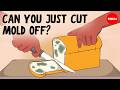
Whatever type of mold grows on a product, it does not stay on the surface. Like most fungi, mold forms a root-like structure, the mycelium, which penetrates deep into the product. For this reason, food safety specialists recommend discarding the entire product. Removing the visible spots does not eliminate the mycelium inside.
In addition, mold behaves as follows under different conditions:
- High temperature can kill the mold body, but spores remain viable. They enter a dormant state and resume growth when conditions become suitable.
- Cold can destroy some species, but others survive sub-zero temperatures.
- Refrigeration generally slows mold growth. This can extend the shelf life of products by several additional days.
- Humidity. Other mold species develop in damp darkness, which forms from condensation in the refrigerator's crisper drawer.
Is It Safe to Eat Moldy Food?
Molds range from harmful to beneficial species. So-called spoilage molds, which appear on food, are mostly harmless. They can cause allergic reactions, as can any other food. Eating large amounts of such food may lead to vomiting and diarrhea. For most people, accidentally biting into moldy food does not cause a serious illness.
Mold generally tastes unpleasant, so a second bite is usually not advisable. The sense of taste likely evolved as a survival mechanism. It helped early humans recognize tasty, nutritious food and avoid deadly toxins.
The same evolutionary trait may explain why some molds are eaten. Such molds are used in blue cheese, soy sauce, miso, and many aged products. Over generations, people have effectively domesticated these species by selecting them for their flavor and culinary qualities.
Dangerous Types of Mold
A small group of mold species poses a real threat. When competing for space on a substrate, some species use chemical means. They produce bright pigments, strong odors, and dangerous compounds called mycotoxins.
For example, a small group of molds that grow on barley, wheat, corn, and peanuts produces aflatoxin. Aflatoxin is known to cause liver and lung cancer. Most countries carry out strict food safety controls to keep aflatoxin from reaching consumers.
Conclusion
Despite the presence of mycotoxins, most molds that people encounter do not pose a danger.
What Mold Is and Where It Lives
Mold is a diverse group of fungi whose spores are constantly present in the air and on food.
- Molds form a diverse group of fungi that includes hundreds of thousands of species, only some of which have been studied.
- Mold spores are everywhere and are constantly carried by air in search of a suitable place.
- Molds look for a specific combination of temperature, humidity, and nutrients, most often in soil, plants, and food.
- The produce section of a store is one of their favorite places to settle.
How Mold Grows on Food
Spores germinate, form a network of hyphae, and secrete enzymes that break down the food, after which new spores are formed.
- After landing on food, a spore sprouts into a tube that develops into a network of branches called hyphae.
- The hyphae spread through the food and secrete enzymes that break it down into easily absorbed fats, sugars, and amino acids.
- As it grows, the mold forms structures that produce and release new spores.
- Most food molds complete the cycle in 1–3 days; the exact timing depends on the mold species.
Why Different Foods Get Infected by Different Molds
Each product has its own composition, so certain types of mold take hold on it.
- The composition of a product (carbohydrates, proteins, fats, vitamins, and minerals) determines which molds can grow on it.
- On berries, which have high moisture and sugar content, Botrytis cinerea, Penicillium, and Cladosporium often grow.
- On tomatoes and other acidic foods, Alternaria alternata usually grows; it pumps acid out of cells using pumps in the cell walls.
- On bread, which is rich in starch, Rhizopus stolonifer lives; it breaks down starch with a special enzyme.
Why You Can't Just Cut Off Mold
Mold penetrates deep into the product through its mycelium, so cutting off the visible part does not help, and spores survive even when heated.
- Mold develops a root-like structure of mycelium that extends deep into the product.
- Food safety specialists advise discarding spoiled foods whole, since removing visible mold does not remove the mycelium inside.
- High temperatures can kill the mold body, but spores may survive and sprout again under suitable conditions.
- Cold slows the growth of many molds, and refrigeration can extend shelf life by several days.
- In humid refrigerator drawers with condensation, some molds thrive.
Is Mold Edible and Why Is It Usually Not Eaten
Household mold is mostly harmless but can cause allergies, vomiting, and diarrhea if consumed in large amounts. Taste helps people avoid it.
- Common molds on spoiled foods are mostly harmless but can cause allergic reactions.
- Consuming large amounts may cause vomiting and diarrhea.
- For most people, accidentally biting into moldy food does not lead to serious illness.
- Mold usually tastes unpleasant, so a person is unlikely to eat it again.
- The sense of taste likely evolved as a survival mechanism, helping to find nutritious food and avoid poisons.
- Some molds are intentionally used in blue cheese, soy sauce, miso, and other foods, and people have domesticated them over generations.
Dangerous Mycotoxins
A small group of molds is dangerous because it produces mycotoxins, such as aflatoxin, which causes liver and lung cancer.
- Some mold species produce bright pigments, strong odors, and dangerous compounds called mycotoxins in the competition for space.
- A small group of molds growing on barley, wheat, corn, and peanuts produces aflatoxin.
- Aflatoxin is known to cause liver and lung cancer.
- Many countries conduct strict food safety testing to keep aflatoxin from reaching consumers.
- Most molds we encounter do not pose a threat.