
 ~3m3:47
I Gave 4 AIs the Same Prompt to Build Need for Speed
Nov 7, 2026
Read: ~3m · You save: 47 sec
I Gave 4 AIs the Same Prompt to Create Need for Speed
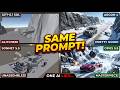
Four AIs got one prompt and one time limit to build Need for Speed. Which one did best? Watch the comparison of driving, crashes, and avalanches.
Task: build a game from scratch within a limited time. Four AI models received the same prompt and the same time limit. The results turned out to be fundamentally different. Below, we break down the tested features: controls, collisions, and the final avalanche scene.
Test Conditions
- Task: A Need for Speed-style racing game featuring a race along a mountain road, falling boulders, and a final chase from an avalanche.
- Minimum runtime: 80 minutes.
- Evaluated aspects: controls, collision physics, destructible objects, final scene.
Opus
The game opens with a scene: snow collapses, after which the player finds themselves on a road.
- Visuals: the car looks fully realized, the road is easy to read, and cliffs tower above the track.
- Obstacles: boulders roll down the slope straight toward the road.
- Destructibility: breakable guardrails and detaching body panels are advertised. The footage shows a guardrail and a body panel being destroyed. Object reactions match the intended design.
- Finale: a chase from an avalanche with a rear-view camera is implemented.
- Runtime: 66 minutes. This is below the 80-minute minimum, so the runtime requirement is not fully met.
Argan
Argan bets on scale: more snow, more trees, and a dashboard interface overloaded with information.
- Cabin: the windshield wipers work. This is a noticeable detail.
- Camera: for most of the run, the road is barely readable, and the car visually gets lost in its surroundings.
- Environment: a well-lit shelter and a bridge strewn with boulders almost the size of the car.
- Verdict: impressive chaos, but not a race.
- Runtime: 81 minutes. Most of the time budget is used, and many features are implemented.
Sonit
- Car: instead of a familiar vehicle, the model looks like an disassembled diagram that still moves. This is not collision damage; the model was designed this way from the start.
- Road: strips of asphalt, gaps, and barriers across the track. The course resembles an obstacle course more than a mountain pass.
- Runtime: 81 minutes. According to Sonit, the game is complete and has been tested.
- Result: the game launches, but its appearance and behavior differ noticeably from what was expected.
- Ending: on a bridge, amid flying rocks, the final screen appears.
GPT Saul
- Runtime: 12 minutes 58 seconds. This is significantly less than the 80-minute minimum.
- Result: a procedural generation kit and a Godot project. There is no verifiable gameplay recording.
- Status: a working prototype on paper, not a finished race.
Final Comparison
| Model | Runtime | Key Result | Main Limitation |
|---|---|---|---|
| Opus | 66 min | A coherent race with destructible objects and a final chase | Runtime is below the 80-minute minimum |
| Argan | 81 min | Working windshield wipers, rich environment | The road is hard to read, the camera gets lost in the scene |
| Sonit | 81 min | The game launches and the final screen works | The car and road are far from the stated concept |
| GPT Saul | 12 min 58 s | Procedural generation and a Godot project | No verifiable gameplay, the race is not finished |
Conclusion
The author chooses Opus. This model is closest to the original idea: a coherent race through falling rocks with objects that clearly break apart. Argan implemented a number of details, but the camera constantly gets lost in the environment. Opus did not meet the time requirement, but it skipped only part of the task.
Setting Up the Experiment
The author sets up an experiment: four AI models receive the same prompt and a time limit to create a game in the spirit of Need for Speed.
- Four AI models received the same prompt and the same time limit
- Goal: create their own game from scratch
- The comparison covers driving, crashes, and the final avalanche
Opus
Opus opens the scene with an avalanche, provides a readable mountain road with falling rocks, as well as destructible barriers and panels. The claimed runtime is 66 minutes, which is below the 80-minute minimum.
- Start: snow slide, car on a mountain road, overhanging cliffs
- Rocks roll down the slope straight onto the road
- Destructible railings and detachable body panels provide feedback
- There is a chase from the avalanche with a rear-view display
- Claimed 66 minutes, stopped short of the 80-minute minimum, time requirement not met
Argon
Argon emphasizes spectacle: more snow, trees, and an overloaded dashboard. The windshield wipers work inside the cab, but the road is barely readable, and it feels more like chaos than a race.
- More snow, trees, and a busy dashboard
- Windshield wipers work inside the cab
- A lit shelter and a bridge strewn with boulders nearly as wide as the car
- For most of the run the road is hard to read, and the car seems to fly through scenery
- Listed at 81 minutes, nearly the entire time budget used, many features
Sonit
Sonit released a build that looks like an exploded diagram rather than a mountain pass: strips of asphalt, gaps, and fences across the route.
- The wheels are detached from the car, which looks like an exploded diagram yet still drives
- The road consists of strips of asphalt, gaps, and fences
- It resembles an obstacle course more than a mountain pass
- After 81 minutes, Sonit reported completion and testing
- The final screen appears after a bridge and falling rocks
Final Choice
The author chooses Opus as the best build: a coherent race through falling rocks with visibly breaking objects, although the minimum time is not met.
- Choice: Opus, closest to the idea
- A coherent race through falling rocks with breaking objects
- Opus stopped before the minimum time and skipped part of the task
- Argon: good wipers, but the camera is constantly absorbed by the environment
GPT Saul
GPT Saul stopped after 12 minutes 58 seconds, far short of the 80-minute minimum. What remains is a procedural foundation and a Godot project without verified gameplay footage.
- Stopped after 12 minutes 58 seconds with an 80-minute minimum
- Left behind a procedural kit and a Godot project
- No verified gameplay recording
- Result: a paper prototype, not a finished race