
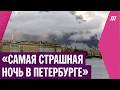
 ~4m5:28
Жители Петербурга о самой масштабной атаке дронов на город и область
Oct 18, 2026
Read: ~4m · You save: 1 min
St. Petersburg residents describe the largest drone attack on the city and region
Residents of St. Petersburg describe the night of the largest drone attack on their city: record interceptions, fires at fuel sites, power loss, and a shelter turned aw
Dated 18 October 2026
Air raid warnings sounded at 1:30 a.m. By morning, air defense had downed a record 145 drones over the city, according to reports. Viewers of Dozhd (TV Rain) described the night as the most frightening in St. Petersburg since the start of the war. The attack damaged infrastructure, residential buildings, businesses, and vehicles, and it caused fuel shortages and power outages.
Casualties and Damage
| Category | Reported figure |
|---|---|
| Drones downed over the city | 145 (record) |
| Deaths | 1 |
| Injured | 15 |
| Residential buildings damaged | 12 (2 private houses) |
| Residents without electricity and heat | About 20,000 |
Cars were also damaged. Dozens of vehicles were hit, and some drivers were caught at gas stations when the attack began.
Targets
- Oil infrastructure. Fires broke out on the territory of the St. Petersburg oil terminal, an oil depot, and industrial warehouses in the Kolpinsky district.
- Data center. A VKontakte data center was damaged. The company stated that its services were operating normally, but the city recorded a surge in user complaints.
- Logistics. One of Ozon's logistics centers was hit. Work at an Ozon pickup point stopped. An employee said staff did not know whether further work or attacks would follow.
- Power grid. Damage occurred at the Vostochnaya substation. Leningrad Oblast Governor Alexander Drozdenko described the damage as minor. He said that most of the damage involved wiring inside the substation, that transformers and main power equipment were operating, and that the problems would be resolved in the near future.
Fuel Shortages
Residents reported long fuel queues before the attack, with some people waiting at gas stations at 3:00 a.m. Residents said the situation added to existing fuel supply problems in the city.
Dozhd viewers and a commentator linked the terminal strike to the ownership of the facility. According to the commentator, 55% of the terminal's shares belong to the Rotenberg family. The commentator argued that the strike hit a sensitive asset and questioned whether the state would take control of the terminal from the Rotenbergs because they could not protect it. These statements are the commentator's assessments and have not been confirmed by official sources.
Shelter Access and Emergency Response
- Residents' shelter. Residents of several buildings sheltered in corridors from about 3:30 to 5:00 a.m. Lights flickered, and loud explosions and drone noise were audible.
- Evacuation and cordons. In the Moscow district, a building was evacuated. Police, firefighters, and ambulances cordoned off a courtyard in the area. Residents reported a strong smell of smoke in the Moscow district. Many residents remained in their cars and were afraid to leave.
- Passport requirement. In Kudrovo, Leningrad Oblast, a resident said staff refused to admit her to a shelter without a passport. She said she was admitted only after another employee intervened.
- Lack of guidance. A student living in a dormitory said that residents had never received instructions on safety measures. She said she could not find the address of the nearest shelter online. She also reported that she had been without contact with her relatives for a long time because of communication restrictions.
Official Statements and Information Restrictions
- City government. St. Petersburg Governor Alexander Beglov posted about the attack in the morning, describing the attackers as "Ukrainian Nazis," and stated that there were no casualties. He did not update the post after reports of a death emerged.
- Media restrictions. State-controlled media in the city reminded residents of a ban on filming and publishing footage of the attack. Sergei Kovalchenko stated that the instruction likely came from Smolny, the seat of the city government. Despite the restrictions, footage of burning buildings and residents' complaints about the authorities spread on social media.
Residents' Assessments
Residents expressed distrust of local authorities. One resident said that officials did not help residents and repeated slogans about Nazis and Banderites instead. Another resident said that people were trying to survive on their own. These statements reflect personal opinions and were not verified.
A resident living on Fifth Line near Malaya Prospekt, who previously worked nearby and commuted through the area for years, said that the Ozon warehouse on fire is visible from the windows of nearby homes. He also stated that Vladimir Putin started the war. This claim is the resident's personal view.
A record night of drone interceptions
Residents recount the night of the air-raid alert, which began at 1:30 a.m., and a record number of drones shot down over the city.
- Air-raid alert was announced at 1:30 a.m.
- By morning a new record of 145 drones shot down over the city was reported.
- Viewers call it the most frightening night in St. Petersburg since the start of the war.
- A woman and her husband live near the port and have been woken by explosions for the third time this year.
- She described a flash in the window and said the drone seemed to be right above them.
Casualties and damage
Official casualty and damage figures reported after the attack.
- One person was killed and 15 were injured.
- 12 residential buildings were damaged, two of them private houses.
- A resident hid in a corridor away from the window from about 3:30 to 5:00 a.m., with lights flickering and loud explosions.
- A courtyard was cordoned off by police, firefighters and ambulances, and a strong smell of burning was reported in the Moskovsky district.
- The building was evacuated, but many people remained sitting in their cars, afraid to leave.
- Dozens of cars were damaged, and some people were caught at a gas station when the attack began.
Fuel shortages and oil terminal fire
Fuel queues and a fire at the oil infrastructure intensified the city's existing fuel problems.
- People were reported standing in fuel lines at 3:00 a.m. before the attack.
- Fires broke out on the territory of the St. Petersburg oil terminal, oil depots and industrial warehouses in the Kolpinsky district.
- One resident said he went to refuel because otherwise the next day there would be no fuel left.
Political reading of the terminal strike
A commentator argues the attack targets a terminal linked to Vladimir Putin's associates, and questions whether the terminal will be taken from its owners.
- The speaker claims the terminal is linked to Vladimir Putin, so Ukrainian strikes hit a sensitive spot.
- The speaker claims 55% of the shares belong to the Rotenberg family.
- The speaker asks whether Putin will take the terminal from the Rotenbergs because they cannot protect it from air attacks.
- The speaker says Putin could either take it from friends or tell people he cannot defend his terminal and can only protect his own life at Valdai.
Infrastructure and energy damage
Attacks hit digital services, logistics and the energy grid, leaving thousands without power and heat.
- The VK data center was damaged; the company said services work normally, but the city saw a spike in complaints.
- One Ozon logistics center was hit, and work at the pickup point stopped.
- An Ozon pickup point employee said staff do not know whether work will continue or whether more strikes will come.
- About 20,000 people were left without electricity and heat.
- Leningrad region Governor Alexander Drozdenko called the damage at the Vostochnaya substation minor.
- He said the damage mainly involved wires inside the substation, while transformers and main equipment were working, and problems would be resolved soon.
Official statements and public criticism
St. Petersburg Governor Alexander Beglov's statements and residents' criticism of local authorities.
- Beglov wrote in the morning about the attack, calling the attackers Ukrainian Nazis, and said there were no casualties.
- He did not update the post after reports of one person's death.
- A resident said the governor lives in his own fantasies and that people have adapted to a state of frozen self-preservation.
- The speaker says people should not expect help from the authorities, who only repeat slogans about Nazis and Banderites.
Shelter access and information restrictions
Residents report being denied shelter and facing unclear rules during the attack, and describe limited information and filming restrictions.
- In Kudrovo, in the Leningrad region, a woman was refused entry to a shelter without a passport.
- She said she woke up to flights overhead from the eighth floor and was told about the passport instead of being let in.
- Another employee told her she must leave the apartment with all documents.
- Another employee let her into the shelter only after intervention by a colleague.
- A student living in a dormitory said no one had ever told her what safety measures to take, and she could not find the nearest shelter online.
- She said she was the only person in her room and felt responsible for her roommates.
- City outlets controlled by the authorities reminded residents of a ban on filming and publishing footage, reportedly from the Smolny, according to Sergei Kovalchenko.
- Despite this, footage of burning buildings and complaints about the authorities still filled social media.
Personal account from Malyi Prospekt
A resident near Malyi Prospekt on the Fifth Line describes the Ozon warehouse fire and blames Vladimir Putin for the war.
- The speaker lives in Kupchino and used to walk past the building on Fifth Line near Malyi Prospekt every day for years.
- The speaker says the burning Ozon warehouse could be seen from their windows.
- The speaker blames Vladimir Putin, described as a fellow countryman, for starting the war.