
 ~6m15:42
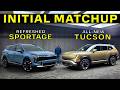
SIBLING RIVALS! -- New 2027 Hyundai Tucson vs. 2027 Kia Sportage: Initial Matchup Comparison
Oct 25, 2026
Read: ~6m · You save: 10 min
Rivals: New Hyundai Tucson 2027 vs Kia Sportage 2027 - First Comparison
Hyundai Tucson 2027 vs Kia Sportage 2027: 17-inch screen, more rear space, hybrids and prices. Who wins the first comparison?
Compact crossovers have become the top choice for American buyers, and Hyundai made significant changes to the Tucson for the 2027 model year. The editorial team spent time with the new Tucson and obtained key specifications that allow us to compare it with its main rival, the Kia Sportage. The comparison pits the top trim levels against each other: the Tucson Limited and the Sportage SX Prestige.
The updated Tucson has not yet arrived at dealerships. Sales will begin in early 2027. A more detailed comparison will be published later.
Exterior
Design. The Sportage is built within Kia's unified design concept. It features a glossy black and silver finish and a pronounced "tiger nose" radiator grille. The refreshed Tucson is built on Hyundai's "Art of Steel" design language. Its body is more angular, and the emphasis is on body paint.
Headlights. Both models feature premium-level LED lighting. In the editorial team's assessment, the Sportage's headlights are on par with those of many luxury cars. The Tucson's headlights are based on Hyundai's micro-pixel technology, and the editors expect a similar level of quality. Only the Sportage has fog lights.
Dimensions. The fifth-generation Tucson is 185 inches long, which is 0.6 inches longer than the Sportage (184.4 inches). Both models are among the largest in their class.
Wheels. The Tucson Limited comes with 20-inch alloy wheels, while the Sportage SX Prestige comes with 19-inch wheels.
Body kit. The Sportage has a thinner glossy black body kit. The Tucson's body kit is thicker and matte, which gives the vehicle a more brutal look.
Rear. Both models have LED taillights, a roof spoiler, prominent logos, and a hidden rear wiper. The main difference is towing capacity. The all-wheel-drive Tucson Hybrid is rated to tow up to 3,000 pounds, which for the 2027 model year is higher than the Sportage Hybrid's maximum of 2,000 pounds.
Safety and Driver Assistance
The side mirrors on both models provide basic functions: heating and blind-spot monitoring. Both cars are equipped with a suite of active safety systems. Higher trim levels receive a highway drive assist system.
Interior
Seating and access. Both models feature keyless entry (smart entry).
Front seats. The front seats in the top trims feature power adjustment, memory function, heating, and ventilation. Tucson massage seats are available in other markets, but this option will not be offered in the US.
Trim. Both models use widely used soft-touch materials and multicolor adjustable ambient lighting. The Tucson gets more extensive lighting and wood-effect trim. The Sportage uses textured plastic. Both vehicles surpass many competitors in their class.
Instrument panel. The Sportage has a 12.3-inch digital instrument cluster in the traditional location. The Tucson gets a more compact 9.9-inch display positioned higher on the dashboard. A head-up display is standard on the Sportage SX Prestige. The editors do not yet know whether it will appear on the US-spec Tucson.
Steering wheel. The steering wheels of both models have a non-standard design. Both feature leather trim and heating.
Climate controls. Key functions, such as temperature adjustment, are implemented with physical buttons. Dual-zone climate control is standard on both models.
Audio systems. Kia uses a Harman Kardon system, while Hyundai uses Bang & Olufsen. The editors have not yet tested the new Tucson system, but they expect good sound, since Bang & Olufsen is usually installed in premium-class vehicles.
Central display. The Sportage has a 12.3-inch multimedia screen. The base-trim Tucson gets a 12.9-inch screen, and the top versions get a 17-inch touchscreen, the largest in its class.
Software. The systems run on different platforms, but both are responsive. Kia uses CCNC software, which has been used in Hyundai Motor Group vehicles for several years. The Tucson runs on the new Play OS platform, which provides access to advanced features, including apps and AI. Both models support Apple CarPlay and Android Auto.
Roof. Both models are equipped with panoramic sunroofs with sunshades.
Second-Row Space
The updated Tucson has received increased interior dimensions. Thanks to its lengthened wheelbase for the 2027 model year, it offers 41.9 inches of second-row legroom, the best figure in its class. The Sportage's figure is 41.3 inches. The Tucson's roof is higher, and its maximum headroom is 39.5 inches.
Second-row features in top trims are nearly identical: air vents, USB ports, reclining seatbacks, and heated seats are included in both models. The Tucson's additional option is built-in window sunshades.
Cargo Compartment
The trunk opens via a keyless power rear liftgate. Hyundai claims the Tucson will be the segment leader in cargo volume. According to the manufacturer, 41.7 cubic feet are available behind the second row of seats, and the maximum volume with the rear seats folded is 77.7 cubic feet. For the Sportage hybrid (HEV), these figures are 39.5 and 73.7 cubic feet, respectively. Both values remain among the highest in the class.
Common features: both models have 60/40 split-folding seatbacks, seatback release handles in the trunk, and a spare tire under the floor, including in the hybrid versions.
Powertrain
Both models are available in a hybrid configuration. The hybrid system consists of a turbocharged 1.6-liter four-cylinder engine and electric components. The Tucson's system was upgraded this year to increase power and efficiency.
Power and acceleration. The Tucson is expected to be more powerful than the Sportage, especially the all-wheel-drive version: 242 hp versus 232 hp for the Kia. The estimated 0–60 mph acceleration time is 7.4 seconds for the Sportage and around 8 seconds for the Tucson. The editorial team notes that the Sportage offers a noticeable gain in performance compared to the gasoline version and is quieter under acceleration.
Transmission. The Sportage and Tucson hybrids use a conventional six-speed automatic transmission. Competitors mostly use continuously variable transmissions (ECVT). The six-speed gearbox offers a more familiar driving feel, but it is slower to shift gears because it has relatively few ratios.
Powertrain options. The Sportage is sold with three types of powertrain. All-wheel-drive versions with off-road packages are available for both the Tucson and the Sportage.
The editorial team has not conducted a full test drive of the new Tucson. The specifications are based on preliminary data.
Fuel Consumption
The all-wheel-drive Sportage Hybrid has an EPA rating of 35 miles per gallon combined. Hyundai projects a 38 miles per gallon rating for the top-trim all-wheel-drive Tucson Hybrid.
For the 2027 model year, both models are available with purely gasoline engines. The plug-in hybrid remains only on the Sportage.
Reliability, Cost of Ownership, and Warranty
Detailed data on value retention and reliability are not covered in this review. Based on historical data, both brands have shown above-average performance in recent years. Hyundai has an advantage in value retention.
Hyundai and Kia's warranty terms are identical: a limited bumper-to-bumper warranty for 5 years or 60,000 miles and a powertrain warranty for 10 years or 100,000 miles. Neither brand offers free maintenance.
Prices
The base price of the 2027 model year Sportage Hybrid SX Prestige is 43,000.
The official price of the Tucson Limited Hybrid has not yet been announced. According to Car Confections' estimate, the fully equipped Limited Hybrid with all-wheel drive will cost around $45,000. The estimate is based on the fact that prices typically rise after a facelift.
Conclusions
Advantages of the Tucson:
- more legroom in the second row;
- a larger cargo compartment, which is expected to be the best in its class;
- a 17-inch touchscreen, the largest in its class, and new software;
- increased towing capacity.
Advantages of the Sportage:
- a more traditional cabin layout without a large screen;
- LED fog lights, which the Tucson will probably not have.
Introduction and Problem Statement
Introduction: the compact crossover has become the most popular choice among American buyers, and Hyundai has updated the Tucson for 2027.
- Comparison of the 2027 Tucson and Sportage, which belong to the same group (Hyundai Motor Group).
- The top trim levels are compared: Tucson Limited and Sportage SX Prestige.
- Sales of the new Tucson will begin in early 2027.
- The authors had the opportunity to inspect the new Tucson in person.
Exterior and Dimensions
Appearance: The Sportage stands out with Kia's signature design and tiger-nose grille, while the Tucson has an angular shape and body-colored cladding.
- Sportage: "tiger nose" grille, glossy black and silver accents.
- Tucson: Hyundai's "Art of Steel" design language, angular body, emphasis on body-colored cladding.
- Both vehicles have LED high-beam headlights; only the Sportage is equipped with fog lights.
- The Tucson is longer: 185 inches versus 184.4 inches for the Sportage.
- Wheels: 20 inches on the Tucson, 19 inches on the Sportage SX Prestige.
- The Sportage has a thinner glossy black trim, while the Tucson has a thicker matte one.
- Rear: common LED taillights, a roof spoiler, and concealed rear wiper.
Features and Safety
The main exterior difference lies in functionality: the Tucson Hybrid AWD has greater towing capacity.
- Tucson Hybrid AWD: towing up to 3000 lbs for the 2027 model year.
- Sportage Hybrid: towing up to 2000 lbs.
- Mirrors on both models have heating and blind-spot monitoring.
- Both have a suite of active safety systems and highway drive assist in the upper trims.
Cabin: Seats and Materials
Interior: power-adjustable seats with memory, heating, and ventilation; the Tucson's massage seat is only offered in other markets.
- Front seats in top trims: power adjustment, memory, heating, ventilation.
- The Tucson's massage seat is not available in the US market.
- Both models have soft-touch trim and multicolor ambient lighting.
- Tucson: more lighting and wood-look trim; Sportage: textured plastic.
- Both models surpass many competitors in cabin quality.
- Climate buttons: physical switches; dual-zone climate control in both.
Instrument Panel and Steering Wheel
Instrument cluster and controls: the Sportage has a 12.3-inch panel, while the Tucson's 9.9-inch one is positioned higher.
- Sportage: 12.3-inch digital instrument cluster in the traditional location.
- Tucson: narrow 9.9-inch display positioned higher on the dashboard.
- A head-up display is available in the Sportage SX Prestige; for the Tucson in the US version, it is not yet known.
- The steering wheels of both models are leather-wrapped and heated.
Storage Spaces
Storage: both models have large consoles; the Tucson has more space and an additional wireless charger.
- The Tucson's console is deeper and wider.
- Sportage: reconfigurable cup holders and one wireless charger.
- Tucson 2027: passenger shelf, pass-through compartment, and a second wireless charger.
- Electronic gear selector in both models; on the Hyundai it is on the steering column.
Parking, Climate and Audio
Parking and climate: both models have 360° cameras, Tucson gets reverse parking assistance; climate control is dual-zone.
- Both models have 360° surround-view cameras on top trims when reverse gear is engaged.
- Tucson 2027: memory reversing assist for exiting tight parking spaces.
- Audio systems: Harman Kardon in the Kia, Bang & Olufsen in the Hyundai.
- The authors have not yet tested the Tucson's system.
Multimedia and Software
Multimedia: The Tucson gets a screen up to 17 inches and Play OS software, while the Sportage runs on more traditional software.
- Sportage: 12.3-inch screen.
- Tucson: base 12.9 inches, up to 17 inches in top trims — the largest in its segment.
- Sportage runs on CC NC software, which Hyundai Motor Group models have used for several years.
- Tucson uses next-generation Play OS with apps and AI features.
- Both support Apple CarPlay and Android Auto.
- Panoramic sunroofs with sunshades in both models.
Rear Seat Passengers
Rear seat: the Tucson has more legroom and higher headroom; both models have similar amenities.
- The Tucson's wheelbase is longer: 41.9 inches of rear legroom versus 41.3 in the Sportage.
- Tucson cabin height: 39.5 inches.
- Both models: rear vents, USB ports, reclining seatbacks, heated seats.
- Side window sunshades are only available in the Tucson.
Cargo Space
Cargo: The Tucson offers more volume; the Sportage HEV also has a large trunk for its segment.
- Tucson: 41.7 cu ft behind the second row, 77.7 cu ft maximum (according to Hyundai).
- Sportage HEV: 39.5 cu ft behind the second row, 73.7 cu ft maximum.
- Both models: 60/40 split seats, folding handles, and a spare tire under the floor even on the hybrids.
Engines and Transmission
Powertrain: both hybrid models use a 1.6-liter turbocharged four-cylinder engine and an electric motor; the Tucson is more powerful.
- Tucson Hybrid AWD: 242 hp versus 232 hp for the Sportage.
- 0–60 mph acceleration: Sportage about 7.4 s, Tucson about 8 s (estimate).
- Both models have a 6-speed automatic transmission (unlike the ECVT found in many competitors).
- The Sportage is available with three powertrains, including a plug-in hybrid (only the Sportage retains a plug-in).
Fuel Consumption
Fuel economy: Sportage Hybrid AWD 35 mpg, Tucson Hybrid AWD claimed 38 mpg.
- Sportage Hybrid AWD: 35 mpg combined per EPA.
- Tucson Hybrid AWD: claimed 38 mpg combined for the top trim.
- Both models have fully gasoline variants for 2027.
- Tucson test drive has not yet been conducted; a full review with noise assessment will come later.
Reliability, Resale, and Warranty
Reliability, resale, and warranty: both brands are above the market average; Hyundai is stronger on resale value; the warranties are the same.
- Hyundai likely retains its value better on resale.
- Warranty for both brands: 5 years or 60,000 miles limited bumper-to-bumper; 10 years or 100,000 miles on the powertrain.
- Neither brand offers free maintenance.
Prices
Prices: Sportage Hybrid SX Prestige starts at $40,690, with options around $43,000; Tucson Limited Hybrid AWD is estimated at about $45,000.
- Sportage Hybrid SX Prestige: base price $40,690 (model year 2027).
- With options, Sportage: about $43,000.
- There is no official price for the Tucson Limited Hybrid yet; Car Confections' estimate is about $45,000 with full AWD trim.
- Prices usually rise after a redesign.
Comparison Conclusions
Verdict: The Tucson wins on rear-seat roominess, cargo capacity, screen, and towing; the Sportage wins on its traditional interior layout and fog lights.
- Tucson advantages: more rear-seat room, larger trunk, 17-inch screen, higher towing capacity.
- Sportage advantages: more traditional cabin layout without a large screen, LED fog lights.
- Call to viewers to leave their opinion and choose a model.
- Link to carconfections.com/newcarquotes for finding dealers and information about invoice pricing (dealer cost).