
Why Is All of Europe Protesting at the Same Time?
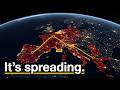
Why did protests erupt across Europe at the same time? From a Madrid apartment to an Albanian beach, we search for the common cause behind 14 countries.
This autumn, people took to the streets in 14 European countries. The protests began for different reasons: in Madrid, over the eviction of an elderly woman; in France, over a shortage of teachers at one school; in Albania, over a fenced-off beach by a lagoon with flamingos; in Germany, over a questionnaire for 18-year-olds. However, in October these conflicts coincided in time and in their underlying causes. The key factor was the energy shock of 2026, yet its scale turned out to be smaller than in 2022, while the protests were nevertheless stronger.
Four Sparks
Madrid: An Apartment
María del Carmen Abascal, known as Mari Carmen, was 87 years old. For about 70 years she had lived in one apartment in Madrid and paid around 500 euros a month. An investment fund bought the building, and the rent rose to more than 1,600 euros. On September 23 she was evicted.
About 10,000 people took to the streets of Madrid. For several days a tent camp occupied Puerta del Sol square in the city center. The woman was offered the chance to return to the apartment at her previous rent. On October 7, a tenants' union reported that she had died.
Spain's economic data explain the scale of the protest:
| Indicator | Value |
|---|---|
| Minimum wage in 2026 | 1,221 euros a month before deductions, paid 14 times a year |
| Average rent for an 80 sq. m apartment | about 1,130 euros |
A 20-year-old waitress named Diana told the Associated Press that most of her salary goes to rent.
Prime Minister Pedro Sánchez sought passage of a housing package, but parliament did not support it. He then called early elections for November 29. Unions announced a general strike over housing for November 11. It will be the first such strike in the country in 14 years.
Portugal
According to Reuters, housing purchase prices in Portugal have more than doubled since 2017, and rents on new contracts have nearly doubled. In the second quarter of 2026, Portugal ranked first in the European Union for housing price growth, with an annual increase of 16.5%.
The Bank of Portugal estimates that the country lacks 300,000 dwellings. That is roughly the number of homes in all of Lisbon. Tens of thousands of people protested in Lisbon. Police dispersed camps in Lisbon and Porto, but protesters continue to return.
Across the European Union, housing prices rose by about 53% from 2010 to 2024. Those who bought homes before this increase benefited from it. Those who became buyers later pay that difference every month.
France: School
In mid-September, teachers at a lycée in Créteil, a Paris suburb, announced a strike. Their main demand was staff shortages. Students joined the strike. Within a few weeks, high school students were blockading schools across France. They pointed to dilapidated classrooms, a shortage of teachers, and buildings that cannot cope with the heat.
On October 17, workers and opponents of rising fuel prices joined the protest. France's Ministry of the Interior counted 550,000 participants. The organizers claimed 800,000.
Most participants protested peacefully, but in several cities shops were vandalized. In Limoges, the city hall building, which opened in 1883, was set on fire; most of the building was lost. Hundreds of police officers and firefighters were injured, as were many protesters. According to CNN, at least two people died during the unrest. President Emmanuel Macron placed the blame on ultra-left activists.
France spends more on education than the EU average, which contradicts the protesters' expectations. According to analyst Mujtaba Rahman, more than a quarter of this spending goes to pensions for retired teachers. Economist Paul Krugman views the crisis as a struggle over the distribution of money between older and younger generations.
France's economic situation in 2026 looks like this:
- in September, energy prices rose by more than 21% year on year;
- unemployment among citizens aged 15 to 24 nearly reached 22%;
- according to one French institute's estimate, since 2024 a family of four has lost about 1,200 euros a year in purchasing power.
Students demanded more funding for schools, and workers demanded a higher minimum wage. The government rejected both demands. The draft budget for the next year provides for a freeze on civil servants' pay scales and stricter rules for sick pay.
Italy: Diesel Pump
In mid-October, truck drivers and farmers in Italy stopped work over diesel prices. In the south of the country, fuel shortages emerged, and goods disappeared from supermarket shelves. That same weekend, marches in Milan, Turin, and Bologna escalated into riots.
According to the Associated Press, 271 people were detained in Milan, most of them minors. The government of Prime Minister Giorgia Meloni introduced a security decree. It provides for two to five years in prison for violent rioting.
On October 30, the USB union announced a 24-hour general strike against the rising cost of living and war. CNBC links high fuel prices to the wars in Iran and Ukraine.
Inflation in Italy reached 4.2%. In September, inflation in the eurozone stood at 3.8%, the highest level in three years. Energy prices rose by almost 19%.
According to Eurostat, from August 2021 to August 2026, food prices in the EU rose by 34%. They have not fallen since.
Belgium
In Brussels, tens of thousands of people marched against rising education costs. In Liège, hundreds of students were detained.
Albania: Flamingo Beach
In late May, fences and bulldozers appeared on the beaches of Zvërnec on the Albanian coast, next to a lagoon known for its flamingos. The construction is linked to a luxury tourist complex project connected to the investment company Affinity Partners, founded by Jared Kushner. Another part of the plan concerns Sazan Island, located not far from the shore.
Local residents said they had not been informed about the project. Protesters came with pink flamingos as a symbol. Journalists dubbed the movement the "Flamingo Revolution." Demands quickly expanded: fighting corruption, improving healthcare and pensions, and the resignation of Prime Minister Edi Rama, who has been in power since 2013.
In October, students joined the protest over tuition fees and the condition of universities. By October 24, more than 300 protesters and police officers had been injured. Rama refused to resign.
According to a comparison of 32 countries conducted by Newsweek, Albania has the highest youth unemployment: more than 25%.
Serbia: The Railway Station in Novi Sad
In November 2024, the roof of the railway station in Novi Sad collapsed. Sixteen people died. Students began protesting against corruption and continued the protests for almost two years. On October 25, a student list won Serbia's elections, gaining about 140 of the 250 seats in parliament. Aleksandar Vučić, who had led the country for 14 years, conceded defeat.
Germany and Other Countries
A new law in Germany requires every 18-year-old man to fill out a questionnaire about military service. According to the organizers, about 45,000 students left classes in September. In Prague, thousands of people protested the abolition of license fees that fund public television and radio. In Vienna, the protests are linked to cuts in university funding; in Athens, to the affordability of student housing; and in Dublin, to pay in the public sector.
Axios describes shared anxieties that do not add up to a single movement.
Migration as an Explanation
Some politicians explain the protests by migration. Donald Trump wrote on social media that migrants have taken over France. Meloni stated that nearly half of those detained after the riots in Milan have immigrant backgrounds. Alice Weidel of the German AfD blamed left-wing groups and people with migrant backgrounds.
However, the Associated Press reports that French authorities and police did not blame migrants. The Economist concluded that the wave of protests is mainly linked to rising living costs and the poor quality of public services, and that most protesters are citizens of their own countries.
Migration remains a subject of political debate in Europe. An anti-migration march took place in Lithuania this month. However, there is no evidence that migration caused the general wave of protests.
Energy Shock: Why the Numbers Don't Add Up
Economists at the International Monetary Fund have calculated what this year's energy shock costs an average European household. As of spring 2026, the losses amounted to about 0.7% of expenditure. In 2022, when Russia invaded Ukraine, the losses reached 8.5%, roughly 12 times as much.
Andrew Kenningham, Chief Europe Economist at Capital Economics, notes the same difference. The energy shock was stronger back then, yet there were no large-scale violent protests.
At the end of October, the price of gas once again exceeded 100 euros per megawatt-hour, for the first time since 2022.
Public Money and Debt
From September 2021 to January 2023, European governments allocated €758 billion to protect households and companies from rising energy bills. According to the Brussels-based think tank Bruegel, this amounts to about €1,460 per supported person. Germany allocated €264 billion. The measures included price caps, fuel discounts, and payments to citizens.
Governments were able to do this thanks to cheap borrowing. In early 2022, the European Central Bank's deposit rate remained below zero. In 2026 it stands at 2.5%, after two increases this year. On October 29, the bank kept the rate unchanged. Christine Lagarde said that a further increase could not be ruled out.
Energy support in Europe in spring 2026 was estimated at less than 0.2% of GDP. By comparison, in 2022 and 2023 this figure was 2.5% of GDP. Part of the difference is explained by the smaller scale of the shock, and part by a shortage of money.
The situation in France:
- government debt stands at 119% of GDP, a record and the highest share since just after World War II;
- the budget deficit is 5.4% of GDP;
- the cost of 10-year borrowing has reached its highest level since 2002;
- the yield gap with Germany is the largest since 2011;
- according to one estimate, interest payments in 2027 will amount to €91 billion.
On October 23, Moody's kept France's rating. In doing so, it assumed that a budget reducing the deficit would be adopted and that social tensions would ease. Macquarie strategists warned that prolonged protests could force the government to increase spending, which would again raise borrowing costs.
Thus, the state finds itself caught between the demands of the street, which asks for more money, and creditors, who demand lower spending.
Who Is Taking to the Streets
The Guardian, Reuters and NPR note that the protests are led by young people, primarily Generation Z. In France, the movement began with high school students, in Milan most of those detained were minors, and in Germany a questionnaire for 18-year-olds sparked the protest.
Young people face the following conditions:
- housing prices doubled before young people were able to buy an apartment;
- rent absorbs most of their salary;
- youth unemployment exceeds 20% in France, Italy, Portugal and Albania and approaches 25% in Spain;
- national debt, whose interest they will have to pay throughout their working lives.
Germany shows that unemployment alone does not explain the protests. Youth unemployment in Germany is below 7%, one of the lowest rates in Europe, yet students went on strike anyway.
Cunningham believes the main problem is that politicians, in his words, cannot offer hope for a better life. Sociologist María Silvestre from the University of Deusto in Spain told the Associated Press that young Europeans feel a strong sense of uncertainty and a lack of control over their lives.
The common denominator looks like this: in every case, someone else makes the decision, and the young person pays the bill.
How Protests Spread
Tents appeared in Madrid's Puerta del Sol square, where young Spaniards set up a camp in May 2011 during the previous debt crisis. In France, the "yellow vests" movement, which emerged in 2018 over a fuel tax, was revived online in September 2026.
It has not been proven that protests spread from one country to another. Axios points out that this is not a single movement. However, a teenager in Milan can watch news about Paris that same evening, and then about Serbia, where students won the elections.
Historical Parallels
In 1848, after several years of crop failures, uprisings spread rapidly from Paris to Vienna, Berlin, and Milan. Most of them were suppressed. In May 1968, French students took to the streets first, and then millions of workers joined the strike. The sequence of events coincides with what is being observed in October 2026: first the students, then the workers.
Protest Pressure Index
Newsweek has compiled a protest pressure index for 32 countries. It takes into account youth unemployment, inequality, and trust in government.
| Place | Country |
|---|---|
| 1 (joint) | France and Greece |
| 3 | Albania |
| 4 | Spain |
| 5 | United Kingdom |
The United Kingdom has not seen prolonged protests of this scale. Romania stands out: 80% of its residents believe the government is completely indifferent to them. This is the highest figure in the index. Newsweek itself cautions that the index "is not a timetable for revolution." Most of the data predates the energy shock of this year.
Key Dates
- November 11: nationwide general strike in Spain.
- November 15: a large demonstration is planned in Prague.
- November 29: elections in Spain.
- Spring next year: presidential elections in France. Before then, the government must pass the budget through parliament, where it does not have a majority.
Winter is approaching with gas prices above 100 euros per megawatt-hour.
Conclusion
Europe is not protesting against a single problem. An apartment, a school, diesel prices, and a beach in Albania are local conflicts, many of which have dragged on for years. What unites them is the loss of former conditions. Four years ago, Europe found 758 billion euros to protect people from the energy shock, and cheap money made this possible. Today money costs more, debts are larger, and the young generation, having studied the figures, has determined who pays the bills. María del Carmen lived in the same apartment for about 70 years, paying rent she could afford. The young people who take to the squares of her city demand far less than she received.
Spark One: An Apartment in Madrid
Protests began from different local triggers: the eviction of a pensioner in Madrid, teacher shortages in France, diesel fuel in Italy, a flamingo beach in Albania, and a questionnaire for 18-year-olds in Germany.
- In Madrid, 87-year-old Maria del Carmen Abascal was evicted on September 23; according to a tenants' union, she died on October 7
- Apartment rent rose from about 500 to more than 1,600 euros per month after an investment fund bought the building
- About 10,000 people took to the streets of Madrid; a tent camp filled Puerta del Sol square
- The minimum wage in Spain is 1,221 euros per month before deductions, paid 14 times a year
- The average rent for an 80 sq. m apartment is about 1,130 euros
- A general strike over housing in Spain is scheduled for November 11; early elections are set for November 29
- In Portugal, home purchase prices have more than doubled since 2017; the Bank of Portugal estimates a shortage of 300,000 homes
- From 2010 to 2024, housing prices in the EU rose by about 53%
The Second Spark: A School Outside Paris
In France, the protests began with teachers at a lycée in Créteil near Paris. They were joined by students, then by workers and protesters against fuel prices.
- In mid-September, teachers at a Créteil lycée went on strike over staff shortages
- On October 17, France's Interior Ministry counted 550,000 participants; organizers put the figure at 800,000
- In Limoges, the town hall built in 1883 was set on fire; CNN reports at least two people died during the unrest
- President Macron blamed ultra-left activists for the unrest
- Education spending in France is above the EU average, and more than a quarter goes to pensions of retired teachers, according to analyst Mujtaba Rahman
- In September, energy prices in France rose more than 21% year on year; unemployment among 15–24-year-olds was nearly 22%
- A family of four lost about 1,200 euros in purchasing power per year since 2024, according to a French institute's estimate
- The draft budget freezes civil servants' salaries and tightens sick leave rules
The Third Spark: The Diesel Pump
In Italy, strikes by truck drivers and farmers over diesel prices caused fuel shortages in the south and clashes in major cities.
- In mid-October, Italian truck drivers and farmers stopped work over diesel prices
- In Milan, 271 people were arrested, most of them minors, according to the Associated Press
- Prime Minister Giorgia Meloni introduced a security decree: two to five years in prison for violent riots
- On October 30, the USB union announced a 24-hour general strike against the cost of living and war
- CNBC links high fuel prices to the wars in Iran and Ukraine
- In September, inflation in the eurozone reached 3.8%, a three-year high; energy prices rose by almost 19%
- Inflation in Italy stood at 4.2%
- According to Eurostat, from August 2021 to August 2026, food prices in the EU rose by 34%
The Fourth Spark: Flamingo Beach
Protests in Albania began over the construction on a beach in Zvernec next to the flamingo lagoon. Protesters demand the resignation of Prime Minister Edi Rama and are fighting corruption.
- In late May, fences and bulldozers appeared on the beaches of Zvernec; the project is linked to Affinity Partners, the fund of Jared Kushner
- Protesters use pink flamingos as their symbol, and journalists have called it the “flamingo revolution”
- Demands expanded to include fighting corruption, improving healthcare and pensions, and the resignation of Prime Minister Edi Rama, who has been in power since 2013
- In October, students joined the protests over tuition fees and the condition of universities
- By October 24, more than 300 protesters and police officers had been injured
- Rama has refused to resign
- Compared with 32 countries in Newsweek's ranking, Albania has the highest youth unemployment, at over 25%
North: Serbia
In Serbia, protests lasted almost two years after the railway station canopy in Novi Sad collapsed; a student list won the elections, and Vučić conceded defeat.
- In November 2024, the railway station canopy in Novi Sad collapsed, killing 16 people
- Students protested against corruption for almost two years
- On October 25, a student list won the elections in Serbia, receiving about 140 of 250 seats
- Aleksandar Vučić, who had led the country for 14 years, conceded defeat
Different Countries, One Wave
Protests have spread across 14 countries and address different issues: from the tax on TV and radio in Prague to university cuts in Vienna and student housing in Athens; there is no common organization.
- In Germany, a new law requires every 18-year-old man to fill out a questionnaire about military service; in September, about 45,000 students walked out of classes
- In Prague, thousands of people protested against the abolition of license fees that finance public TV and radio
- In Vienna, protests were against university cuts, in Athens against student housing, and in Dublin against public sector pay
- Axios describes shared anxieties without a single movement
- Trump claimed migrants have taken over France; Meloni said that nearly half of those detained in Milan are of immigrant origin; Weidel of the AfD blamed left-wing groups and migrants
Migration as an Explanation
Migration does not explain the wave of protests: according to the Associated Press and The Economist, the main causes are the cost of living and poor public services, and the protesters are mostly citizens of their own countries.
- The Associated Press reports that French authorities and police did not blame migrants
- The Economist concluded that the main factors are the cost of living and poor public services
- An anti-immigration march took place in Lithuania this month, but there is no evidence that it is the cause of the wave
- Rent has been rising for 15 years, and the teacher shortage has lasted for years
Why the Energy Shock Does Not Explain Everything
The 2026 energy shock costs households significantly less than in 2022, but protests are stronger today, so the cause is not only energy.
- IMF: this year's energy shock costs the average European household about 0.7% of spending; in 2022 it was 8.5%
- In 2022 the losses were roughly 12 times larger
- Andrew Kenningham (Capital Economics): in 2022 there were no comparable violent protests
- At the end of October, the gas price rose back above 100 euros per MWh for the first time since 2022
- From September 2021 to January 2023, European governments allocated 758 billion euros to shield homes and companies from energy bills, according to Bruegel
- About 1,460 euros per person supported; Germany allocated 264 billion euros
- The ECB deposit rate was below zero at the start of 2022; now it is 2.5% after two hikes this year
- On October 29, the ECB kept its rate unchanged; Christine Lagarde did not rule out a hike
- Energy support this year is less than a fifth of 1% of GDP, versus 2.5% in 2022–2023
Debt Trap
France has a record public debt and high interest rates, so the government cannot meet the demands of students and workers, and protests create a vicious circle.
- France's public debt is 119% of GDP, the highest level since World War II
- Budget deficit of 5.4%
- The yield on 10-year bonds has reached its highest level since 2002; the spread over German rates is the largest since 2011
- Estimated interest expenses for next year: 91 billion euros
- On October 23, Moody's kept France's rating but named adoption of a budget with a smaller deficit and reduced social tension as conditions
- Macquarie analysts warned that prolonged protests could force the government to spend more, which would raise borrowing costs
Who is on the streets and why
Young people bear the main burden: expensive housing, unemployment, national debt and no hope for a better life; sparks spread quickly via the internet.
- The Guardian, Reuters and NPR describe young people, especially Generation Z, as the leaders of the protests
- Youth unemployment is above 20% in France, Italy, Portugal and Albania, and almost 25% in Spain
- Germany, with youth unemployment below 7%, still saw students leave, so the issue is not only about jobs
- Kenningham: politicians cannot offer hope for a better life
- María Silvestre from the University of Deusto: young people feel uncertainty and a lack of control
- In Paris and Madrid, camps and movements historically recur: Puerta del Sol square in 2011, yellow vests in 2018
- In 1848 and 1968, protests also spread across Europe: first students, then workers
Dates and Protest Index
The Newsweek index across 32 countries places France and Greece at the top of protest pressure; Romania stands out for distrust of government; the next event dates are November 11, 15, and 29.
- The Newsweek index takes into account youth unemployment, inequality, and trust in government
- France and Greece share first place, followed by Albania and Spain; the United Kingdom is in fifth place
- In Romania, 80% believe the government does not care about them at all — the maximum in the index
- Dates: November 11 — general strike in Spain, November 15 — demonstration in Prague, November 29 — elections in Spain
- In France, a budget must be adopted without a parliamentary majority; presidential elections are in the spring