
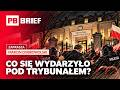
 ~7m20:14
Noc kryzysu konstytucyjnego. Prezydent w TK, starcia i groźba politycznego przesilenia PB BRIEF
Oct 31, 2026
Read: ~7m · You save: 13 min
Night of Constitutional Crisis: President at the Constitutional Tribunal, Clashes, and Threat of Political Upheaval
Night crisis at the Constitutional Tribunal: president at the entrance, judge suspended, legality disputes and zloty risks. Breaking down causes and consequences.
October 31, 2026
On the night of Friday into Saturday, events took place in Warsaw that may become one of the most important episodes in the recent history of Polish democracy. Below are the facts of what happened, the legal grounds of the dispute, and its history since 2015.
Historical Background
The Polish tradition of constitutional review begins long before the modern Constitutional Tribunal.
| Year | Event |
|---|---|
| 1578 | King Stefan Batory established the Crown Tribunal, the highest appellate body for the szlachta of the Kingdom of Poland |
| 1791 | The Commonwealth adopted one of the first modern constitutions in the world. No court existed to review whether laws conformed to the constitution |
| Interwar period | An institution of constitutional review was also not established in the Second Polish Republic |
| 1982 | The Constitutional Tribunal was established by the communist authorities during martial law |
| 1986 | The Tribunal began its judicial activity. Its independence was limited: the Sejm could reject its rulings that laws were unconstitutional |
| 1997 | The Constitution of 1997 enshrined the Tribunal's status. Its rulings became final and binding on all |
The constitutional court was meant to prevent any authority, including one with the strongest democratic mandate, from going beyond the limits set by the constitution.
What Happened on Friday and Overnight
Friday, 30 October 2026:
- Tribunal judge Anna Korwin-Piotrowska, elected by the Sejm, ordered the one-month suspension of Tribunal Chairman Bogdan Święczkowski (Świączkowskiego in the source) and his deputy Bartłomiej Sochański from their official duties. She considered that she had the right to replace the chairman.
- Świączkowski challenged both her authority and the decision itself.
- Prosecutor General Waldemar Żurek reported that five motions to lift the immunity of both judges had been submitted: four concerning Świączkowski and one concerning Sochański.
- Significant police forces, opposition representatives, and demonstrators arrived at the Tribunal building. Demonstrators had been keeping watch at the Tribunal for several months. Clashes broke out, and there were attempts to break through the barrier.
- Three people were detained.
- In Świączkowski's presence, a man with an angle grinder cut through the gate lock, trying to clear a path for him. Police blocked further progress.
President Karol Nawrocki:
- The president cut short his visit to Senegal and returned to Warsaw.
- Anna Korwin-Piotrowska initially refused him a visit to the Tribunal. She then proposed a meeting without escorts.
- After midnight, Karol Nawrocki arrived at Szucha Street. A scuffle broke out at the entrance involving the head of state. Video recordings show a physical confrontation. Each side accuses the other of provoking it.
- According to a published recording, upon entering the building, the president said to Anna Korwin-Piotrowska and others present: "You are not judges of the Constitutional Tribunal."
As of 2:00 a.m., the situation remained unresolved. It is not known what decisions will be taken or whether new clashes will occur.
Assessment of the Situation
Regardless of who initiated the physical confrontation, the appearance of such scenes involving the head of state is a serious event. The President of the Republic of Poland represents the state, and his authority matters beyond the country's borders.
The president's determination to defend the constitutional order is understandable if he considers it his duty. However, recordings of a physical confrontation around the head of state may weaken the image of Poland as a stable democracy. This is especially significant because world news agencies have already reported on events at the Tribunal.
A dispute over who may lead one of the key institutions, which ended in a physical clash at its entrance, makes it harder to perceive Poland as a state with strong and predictable institutions.
Origins of the Conflict: Autumn 2015
To understand the causes of the crisis, we need to go back to autumn 2015. At that time, the term of the Sejm was ending, a parliament in which Civic Platform and the Polish People's Party held the majority.
- The outgoing parliament elected five judges to the Tribunal. The terms of two of them were to begin only after the elections, during the work of the new Sejm.
- In December 2015, the Tribunal ruled that the basis for the election of three judges complied with the constitution, and that of the other two did not.
- In the autumn, power passed to the Law and Justice party. The new majority challenged the election of all five and appointed its own candidates, including three to seats that the previous parliament had filled properly.
- President Andrzej Duda did not administer the oath to the three previously elected judges. This gave rise to the dispute over "duplicate judges."
The outgoing majority did indeed exceed its powers regarding two seats. Law and Justice also challenged three elections whose legality the Tribunal had confirmed. This part of the conflict is often presented in a simplified way, so it is important to mention it.
Further developments:
- In 2016, the Law and Justice government refused to publish some of the Tribunal's rulings.
- Julia Przyłębska became the Chair of the Tribunal.
- In the following years, the Tribunal included, among others, Krystyna Pawłowicz and Stanisław Piotrowicz. Before their appointments, both were active politicians of Law and Justice.
- Past political affiliation does not prohibit someone from serving as a Tribunal judge. However, the selection of people closely tied to a single party reinforced doubts about the independence of the institution.
- In 2021, the European Court of Human Rights found that the participation of an improperly elected judge in considering cases violated the right to a tribunal established by law.
- After the 2023 elections, Donald Tusk's government announced its intention to restore the Tribunal. The change of power did not resolve a problem that had been building for many years.
- In December 2024, Bogdan Święczkowski became Chair of the Tribunal. Previously, he served as National Prosecutor, was one of the closest allies of Zbigniew Ziobro, and headed the Internal Security Agency. He is known for his tough style of work in the prosecutorial community; informally, he is called "Godzilla."
- In March 2026, the Sejm elected new Tribunal judges. The President administered the oath to two of them, and the rest took the oath in the Sejm. The former Tribunal leadership challenged their powers.
Legal Grounds of the Dispute
Anna Korwin-Piotrowska relies on the provisions on replacing the chair of the Tribunal with the judge who, by calculation, has the longest seniority. She also cites Article 130 of the law on the system of common courts. This article allows, in certain circumstances, the immediate suspension of a judge's activity for a period of no more than one month. In her view, these norms can be applied to the Tribunal by analogy.
Critics of the decision dispute:
- the competence of a judge to apply such a measure to the chair of the Tribunal;
- the assumption that she may perform the functions of the head of the Tribunal;
- the status of judges elected by the Sejm whose oath the President has not accepted.
Thus, within a single institution there are competing interpretations of the law, leading to entirely opposite conclusions about who may lead it. An institution designed to resolve disputes about the constitutionality of laws has itself become the subject of dispute, and its participants do not recognize each other's powers.
The debate includes grave accusations, including the accusation of a coup d'état. However, the legal qualification of events requires establishing specific actions, intentions, and the responsibility of individual persons in the course of judicial proceedings. Political accusations cannot substitute for such determinations.
Criminal Law Provisions
- Article 128 of the Criminal Code provides for imprisonment for actions directly aimed at the violent elimination of a constitutional body of the Republic of Poland. For the use of violence or unlawful threats to influence the official actions of such a body, the penalty is imprisonment from one year to 10 years.
- Article 135 of the Criminal Code establishes special protection for the President. For an active assault on the head of state, the penalty is imprisonment from three months to five years. For publicly insulting the head of state, the penalty is up to three years.
A scuffle at the entrance to the Tribunal does not in itself constitute an active assault. However, the disputed actions of the Tribunal's leadership do not automatically amount to an attempted coup d'état. The final legal classification will be determined by the courts.
The Role of the Tribunal in the System of Checks and Balances
The Constitutional Tribunal is one of the key elements of the separation of powers: legislative, executive, and judicial. It may:
- review the conformity of laws with the constitution;
- review constitutional complaints from citizens;
- resolve competence disputes between the central constitutional bodies of the state;
- assess the conformity of political parties' goals or activities with the constitution.
The Tribunal also ensures the continuity of state functioning. In cases provided for by the constitution, it may determine that the President is temporarily unable to perform his duties. The duties are then transferred to the Marshal of the Sejm.
Guarantees of the independence of Tribunal judges:
- Judges are elected for a term of nine years, without the right to be re-elected.
- They enjoy immunity and guarantees of independence.
- They may not be members of political parties.
- Their remuneration is under special protection.
These privileges are retained after the end of the term of office. The judge transitions to the status of a retired judge and receives an allowance of 75% of his last monthly remuneration, excluding the functional supplement. The amount is indexed together with changes in the remuneration of Tribunal judges. As a rule, this payment is made for life, with exceptions established by law.
A retired judge retains some of the guarantees associated with the status of a judge. At the same time, restrictions on political activity and additional employment, as well as disciplinary liability, continue to apply to him.
These guarantees are designed to enable judges to make decisions independently of the expectations of politicians. The key function of a constitutional court lies precisely in its ability to challenge a decision even of a very strong parliamentary majority.
International Context
G20 foreign ministers have gathered in Atlanta, Georgia, USA. Poland is represented at the meeting by Radosław Sikorski. The country is taking part in the talks at the invitation of the American presidency and is seeking a permanent seat at the table of the world's largest economies. Russia has already challenged Polish aspirations.
At the same time, Poland is negotiating with the United States on expanding the American military presence, including the possible creation of a new permanent base. The project may cost several billion dollars and carry strategic significance for the security of NATO's eastern flank for decades to come.
The domestic crisis coincided with a period when, just days before the US midterm elections, the capacity for political decision-making is limited. Poland seeks to strengthen the position of one of the United States' key partners in Europe. Meanwhile, global media report on a president who interrupted a foreign visit to return to a country embroiled in a dispute over its most important institutions.
At present, there is no basis for claiming that the events of this night have affected the position of American authorities or decisions regarding the military base. However, such events make it harder to strengthen the international authority of the Polish state. In diplomacy, not only economic strength and army size matter, but also the stability of institutions and the predictability of a partner.
Economic Consequences
The events took place on Friday, on the eve of All Saints' Day and ahead of the long weekend, so markets had time to partially react to the news before trading opened on Monday. This does not rule out a further reaction.
For comparison, the most significant currency declines linked to constitutional crises in recent times occurred in 2021 in countries with well-established democracies, such as Pakistan and Peru. Poland is in a fundamentally different situation. There are no grounds to predict a fall in the zloty on Monday.
However, a prolonged institutional crisis may raise the risk premium that investors demand for investing capital in the country. This could lead to pressure on the currency, rising bond yields, and greater caution among companies when planning investments. This is especially true in situations where the conflict calls into question the predictability of how law is made and applied.
Entrepreneurs and investors who make decisions about building factories, technology centers, and infrastructure must be confident that the existing rules will be observed in a few years' time as well.
Investors' reaction to the events in Warsaw will be revealed by trading on Monday.
Historical Parallels
In 2016, Jacek Zalewski, a columnist for Puls Biznesu, wrote about the consequences of the non-publication of the Tribunal's rulings and the significance of the conflict for international perceptions of Poland. Since then, questions about the impact of the constitutional crisis on trust in the state have arisen regularly.
A medieval analogy also illustrates the situation. During the Great Western Schism, the Church split between a pope and an antipope, and at some point it was no longer clear which of them was legitimate. The way out was found by convening a council, which deposed all the claimants and elected one.
Выводы
Конституционный спор в Польше затрагивает вопрос о том, кто имеет право толковать конституцию и защищать её. Сам по себе смена руководства Трибунала, новое распоряжение или политическое заявление о победе не решат проблему, которая накапливается с 2015 года.
Демократическое государство нуждается в институтах, законность и полномочия которых признаются большинством. Ему также нужны процедуры, которые действуют независимо от результатов очередных выборов, и доверие граждан к праву.
В демократии политические споры естественны. Конституция, в частности, существует для того, чтобы даже самые острые конфликты между властями разрешались без применения силы. В Польше же спор идёт о том, кто вправе толковать и защищать саму конституцию.
Если каждое новое парламентское большинство будет заново решать, кто является законным судьёй, кто руководит Трибуналом и чьи решения подлежат исполнению, кризис будет воспроизводиться и умножаться при каждых выборах. Поэтому, по оценке автора материала, для восстановления авторитета институтов и доверия к процедурам потребуется более широкое решение.
Introduction
Introduction and overview of the night crisis surrounding the Constitutional Tribunal.
- PB Brief episode from Saturday, October 31, hosted by Marcin Dobrowolski.
- The event is described as possibly one of the most important moments in the history of Polish democracy in almost 40 years.
- The episode covers what happened, the causes of the constitutional crisis, and its possible consequences.
Historical Background
A historical overview of the Constitutional Tribunal and its role.
- In 1578, King Stefan Batory established the Crown Tribunal as the supreme appellate court for the szlachta.
- In 1791, the Commonwealth adopted one of the first modern constitutions in the world, but there was no court to review laws.
- The Second Polish Republic did not create such a body either.
- The Polish Constitutional Tribunal was established in 1982 under martial law and began considering cases in 1986.
- Decisions of the Sejm could overturn the tribunal's findings that laws were unconstitutional.
- The 1997 Constitution gave the tribunal's rulings final and binding force.
Friday Events
Friday events: suspension of the chair's powers and clashes outside the Tribunal.
- On Friday, Anna Korwin-Piotrowska, a judge elected by the Sejm, imposed a one-month suspension of the powers of chair Bogdan Święczkowski and his deputy Bartłomiej Sochański.
- Święczkowski disputed her authority and her decision.
- Prosecutor General Waldemar Żurek filed five motions to lift immunity: four against Święczkowski and one against Sochański.
- Police, opposition politicians, and demonstrators were present at the Tribunal.
- Pushing occurred, and people attempted to break through the barrier.
- Three people were detained; a man with an angle grinder cut the gate lock while trying to help Święczkowski enter.
- President Karol Nawrocki cut short his trip to Senegal and returned to Warsaw.
Night at the Tribunal
Night events at the entrance to the Tribunal involving the president.
- Anna Korwin-Piotrowska initially refused the president a visit, then proposed a meeting without accompanying persons.
- After midnight, Nawrocki appeared on Szucha Street, and clashes involving the head of state occurred at the entrance.
- Both sides accuse each other of provoking the confrontation.
- According to the published recording, the president said: «Państwo nie jesteście sędziami Trybunału Konstytucyjnego».
- The presenter notes that responsibility for starting the confrontation has not yet been established.
Background of the conflict
Background of the conflict: the 2015 judicial elections and subsequent events.
- In autumn 2015, the outgoing Sejm (Civic Platform and the Polish People's Party) elected five judges, two of whom were due to take office after the elections.
- In December 2015, the Tribunal ruled that the election of three judges was constitutional and that of two was not.
- The new PiS majority challenged the election of all five and appointed its own candidates, including three for seats already lawfully occupied.
- President Andrzej Duda refused to swear in the three previously elected judges, sparking a dispute over the so-called 'duplicate judges'.
- In 2016, the PiS government refused to publish some of the Tribunal's rulings.
- Julia Przyłębska became the chair.
- Krystyna Pawłowicz and Stanisław Piotrowicz, former active PiS politicians, joined the Tribunal.
- In 2021, the ECHR found that the participation of a wrongly elected judge violated the right to a tribunal established by law.
- After the 2023 elections, Donald Tusk's government promised to fix the Tribunal, but the problem was not resolved.
- In December 2024, Bogdan Święczkowski, a former national prosecutor and former head of the internal security service, and a close ally of Zbigniew Ziobro, became chair of the Tribunal.
Legal Arguments
Judicial elections in March 2026 and the legal arguments of the parties.
- In March 2026 the Sejm elected new judges; the President administered the oath to two of them, and the rest took the oath in the Sejm.
- Judge Korwin-Piotrowska relied on the rules that the chair is replaced by the judge with the longest service.
- She also cited Article 130 of the law on common courts, which allows suspending a judge's activity for a maximum of one month.
- Critics dispute her competence and her ability to head the Tribunal.
- The status of judges elected by the Sejm without the President's oath remains disputed.
- Debates include accusations going as far as a coup d'état.
Criminal Law Aspect
Criminal articles and legal consequences of violence against state bodies and the head of state.
- Article 128 of the Criminal Code provides for imprisonment for actions aimed at forcibly eliminating a constitutional body.
- Using violence or an unlawful threat to influence bodies is punishable by 1 to 10 years in prison.
- Article 135 provides for 3 months to 5 years for an active attack on the head of state.
- Public insult of the head of state is punishable by up to 3 years.
- The host believes that the clash that occurred does not by itself prove an active attack and does not mean an attempted coup; establishing the facts is possible only during the trial.
Role of the Tribunal
The Tribunal's role in the system of checks and balances and the status of its judges.
- The Tribunal resolves issues of law compliance with the Constitution, reviews constitutional complaints from citizens, and hears competence disputes between central state bodies.
- It assesses whether the goals and activities of political parties comply with the Constitution.
- It may determine the temporary inability of the president to perform duties and transfer the functions to the Marshal of the Sejm.
- Judges are elected for 9 years without the right to re-election, enjoy immunity, and may not belong to political parties.
- After the term ends, a judge receives 75% of the last monthly remuneration without the functional allowance, for life, with exceptions established by law.
International Context
International context: G20 meeting, negotiations over a US base, and Poland's perception.
- The G20 foreign ministers' meeting is taking place in Atlanta (Georgia, USA); Poland is represented by Radosław Sikorski.
- According to the host, Russia has already challenged Polish ambitions.
- Poland is negotiating with the US over expanding its military presence, including a possible permanent base worth several billion dollars.
- The host notes that the domestic crisis coincides with the election week ahead of the US midterm elections (midterms).
- The host claims that the events did not affect US decisions but may weaken Poland's international authority.
Economic Consequences
Economic risks: the zloty, risk premium, and investor confidence.
- The event happened on Friday before All Saints' Day; markets work more calmly on weekends, which gives time to absorb the shock.
- The host cites Pakistan and Peru, where constitutional crises in 2021 caused sharp currency declines.
- According to the host, Poland is in a fundamentally different situation.
- A prolonged institutional crisis may raise the risk premium, bond yields, and caution among entrepreneurs.
- On Monday it will be shown whether investors attach significance to the events in Warsaw.
Conclusions and a Call to Action
Historical parallel and a call for procedures recognized by all sides.
- In March 2016, Jacek Zalewski, a feuilletonist for Puls Biznesu, wrote about the consequences of the non-publication of Tribunal rulings.
- The host notes that the conflict has been going on for 11 years.
- To get out of the crisis, institutions whose legality is recognized and procedures that operate independently of elections are needed.
- The host calls for a broad solution, otherwise the crisis will be reproduced with each new majority.
Announcement and Conclusion
Announcement of the PB Out of the Box podcast and the end of the episode.
- A new episode of PB Out of the Box comes out on Saturday on Spotify, YouTube and pb.pl.
- The episode's topic is the funeral market; guest Mirosław Konkel, majority shareholder of the Klepsydra group.
- The announcement is repeated twice in the text; the episode also featured a historical analogy about the Great Western Schism.