
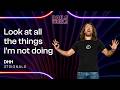
DHH's Opening Keynote at Rails World 2026
DHH on the AI revolution: why manual coding is obsolete and the future lies in managing intelligence. Historical parallels and a call for optimism.
Introduction to the Era of "AI Delirium"
David Heinemeier Hansson (DHH) opened the Rails World 2026 conference in Austin, Texas, declaring the advent of the most exciting era in the history of computing. He termed this state "AI Delirium" or "AI Euphoria," highlighting the unprecedented progress achieved through artificial intelligence. However, he also acknowledged the natural anxiety associated with future uncertainty, comparing the current situation to historical technological shifts.
Historical Parallels: From Painting to Photography
DHH drew parallels with the past, starting with 18th-century portrait painting. He described the process of creating a portrait as laborious and expensive, accessible only to the elite. For example, Sir Joshua Reynolds's portrait of Lady Waldegrave, painted in 1781, required months of the artist's work and was rejected due to a "scandalous" exposed ankle. This highlights the limitations and subjectivity of early technologies.
The advent of photography in the 19th century, and later the mass production of the Kodak Brownie camera in 1900, democratized the image-making process. This forced artists like Laurits Tuxen (DHH's great-grandfather) to seek new forms of self-expression, leading to the flourishing of Impressionism and Cubism. DHH noted that his great-grandmother, Yvonne Tuxen, is depicted in Tuxen's 1888 painting.
The Revolution of Photography and the Digital Age
In the 20th century, photography evolved from a costly process to a ubiquitous phenomenon with the advent of digital cameras and smartphones. While the DHH family took only a few childhood photos in the 1980s, by 2026, approximately 2 trillion photos will be created annually. This exponential growth has been driven by the decreasing cost and friction associated with using the technology.
Opus 4.5: The "Kodak Brownie" of the AI Era
DHH dubbed the release of Opus 4.5 on November 24, 2025, as "the Kodak Brownie" of our era. This event democratized AI technology, ushering in a new age of software development in partnership with artificial intelligence. He emphasized that this moment marked a watershed, dividing history into "before" and "after."
Ups and Downs: From Euphoria to Disappointment and Back
Following an initial surge of enthusiasm surrounding the availability of open AI models, a period of "disappointment tunnel" (February-May 2026) ensued, where new models seemed less advanced. However, the release of Fable 5 and Mythos in June 2026 dispelled these concerns, demonstrating continued exponential growth in AI capabilities. DHH noted that models like GPT-6 Astra and DeepSeek-4-1 Flash, released in September 2026, confirmed this trend.
The 100x and 1000x Programmer: A New Reality
DHH has revisited the concept of the "10x programmer," first proposed in 1968. He argues that with the advent of AI tools, the difference between the worst and best programmer now stands at 100x, and possibly 1000x. He shared his personal experience: over the past 20 months, he has written half as much code as he did in the previous 21 years, yet he has been able to implement all his ideas. This has been possible because he no longer writes code manually but uses AI agents.
Abandoning Manual Coding and Moving to Native Applications
37signals, DHH's company, has decided to abandon manual coding as a standard practice. It is now an exception, requiring an investigation into the reasons why the agent failed to complete the task. DHH demonstrated how a team of designers, using AI, created new features for Basecamp 5, but this led to architectural problems. He concluded that the main question today is how to make the most of AI's capabilities.
The Era of Native Apps and Rust on the Backend
DHH announced that Hey, 37signals' email app, will cease to be a web application and will be rewritten as six native applications. This has been made possible by AI, which allows for the creation of high-quality native applications without the need for manual coding. For the backend, Hey has chosen Rust, a language that DHH considers "ugly" but incredibly efficient when used by AI. This has led to a 99% reduction in CPU consumption and a 95% reduction in memory usage.
Asynchronous Interaction with Agents and the Future of the Web
DHH emphasized that the best way to interact with AI agents is asynchronously, similar to communicating with a colleague rather than in a chat mode. He also noted that the web remains an important platform, especially for applications that do not require installation. Rails, with its "convention over configuration" principles and focus on a single developer, is ideally suited for this era.
A New Development Paradigm: English as a Programming Language
DHH stated that he has found a programming language he likes more than Ruby – it's English. He believes that writing programs in English has become more satisfying and expressive, albeit less deterministic. He admitted that he has moved away from the role of a professional programmer, shifting to the role of a "creator of things" using AI.
Omarchy: The Operating System of the Future
DHH introduced Omarchy, an AI-built operating system that he claims surpasses anything he has used before. He demonstrated Omarchy's installation speed of 35 seconds, and 9 seconds under laboratory conditions. He also showed examples of AI-generated applications: a calculator, a text editor, a video editor, and a new presentation software called "Hype," which is only half a megabyte in size.
Optimism vs. Pessimism: A Look into the Future
DHH acknowledged concerns surrounding AI but urged for optimism. He compared the current situation to the advent of ATMs, which, contrary to predictions, did not lead to mass unemployment among tellers but rather contributed to the growth of bank branches. He also drew a parallel with the atomic bomb, which, despite fears, led to the development of nuclear energy. DHH called for embracing the future with enthusiasm, emphasizing that the "black pill" (pessimism) is for losers, while the "white pill" (optimism) is for those ready for change.
Computer Reformation and the Role of the Programmer
DHH stated that AI agents will lead to a "computer reformation," decentralizing the "clergy" (experts) and enabling everyone to become a programmer. He urged programmers to embrace this new reality, leverage their knowledge and skills to build amazing things, and steer intelligence that was recently only available in science fiction. He emphasized that this is the biggest event in computing history and called for everyone to embrace it with enthusiasm and acceleration.
Introduction: The Excitement and Uncertainty of the AI Era
DHH kicks off by welcoming attendees to Rails World 2026 in Austin, expressing excitement about the current moment in technology, especially in AI. He introduces the terms 'AI psychosis' and 'AI delirium/euphoria,' describing mixed feelings of excitement and some nervousness due to the uncertainty of the future.
- Welcome to Rails World 2026 in Austin.
- Expressing excitement about the current moment in AI development.
- Introduction of the terms 'AI psychosis' and 'AI delirium/euphoria'.
- Description of mixed feelings of excitement and nervousness due to AI's uncertain future.
Historical Parallels: From Painting to Photography
DHH draws a historical parallel, comparing the advent of AI to the photography revolution. He talks about 18th-century portrait painting, its exclusivity and laboriousness, and then the emergence of the camera and mass photography (Kodak Brownie), which led to a change in the role of artists and an explosion of creativity (Impressionism, Cubism).
- Comparison of the AI era with the photography revolution.
- Description of 18th-century portrait painting: exclusivity, laboriousness.
- Emergence of the camera and mass photography (Kodak Brownie).
- Change in the role of artists and the emergence of new art forms (Impressionism, Cubism).
The Evolution of Photography: From Film to Digital Ubiquity
DHH continues his historical excursion, noting that after the advent of the camera, progress in photography was slow until the end of the 20th century. He describes how the digital revolution and the emergence of smartphones made photography ubiquitous and almost free, leading to an exponential increase in the number of photos.
- Slow progress in photography after the advent of the camera until the end of the 20th century.
- The digital revolution and smartphones made photography ubiquitous.
- Exponential growth in the number of photos due to reduced cost and accessibility.
The AI Revolution: From Accessibility to Exponential Growth
DHH declares November 24, 2025 (Opus 4.5 release) the "Kodak Brownie of our era," the moment AI became widely accessible. He describes the subsequent explosion of new AI forms and formats, the euphoria of open models, a brief "trough of disillusionment," and the subsequent rapid development (Fable 5, Mythos, GPT-6 Astra, DeepSeek-4-1 Flash).
- November 24, 2025 (Opus 4.5) is the "Kodak Brownie" of the AI era.
- AI becomes widely accessible.
- An explosion of new AI forms and formats.
- A brief "trough of disillusionment" followed by rapid model development.
AI and Programmer Productivity: The 100x Revolution
DHH discusses the impact of AI on programmer productivity, comparing it to the concept of the '10x programmer'. He argues that the difference between the worst and best programmers with AI tools can reach 100x or even 1000x. He shares his personal experience, stating that he has written half as much code manually in the last 20 months compared to the previous 21 years, emphasizing the productivity revolution.
- The concept of the '10x programmer' and its evolution.
- AI tools increase the productivity gap between programmers to 100x-1000x.
- DHH's personal experience: half the manual code in the last 20 months compared to 21 years prior.
- Emphasis on the developer productivity revolution.
The End of Manual Coding: A New Reality
DHH returns to his 2005 talk about the code he *doesn't* write and contrasts it with the current reality where he writes almost no code manually, yet achieves all goals. He declares that 37signals is stopping writing code manually as a regular practice, seeing it as a sign that something has gone wrong. He notes that most people in the audience are no longer writing code manually weekly.
- Return to the theme of "code I don't write" from the 2005 talk.
- Current situation: almost complete absence of manual code writing.
- 37signals' decision to stop manual code writing as the norm.
- Most attendees no longer write code manually weekly.
From Web Apps to Native: AI as a Catalyst
DHH discusses a failed attempt to use AI for the final touches of Basecamp 5, which led to architectural issues. He concludes that the main question is how to best leverage AI. He announces the shift from web applications to native applications for Hey, as AI has made native app development nearly free, showcasing examples of native apps for Hey and the Shop app.
- Failed experience using AI for the final touches of Basecamp 5.
- The main question: how to best leverage AI.
- Transition from web applications to native applications for Hey.
- AI has made native app development nearly free.
- Examples of native apps for Hey and the Shop app.
Rust and AI: Efficiency Through Division of Labor
DHH expresses his dislike for the Rust language but acknowledges its value for AI agents due to its efficiency. He describes how rewriting Hey's frontend into native applications and using Rust for the backend led to a radical reduction in resource consumption (CPU, memory). He emphasizes the division of labor: AI writes in Rust, and humans don't see this code.
- DHH's dislike for Rust, but recognition of its efficiency for AI.
- Rewriting Hey's frontend into native applications.
- Using Rust for the backend led to a 99% reduction in CPU consumption and 95% in memory.
- Division of labor: AI writes in Rust, humans don't see the code.
The Future of Ruby and Rails in the AI Era: Asynchronicity and New Paradigms
DHH discusses working with AI agents, recommending an asynchronous approach over chat interfaces. He notes that the AI era began only a few months ago, and we are just learning to work with this technology. He questions the future of Ruby and Rails, suggesting that for some applications (like Hey), the future is native frontends and Rust on the backend, but the web platform will remain important.
- Recommendation of an asynchronous approach when working with AI agents.
- The AI era began recently (less than a year ago).
- The future of Hey: native frontends and Rust on the backend.
- The web platform will remain important for many applications.
Rails and AI: Advantages and New Development Approaches
DHH emphasizes that Rails is well-positioned for the AI era due to its 'convention over configuration' principles and focus on the solo developer, which enhances token efficiency. He mentions that AI agent tests for Rails show high results and warns developers not to be too prescriptive, but to use a 'beginner's mind' when working with AI.
- Rails is well-positioned for the AI era (convention over configuration, solo developer focus).
- Increased token efficiency.
- High results from AI agent tests for Rails.
- Warning: don't be too prescriptive, use a 'beginner's mind'.
AI Black Box and the Future of Web Applications
DHH shares his experience with Rust, which he doesn't know, but considers it an advantage, allowing him to treat it as a black box and evaluate only the result. He compares this to how businessmen hire programmers. He also talks about how web applications will remain important for applications requiring quick setup and availability for ephemeral clients.
- Working with Rust as a black box without knowing the language.
- Comparison with businessmen hiring programmers.
- Web applications will remain important for quick setup and ephemeral clients.
English as the New Programming Language: DHH's Personal Experience
DHH notes that his work has changed significantly over the past year: the share of Ruby in his code has dropped from 50% to 3%. He writes significantly more code (150,000 lines in August versus 30,000 a year earlier), although most of it is verbose Rust. He admits that he has found a programming language he likes more than Ruby – English, and describes programming in English as a satisfying experience.
- Drastic reduction in the share of Ruby in DHH's work (from 50% to 3%).
- Significant increase in the volume of code written (150,000 lines per month).
- Recognition of English as the best programming language.
- Programming in English as a satisfying experience.
Farewell to Hand-Coding: A New Era of Creators
DHH announces he stepped away from professional programming about 4-5 months ago, having spent a quarter-century hand-coding. He urges viewing this with joy, not regret, as hand-coding is no longer economically productive. He foresees a new career as a "thing creator," where the main task is managing intelligence.
- DHH's departure from professional programming.
- A quarter-century of hand-coding.
- Hand-coding is no longer economically productive.
- New career: "thing creator," managing intelligence.
Rethinking Software Architecture and Development Methodologies
DHH compares the current moment to the advent of the internet but believes the current shift is much larger. He argues that traditional approaches to software architecture based on abstractions are losing their meaning in the AI era, as the cost of code repetition has become almost zero. He invites listeners to participate in defining new development methodologies.
- The current technological shift is larger than the advent of the internet.
- Abstractions in software architecture are losing their meaning in the AI era.
- The cost of code repetition has become almost zero.
- An invitation to participate in defining new development methodologies.
CLI as the Interface of the Future: Personal Butlers Instead of Chatbots
DHH criticizes the idea of embedding chatbots into applications, suggesting instead the use of CLIs for interacting with applications via AI assistants ("personal butlers"). He demands that all applications have a CLI by next Friday, demonstrating examples of using the CLI for searching in Hey, which finds information by concepts rather than keywords.
- Criticism of embedding chatbots into applications.
- Suggestion to use CLIs for interacting with AI assistants.
- Demand for CLIs in all applications.
- Example of concept-based search in Hey using CLI.
Omarchy and App Creation: Speed, Ease, and Optimization
DHH talks about his project Omarchy – an operating system that can be installed in 35 seconds (or even 9 seconds in a lab). He compares this to the past when applications were slow and cumbersome, and now optimization has become accessible. He demonstrates how easy it is to create applications (calculator, text editor, video editor, presentation software) using AI, even without knowing the relevant programming languages.
- Omarchy project: OS installable in 35 seconds (or 9 seconds).
- Comparison to slow and cumbersome applications of the past.
- Ease of creating applications (calculator, editor, presentation software) using AI.
- Ability to create applications without knowing the relevant programming languages.
Optimism vs. Pessimism: The Future of AI and Humanity
DHH acknowledges concerns about AI but considers them exaggerated. He draws parallels with the advent of ATMs, which did not lead to mass unemployment but instead created new jobs. He calls for optimism ('P-Bloom') rather than pessimism ('P-Doom'), comparing the current situation to the invention of the atomic bomb, which led to nuclear energy. He emphasizes that humanity is capable of correcting mistakes and inventing technologies to solve problems (e.g., safety).
- Concerns about AI are exaggerated.
- Parallel with ATMs: creation of new jobs.
- Call for optimism ('P-Bloom') instead of pessimism ('P-Doom').
- Comparison with the atomic bomb: advent of nuclear energy.
- Humanity is capable of correcting mistakes and inventing technologies to solve problems.
Optimism as the Only Strategy: The Future Belongs to Creators
DHH references Jevons' paradox and the ATM example, arguing that no one can predict the future. He calls for full optimism, as utopia is near. He compares AI to the Reformation, which 'disintermediates' the 'clergy' (programmers) class, allowing anyone to create programs. He urges embracing the future with enthusiasm, like children do, and to 'take the white pill' of optimism.
- Jevons' paradox: no one can predict the future.
- Call for full optimism: utopia is near.
- AI as the Reformation, disintermediating the programmer class.
- Call to embrace the future with enthusiasm, like children.
- 'Take the white pill' of optimism.