
 ~7m17:01
Once You Reach This Net Worth, Money Stops Mattering In Retirement
Nov 1, 2026
Read: ~7m · You save: 10 min
Once You Reach This Net Worth, Money Stops Mattering In Retirement
Ever wondered when you have enough for retirement? Learn the three-number math that reveals your personal finish line and why extra millions may not change much.
A financial adviser with 15 years of experience has observed households add an additional $1 million to their retirement savings with little change in their daily lives. The adviser argues that a specific net worth exists beyond which additional money no longer materially improves retirement. This threshold is likely lower than most people expect. The adviser also states that the threshold can be calculated with mathematics.
Money does not stop mattering entirely. Households always need income to cover living costs. The point at which money stops mattering is the point beyond which each additional dollar no longer changes how a household lives or how secure its plan is.
Why the Finish Line Is Rarely Identified
Most people do not know where their threshold lies. The adviser observes that many households above the threshold continue to work and worry about money. Some households below it report high levels of calm and comfort. In the adviser's experience, the most anxious clients were often above their threshold, while some of the most comfortable clients were below it.
The industry commonly frames retirement as an endless accumulation process, with the message that saving more and growing assets is always better. The adviser contends that the accumulation side of the financial profession has little incentive to tell clients they have enough. Compensation tied to assets under management does not reward that message. The adviser attributes this outcome to the business model rather than to individual bad intent.
Once a household passes its threshold, the planning question changes. Households stop asking whether they have enough. They start asking whether their plan is built correctly. The adviser describes this as a different and more enjoyable type of work.
Diminishing Returns in Retirement Savings
The adviser applies the economic concept of diminishing returns to retirement savings:
- Early dollars fund survival, including housing, food, and basic needs.
- Middle dollars fund comfort and security, including travel, a financial cushion, and confidence in long-term stability.
- Dollars beyond the threshold change neither lifestyle nor plan security in a meaningful way.
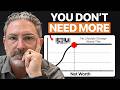
When plotted, lifestyle and plan security rise quickly at first. The curve then flattens. The adviser states that the flat portion is the focus of the analysis.
Three Numbers That Define the Threshold
The threshold is derived from three inputs:
- Real annual spending. This figure comes from actual annual outflows shown on bank and account statements.
- Guaranteed income floor. This figure equals Social Security benefits plus any pension income.
- The gap. The gap is the difference between annual spending and the guaranteed income floor. The portfolio must cover this gap, which is the only income requirement assigned to the portfolio.
Worked Example
The adviser illustrates the method with a hypothetical couple.
| Item | Amount |
|---|---|
| Annual spending | $96,000 |
| Annual Social Security income (combined) | $42,000 |
| Gap the portfolio must cover | $54,000 |
| Portfolio range at sustainable withdrawal rates supported by research | 1.8 million |
| Comfortable threshold after adding margin | 2.2 million |
The adviser states that a sustainable withdrawal rate applied to the gap points to a portfolio between 1.8 million. A complete plan requires additional margin for health care costs, poor market conditions, and unexpected events. After adding this margin, the comfortable threshold for this household falls between 2.2 million.
Comparing Portfolio Sizes
The adviser compares the threshold portfolio with a larger portfolio held by the same household. The illustration assumes the portfolio grows only at the rate of inflation, with no real growth.
- At 54,000 annual gap for about 40 years.
- At $3.2 million, the portfolio covers the same gap for about 59 years.
The difference of roughly 19 years reflects the additional $1 million. The adviser notes that this comparison is a simplified thought experiment. Real markets do not move in a straight line, and a poor market period early in retirement can affect outcomes more than the long-run average return. Taxes also reduce available funds. The adviser states that dividing an account balance by annual spending does not constitute a plan. A complete plan must be stress-tested against some of the worst market periods in history.
Both portfolio levels in this example fall on the flat portion of the curve. The additional $1 million moves the household further along a plateau that has already leveled off. The adviser concludes that the extra million likely costs years of work and provides almost no difference that the household would notice day to day.
Starting With Spending
The adviser's process begins with spending rather than with a target portfolio size. The process includes:
- Reviewing approximately 12 months of actual outflows from the client's checking account.
- Obtaining real Social Security projections.
The adviser describes the threshold as a probability statement rather than a fixed number. It marks the point at which a plan's probability of success stops improving in a meaningful way despite additional savings.
The adviser states that pushing success probability from very high levels toward certainty usually costs more than it is worth. The adviser objects to the probability dial, a common planning output, because clients often expect it to read 100%. The adviser states that a 100% reading indicates either that the client is working more years than necessary or that the client will underspend in retirement.
Four Factors That Move the Threshold
The adviser identifies four factors that determine where an individual's threshold lies.
- Spending. Spending has the largest effect. A household spending 12,000 per month can have thresholds more than $1 million apart.
- Income floor. A strong pension or two Social Security benefits reduce the portfolio's required role. Some households reach their plateau at portfolio levels that would appear inadequate by common public benchmarks.
- Retirement timing. Retiring at age 55 requires savings to support 12 more years than retiring at age 67. Timing therefore shifts the threshold.
- Flexibility. A household with low fixed costs and a large share of discretionary spending, such as travel, hobbies, and gifts, reaches its plateau earlier than a household whose budget is fully committed. Fixed costs must be paid regardless of circumstances, while discretionary spending provides room to adjust.
Using Personal Numbers
The adviser cautions against adopting another person's figure. Such figures may come from online forums, acquaintances, or media headlines. The adviser identifies this as a common way people work longer than necessary while pursuing someone else's goal.
Knowing one's own threshold protects against two errors:
- Working past the threshold out of fear, without having examined one's financial position.
- Stopping short of the threshold out of unwarranted optimism, again without examination.
The adviser recalls a client with about $2 million who was told they had passed their threshold. The client responded that a friend with a similar balance still had to work. The adviser explains that the two households differed in critical ways. One household had its home paid off and received pension income. The other did not. Both portfolios and thresholds therefore differed substantially.
The adviser states that the more useful question is what a household's financial situation looks like in full. Reviewing that situation makes it possible to determine the household's own threshold, which the adviser describes as a step that almost no one takes.
Anxiety Above the Threshold
The adviser states that households often assume worry will decline as assets grow. The adviser observes the opposite in practice. Households well above their thresholds check markets daily and still hesitate over spending they can clearly afford.
The adviser explains that a balance without a plan provides no reference point. If a household has never defined what "enough" means, no amount will feel sufficient.
The adviser also reports that some clients with modest assets feel fully secure. These clients know their plan supports their lifestyle, and they accept that position. The adviser concludes that security comes from a plan that has been tested, not from a specific amount of money.
According to the adviser, after a portfolio is well structured, spending decisions have a greater effect on retirement security than investment selection. Once a household knows how much it can safely spend, everyday decisions, such as dining out or taking a special trip, become less stressful.
Guardrail Spending
The adviser's Modern Guardrails system provides a probability-based assessment of whether a plan remains on track. The system is designed for households within five years of retirement.
The process works as follows:
- Before retirement, the household reviews how its guardrail spending level is developing for the planned retirement date.
- Boundaries are set. The upper and lower boundaries are based on how the plan is actually tracking.
- After retirement, monthly income remains steady. The plan's risk is evaluated every month, so the household does not need to monitor it directly.
- Upper guardrail. If the plan moves sufficiently ahead of its target, the upper guardrail signals that discretionary spending may increase without guilt.
- Lower guardrail. If the plan shows more risk than acceptable, the lower guardrail signals a modest, temporary reduction in discretionary spending. The aim is to keep lifestyle within an acceptable range.
Time as the Remaining Resource
Once the money question is answered, time determines how satisfying retirement is. Healthy, active years follow the individual's own schedule, and that schedule is independent of portfolio size.
The adviser considers trading additional active years for money that will not be needed to be the poorest trade people make once they pass their threshold. The adviser reports observing clients weigh more money against more years to enjoy. Measuring one's financial position and personal threshold provides the evidence most people need before they can relax.
The adviser states that people who continue working because they enjoy their work have a legitimate reason to do so. Continued work driven only by the absence of a defined finish line is the outcome the adviser seeks to address.
Summary of the Approach
The adviser identifies three elements required to begin identifying a threshold:
- Approximately 12 months of actual spending, drawn from account statements.
- Social Security projections.
- A realistic retirement date.
Identifying the gap that the portfolio must cover provides a starting estimate of the threshold. The adviser states that this estimate is only a starting point. A general analysis cannot account for an individual's taxes, health, or budget flexibility. Each of these factors must be tested against the household's own circumstances and against historically severe market conditions.
Once the threshold is identified, the central question changes from whether there is enough money to how time should be spent.
Introduction: The Retirement Finish Line
Many people never learn where their retirement finish line is, so they keep working and worrying regardless of wealth.
- The speaker has watched households add an extra million dollars to retirement savings with little change in their lives.
- After 15 years working with people on both sides of the threshold, the most anxious people are often above it and the calmest are often below it.
- The finish line is rarely marked by the financial industry, which has little incentive to tell people they have enough.
Diminishing Returns and the Flat Part of the Curve
Money stops mattering past a threshold, and the flat part of the diminishing-returns curve is where additional wealth adds little.
- Money never completely stops mattering; past a certain point, additional money stops changing lifestyle and plan safety.
- The industry typically frames retirement as an endless race to save more.
- First dollars buy survival, middle dollars buy comfort and security, and dollars past the threshold change nothing about daily life.
- The speaker refers to the industry's business model as the 'Wall Street system'.
Shifting from Accumulation to Plan Design
Once past the line, the question shifts from 'do we have enough' to 'is our plan built right'; a couple past their line for two years gradually phased down work.
- A couple was past their line for 2 years when their numbers were run.
- They did not quit immediately but started phasing into retirement over a period whose length was not specified.
- Their feelings about work relaxed significantly, which was described as a major change.
The Three-Number Calculation
The threshold comes from three numbers: real annual spending, guaranteed income floor, and the gap between them that the portfolio must cover.
- Number one: real annual spending, pulled from real statements.
- Number two: guaranteed income floor, which is Social Security plus any pension.
- Number three: the gap between spending and income floor, which is the only job the portfolio has.
- The speaker's process starts with about 12 months of what actually left the checking account and real Social Security projections.
Worked Example: A Couple's Threshold
For an example couple, a $54,000 gap implies a $1.4-1.8 million portfolio, and about $2-2.2 million with margin; $3.2 million offers only about 19 extra years.
- Couple spending: $96,000 per year.
- Combined Social Security: about $42,000 per year.
- Income gap for the portfolio: $54,000 per year.
- Sustainable withdrawal range implies a portfolio of about 1.8 million.
- With margin for health care, bad markets and surprises, the comfortable threshold is about 2.2 million.
- At 54,000 gap is covered for about 40 years if the portfolio only keeps pace with inflation.
- At $3.2 million, the gap is covered for about 59 years under the same assumption.
- Real markets are not linear, early bad returns matter, and taxes apply; plans should be stress tested against the worst markets in history.
Threshold as a Probability Statement
The threshold is a probability statement; pushing success odds from very good toward perfect costs more than it is worth, and the probability dial is misleading.
- The threshold is the point where plan success odds stop improving meaningfully.
- The speaker's process starts with discussing spending rather than the number.
- A 100% reading on the probability dial implies working more years than needed or underspending in retirement.
- The speaker hates the probability dial because people misinterpret it and want 100%.
- A white paper on the 'modern guardrail system' is referenced, with a link in the description.
Four Factors That Move Your Line
Four factors move a household's line: spending, income floor, retirement timing, and flexibility of discretionary spending.
- Spending moves the line most; households at 12,000 per month can differ by more than a million dollars in threshold.
- Income floor is the second lever: a strong pension or two Social Security checks shrinks the portfolio's job.
- Retiring at 55 versus 67 means money must carry 12 more years, moving the line.
- Flexibility: lower fixed costs and more discretionary spending (travel, hobbies, gifts) lead to an earlier plateau.
- Fixed costs must be paid regardless, while discretionary spending gives room to breathe.
Know Your Own Line
Use the example as a template only; chasing someone else's number leads to unnecessary work. Knowing your own line protects against both over-grinding and under-saving.
- Do not chase numbers from forums, neighbors, or headlines.
- Knowing your own line protects against grinding past it out of fear and stopping short out of optimism.
- A client with about $2 million was told they were past their line but compared themselves to a friend; their situations differed in house ownership and pension income.
- The better question is what the financial story looks like.
Worry, Plans, and Spending Decisions
Crossing the line does not automatically remove worry, because without a defined plan no amount feels like enough; a tested plan brings security, and spending decisions matter most.
- Many households past their threshold still check markets daily and hesitate on affordable spending.
- Without a plan defining 'enough', no balance feels sufficient.
- People with modest numbers who have a tested plan often feel completely secure.
- Security comes from a plan that has been tested, and everyday spending decisions protect retirement more than investment performance.
The Modern Guardrails System
The Modern Guardrails system gives a probability-based view with upper and lower spending boundaries, reviewed monthly, starting within 5 years of retirement.
- People within 5 years of retirement can see how guardrail spending is shaping up.
- They set upper and lower boundaries based on how the plan is tracking.
- Monthly income stays steady after retirement; plan risk is evaluated monthly.
- Upper guardrail: when the plan is far enough ahead, it permits increasing discretionary spending without guilt.
- Lower guardrail: when risk is too high, a modest temporary cut to discretionary spending is indicated, staying within an acceptable lifestyle range.
- The white paper explaining setup is linked in the description.
Time Becomes the Scarce Resource
Past the threshold, time replaces money as the scarce resource, and trading healthy years for unneeded money is considered the worst trade.
- Healthy, active years run on one's own clock, which does not care about portfolio balance.
- Trading more years for money one will never need is described as the worst trade people make.
- The speaker has seen people wrestle with more money versus more summers to enjoy.
- People often need proof before they can relax; measuring the financial story and personal line provides it.
Building Your Own Starting Point
Three steps build a starting point: 12 months of real spending, Social Security projections, and an honest retirement date; a video cannot account for taxes, health, or flexibility.
- Three components: 12 months of real spending from statements, Social Security projections, and an honest retirement date.
- Finding the gap the portfolio must cover gives a start on the number and the line.
- A video cannot see taxes, health, or budget flexibility, which must be tested against one's own life and the worst markets in history.
- A free training link is offered in the description for the framework used with clients.