
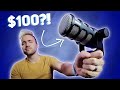
This Microphone May Be the Best Streaming/Podcast Mic You Can Buy for $100
We compare the $100 RODE Podcaster with the $400 Shure SM7B: sound, isolation, equalizer, and takeaways for streamers. Is it worth paying more?
Publication date: October 11, 2019
Purpose of the review: to compare inexpensive microphones with more expensive models and determine whether costly streaming equipment can be replaced with a more affordable option without a noticeable loss in audio quality. The author, Harris Heller, tests this hypothesis using the $100 Rode Podmic dynamic microphone as an example.
Typical Configuration and Its Cost
One of the popular setups for streaming includes:
| Component | Model | Cost |
|---|---|---|
| Microphone | Shure SM7B (dynamic) | 400 dollars |
| Amplifier | Cloud Lifter | 150 dollars |
| Audio interface | Go XLR | 400 dollars |
The author notes that when using the Go XLR, the Cloud Lifter is not needed, since the interface provides sufficient gain. By his estimate, dropping the Cloud Lifter saves 450 dollars. Switching to the Go XLR Mini, whose release was expected next month, yields savings of 600 dollars.
Microphones Compared
- Rode Podmic: dynamic, $100.
- Shure SM7B: dynamic, $400.
- Electro-Voice RE20: dynamic, $450. Mentioned as another reference dynamic microphone.
- Blue Ember: condenser, $100.
- Kiwi condenser microphone: used by the author in their own stream.
- Shure SM58: dynamic vocal microphone for live performances.
- Samson Q2U: a microphone mentioned among popular options.
- AT2020, AT2035, Blue Spark: condenser models that viewers often choose.
According to the author, they previously compared a 100 microphone, and a $2,000 microphone. The results of that comparison are published in a separate video, which the author references.
Conclusion for Condenser Microphones
The author believes that when streaming on Twitch, where audio and video signals are heavily compressed, microphones costing over 100 under comparable conditions.
Differences Between Condenser and Dynamic Microphones
According to the author's description:
- Condenser microphone captures detail and sensitivity better. It is used in studios with full control over acoustics and background noise.
- Dynamic microphone provides better isolation. It captures primarily the sound source rather than the surrounding space. Such microphones are used at concerts so that the presenter's microphone does not pick up the entire orchestra.
A dynamic microphone suits streamers if there is a lot of extraneous noise in the room, such as keyboard clicks, mouse clicks, or echo. In addition, according to the author's assessment, the dynamic microphone has a denser "radio-style" sound. He describes the sound of the condenser microphone as more natural.
Test 1: Rode Podmic vs. Shure SM7B
For comparison, both microphones were recorded without an equalizer, with 4:1 compression, which is considered standard for vocals in streaming.
Results:
- The sound of the Shure SM7B is noticeably more pronounced in the low-frequency range and presence.
- The Rode Podmic shows a significant dip in the low-midrange. Because of this, the sound is less dense.
- The author describes the Podmic's sound as clean. In his words, the microphone doesn't sound cheap, but "badly tuned."
During recording, the author didn't hear the difference in real time, since his own voice was coming through his headphones. When listening back to the recordings, the difference was more noticeable than he had expected.
Test 2: Rode Podmic vs. Blue Ember
Both microphones cost $100. The settings were identical: no equalizer, 4:1 compression.
Results:
- The condenser Blue Ember conveys significantly more detail.
- With loud and quiet speech, both models showed different behavior, which the author recorded separately for each microphone.
- The author concludes that the condenser microphone sounds better in direct comparison, which matches the known differences between microphone types.
Test 3: Isolation from External Sounds
To check isolation, the author recorded the sounds of a mouse, a keyboard, clicks, and taps on the desk. The settings on both microphones were identical: 4:1 compression, equalizer disabled, and the same noise gate threshold.
Results:
- On the Blue Ember, the sounds of the mouse and keyboard are clearly audible.
- On the Rode Podmic, these sounds are practically not recorded.
- The author attributes the difference to the operating principle of a dynamic microphone, which does not pick up sounds from behind it.
Коррекция звучания эквалайзером
Автор экспортировал запись Podmic и сравнения с SM7B в Logic и попытался сблизить звучание эквалайзером:
- +2,5 дБ на частоте 230 Гц — основная коррекция, которая восполнила недостаток низких частот.
- Небольшой срез на частоте около 3800 Гц. Автор не уверен, что он необходим, но этот участок показался ему резким.
По его оценке, после этой обработки разницу между Podmic и SM7B стало невозможно уловить. Автор также отмечает, что для динамических микрофонов обычно применяют подъем высоких частот и срез средних, чтобы уменьшить «мутность» звука, однако в данном тесте он ограничился описанными изменениями.
Коррекцию можно выполнить на аудиоинтерфейсе Go XLR, у которого 10-полосный эквалайзер, или Go XLR Mini с 6-полосным эквалайзером.
Live Check
The author connected the Podmic to the second free XLR input. His setup uses two interfaces, the GO XLR and the GO XLR Mini, with identical preamps. During the stream, he switched between microphones and applied a boost at 230 Hz. According to him, the result is satisfactory, but it is difficult to replicate such a setup in a live broadcast: his own voice gets into the headphones, and the microphone cannot be monitored separately.
The author also reported that the GO XLR will receive an update that will allow changing the frequencies of the equalizer bands. The feature is already available in the software beta. In the author's opinion, this will significantly expand the possibilities for configuring microphones on the six-band GO XLR Mini.
Criteria for Evaluating a Streaming Microphone
The author identifies three criteria:
- Sound quality. The most obvious parameter.
- Build quality. Important, but secondary.
- On-camera appearance. An often underestimated criterion. The author notes that the Samson Q2U and Shure SM58 microphones are well known, but they look like live concert microphones. In a video broadcast, such a microphone creates a visual dissonance.
Rode Podmic rating:
- Build quality and appearance: 10 out of 10. The body is made of heavy metal.
- Sound quality right after unboxing: approximately 70% of the level of the Shure SM7B.
- After equalization, according to the author's assessment, the sound becomes virtually identical to the SM7B.
Conclusions
- Rode Podmic is a recommended dynamic microphone for 400 on the SM7B. The author notes that the microphone requires basic equalizer and compressor settings tailored to the user's voice.
- Blue Ember is a recommended condenser microphone for $100.
- The choice depends on the type of microphone the user needs. Condenser models deliver more detail, while dynamic models provide better isolation and a fuller sound.
The author notes that some of the settings and ratings are based on his personal listening tests and are intended for streaming rather than studio recording.
Availability
The author had planned to link all the products mentioned to Amazon. The Rode Podmic was not sold on Amazon at the time, so the author provided a link to Guitar Center, where the microphone was listed as in stock.
Introduction and Purpose of the Video
The author explains the channel's purpose: to help viewers choose suitable equipment without unnecessary spending, and suggests a streamer setup with a Shure SM7B, a GoXLR, and a cloud amplifier.
- The channel's goal is to eliminate guesswork when buying expensive equipment
- A popular combo is the Shure SM7B + GoXLR, often with a Cloud Lifter (about $150)
- The SM7B costs 400
- A Cloud Lifter is not needed with the GoXLR, since it already provides enough gain; savings of $450–600 when buying the GoXLR Mini (coming out next month)
Condenser Microphones and Streaming
For condenser microphones on Twitch, quality barely differs between devices costing over $100 when processed with an equalizer and compression; the difference is noticeable in a studio, but not in a stream.
- The streamer broadcasts streams on Mondays, Wednesdays, and Fridays at twitch.tv/Harris Heller
- On Twitch, audio and video are heavily compressed, so the difference between microphones above $100 is almost unnoticeable
- Previously, 100, and $2000 microphones were tested for comparison of condenser models
Dynamic and Condenser Microphones
Dynamic microphones isolate sound from the surroundings better, while condenser microphones are more sensitive and sound more natural. The RODE Podcaster costs $100 and was ordered via pre-order; delivery was delayed.
- Condenser microphones are more sensitive, dynamic microphones isolate sound better
- Dynamic microphones produce a denser, "radio-like" sound
- The RODE Podcaster costs $100, roughly four times cheaper than the SM7B
- The pre-order was placed in June, and by October the microphone was still on backorder; it was brought from the UK to TwitchCon
- title
SM7B vs RODE Podcaster Test
Comparison of Shure SM7B and RODE Podcaster without equalization and with 4:1 compression: RODE sounds clean but has less low-end depth and presence.
- The test was conducted with 4:1 compression and without equalization
- SM7B sounds denser, while RODE has a noticeable dip in the low-mid frequencies
- The author did not hear a noticeable difference in a live stream, but the difference is noticeable in a recording
- RODE does not sound cheap, more like a poorly tuned microphone that can be leveled out
RODE Podcaster vs Blue Ember Test
Comparison of the RODE Podcaster and the $100 condenser Blue Ember, plus an isolation test: the RODE does not pick up mouse clicks or knocks on the desk, while the Blue Ember does.
- Blue Ember is a $100 condenser microphone
- Both microphones use the same compression, no EQ, and the same noise gate
- The RODE is completely silent on mouse and keyboard clicks, while the Blue Ember transmits them clearly
- A dynamic microphone does not pick up sounds from behind it
Sound Matching with an Equalizer
The author matches the RODE Podcaster to the SM7B using an equalizer: a boost of about 2.5 dB at 230 Hz and a cut of about 3.8 kHz. The difference becomes almost inaudible.
- Boost of about 2.5 dB at 230 Hz
- Slight cut at 3800 Hz, possibly optional
- For dynamic microphones, it is recommended to boost the highs and remove excess midrange
- GoXLR allows applying such correction; GoXLR Mini has a 6-band equalizer, GoXLR has a 10-band equalizer
Stream Testing and GoXLR Update
The author tests the setup during a stream, noting that during a live broadcast it is hard to hear the microphone separately from one's own voice. An update for GoXLR will allow changing the equalizer frequencies.
- The test was conducted on two GoXLR devices (regular and mini) with identical preamps
- The 230 Hz equalizer is applied during the stream
- GoXLR announced a software update with adjustable equalizer band frequencies (currently in beta)
Conclusions and Selection Criteria
Final criteria for a good microphone: sound, build quality, and appearance for broadcasting. The RODE Podcaster is rated highly, but the SM7B remains the benchmark for sound density.
- Three criteria: sound quality, build quality, and appearance on stream
- Shure SM58 and Shure SM7B are live microphones that look unsuitable for broadcasting
- RODE Podcaster: metal body, 10 out of 10 for build quality and appearance
- In terms of sound, the RODE is about 70% of the SM7B's level without processing, but after EQ and compression it is almost indistinguishable
Recommendations and Conclusion
Recommendations: Blue Ember is the best condenser option for $100, and RODE Podcaster is the best dynamic option for $100. Product links are provided in the description, and the Discord community has more than 30,000 members.
- Blue Ember is the best condenser microphone for $100
- RODE Podcaster is the best dynamic microphone for $100
- RODE Podcaster is available at Guitar Center, but it is not on Amazon yet
- The Discord community has more than 30,000 members