
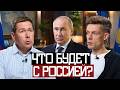
Is the Collapse of Russia Inevitable? - vDud and Novikov
Is Russia's collapse inevitable? Novikov discusses the complex future of Russia, its potential fragmentation, and the implications for Ukraine and global security.
In a 2023 interview, the speaker expressed a willingness to accept a "beautiful future Russia" as a Plan B, but advocated for the dismemberment of Russia as Plan A for the world, including Ukraine. Three years later, this stance remains unchanged, with the speaker elaborating on the rationale behind this perspective.
The Case for Division
The term "dismemberment" is acknowledged as potentially provocative, evoking negative imagery. However, the speaker notes its use by figures like Ilya Yashin, who have stated they are not aligned with a "dismembered Russia." The speaker proposes "division" as a more neutral term, suggesting it does not necessarily imply violence but rather a transition from one country to several.
The core argument for division stems from the perceived lack of viable alternatives to prevent future aggression from Russia. The speaker posits a hypothetical scenario: if Vladimir Putin were to die and a non-authoritarian successor were to emerge, leading to elections won by proponents of a "beautiful future Russia" (e.g., Yulia Navalnaya, Ilya Yashin), these new leaders would face immense challenges.
The Democratic Dilemma and Historical Precedents
Building a genuine democracy in Russia, the speaker argues, would inevitably lead to the loss of power for the initial reformist government. Drawing parallels with Eastern Europe post-1991, the speaker points out that initial elections often bring anti-communist forces to power, but subsequent elections frequently see a resurgence of former communists due to the painful nature of reforms. Those who lose jobs in industries like drone manufacturing, for instance, would likely vote for alternative candidates.
This "honeymoon period" for reformers would be short-lived, leading to their defeat. The speaker contends that even well-intentioned leaders would struggle to address the millions of Russians deeply entrenched in the current war effort—participants, their families, and those who have benefited from it. The speaker dismisses the idea of mass imprisonment or execution of these individuals, highlighting the complexity of judicial processes and the potential for acquittals in a fair system.
The speaker draws a parallel to the Reconstruction Era in the United States after the Civil War. Following the South's defeat, a period of Reconstruction involved restrictions on the rights of former Confederates to prevent further conflict. This, the speaker suggests, is a more realistic model than a swift, democratic transition, as it prioritizes stability over immediate democratic ideals.
The "Plan B" of a Divided Russia
The speaker argues that a divided Russia, even if some successor states are aggressive, would be preferable to a unified, powerful Russia. The primary benefit for Ukraine and other neighbors would be the absence of a monolithic, potentially 150-million-strong nation threatening smaller states. Even a large successor state, such as one encompassing territory up to the Urals with approximately 100 million people, would present a different dynamic.
The speaker suggests that these successor states might focus on internal conflicts or reclaiming lost territories within their own borders (e.g., Kazan for a hypothetical "Great Moscow State"), rather than external aggression. This internal focus would be more advantageous for Ukraine, as it would divert potential Russian aggression away from Kyiv and towards internal matters.
Addressing Concerns: Civil War and Nuclear Weapons
The prospect of civil wars erupting within a fragmented Russia is acknowledged as a significant risk. However, the speaker counters that Ukraine is already experiencing war, and a neighboring country embroiled in internal conflict, while undesirable, might be less of an immediate threat than a unified, resurgent Russia. The speaker emphasizes that the choice is not between a peaceful neighbor and a warring one, but between a potentially warring neighbor and a currently warring, unified, and powerful neighbor.
The issue of nuclear weapons proliferation is also raised. The speaker recalls the post-Soviet era, when the US worked to consolidate nuclear weapons in Russia, suggesting that a similar effort could be made to manage the nuclear arsenal in a fragmented Russia. While acknowledging that the US and Europe would likely prefer a single, stable Russia, they would ultimately accept the reality of a divided state if it occurred.
The Unavoidable Reality
The speaker concludes that the current situation is a choice between bad and worse alternatives. The "beautiful future Russia" scenario, while appealing, is deemed unreliable. The speaker believes that the millions of Russians who have experienced or benefited from the war represent an unchangeable factor. The speaker expresses a pessimistic outlook, stating that there is no clear path to a positive outcome and that even the "lighter" scenarios involve significant risks. The speaker's life, in part, is wagered on the assumption that a global nuclear war or a full-scale European invasion by Russia will not occur. The discussion, the speaker notes, remains within the realm of "hard options" in a "light scenario," excluding possibilities like world war or Putin's "liberation campaign" in Europe.
Introduction: The 'Dismemberment' of Russia
The discussion begins with a reference to a 2023 interview where the guest, Novikov, proposed the 'dismemberment of Russia' as a plan B for the world and Ukraine, while a 'beautiful future Russia' was plan A. The interviewer questions if Novikov still holds this view three years later, to which Novikov confirms. The conversation touches upon the term 'dismemberment' and its connotations, with Novikov suggesting 'division' as a more neutral term.
- Novikov previously stated that the 'dismemberment of Russia' should be plan B for the world and Ukraine.
- He confirms he still holds this view three years later.
- The term 'dismemberment' is discussed, with 'division' proposed as a more neutral alternative.
- Novikov references a 40-minute interview with Nenora Zabashvili on the topic.
Arguments for Division: Preventing Future Aggression
Novikov elaborates on his reasoning for supporting the division of Russia, focusing on the current situation where children in Ukraine live under bombardment. He argues that a unified Russia, even under a democratic future government, risks repeating its aggressive past due to internal political dynamics and the potential for revanchism. He contrasts this with the idea of a divided Russia, which he believes would reduce the threat to Ukraine.
- Novikov highlights the plight of children in Ukraine living under constant threat.
- He argues that a unified Russia, even if democratic, could still pose a threat due to internal political pressures and historical narratives.
- He suggests that a divided Russia would be less capable of launching future aggressions.
- The concept of 'beautiful future Russia' is questioned for its ability to prevent future conflicts.
Hypothetical Democratic Transition and its Challenges
The conversation explores a hypothetical scenario where Putin dies and a democratic government, perhaps led by figures like Yulia Navalnaya or Ilya Yashin, comes to power. Novikov argues that such a government would face immense challenges, including the need for painful reforms and the potential for a backlash from those who benefited from the previous regime, leading to a possible return of similar political forces in subsequent elections, mirroring post-Soviet Eastern European experiences.
- A hypothetical scenario of Putin's death and a democratic succession is presented.
- Novikov predicts that even a democratic Russian government would face challenges from those who benefited from the previous regime.
- He draws parallels with post-1991 Eastern European elections, where initial anti-communist victories were often followed by a communist resurgence.
- Economic reforms under a new government could lead to job losses, fueling public discontent and a desire for change.
Accountability and the Persistence of War Narratives
Novikov discusses the difficulty of holding war criminals accountable in a post-conflict Russia. He suggests that while some individuals might face trials, a mass prosecution of millions involved in the war is impractical. He also points out that many Russians, including veterans and their families, may view their involvement in the war as patriotic, making reconciliation and accountability complex. He likens the potential political landscape to the rise of the AfD in Germany, suggesting a similar emergence of nationalist or revanchist forces.
- Holding millions involved in the war accountable is deemed impractical.
- Many Russians may view their participation in the war as patriotic, complicating reconciliation.
- Novikov compares the potential rise of certain political forces in Russia to the AfD in Germany.
- He suggests that a significant portion of the Russian society, deeply involved in the war, will remain influential.
Reconstruction and Limited Accountability
The discussion shifts to the concept of 'Reconstruction' in post-civil war America as an analogy for Russia's potential future. Novikov argues that unlike the US Reconstruction, a future democratic Russia might not impose significant restrictions on former regime elements. He suggests that while some high-profile figures might face international tribunals, a large-scale punitive process is unlikely, leaving many involved in the war in positions of influence.
- The US Reconstruction period after the Civil War is used as a comparative example.
- Novikov suggests that a future Russia might not implement a strict 'reconstruction' phase.
- He anticipates that some war criminals might face international tribunals (e.g., Strelkov/Girkin, Shoigu).
- He believes a large-scale punitive process against millions involved in the war is improbable.
The Choice Between Bad and Worse Alternatives
Novikov argues that the current Russian government's actions, including the war in Ukraine, have created a situation where a peaceful, democratic Russia that is a reliable partner for Ukraine is unlikely to emerge soon. He posits that a divided Russia, even if it leads to internal conflicts, would be a less dangerous neighbor for Ukraine than a unified, potentially revanchist Russia. He uses the example of the US Civil War and its aftermath to illustrate how a unified nation might handle internal dissent.
- Novikov believes a unified, democratic Russia is unlikely to be a reliable partner for Ukraine in the near future.
- He argues that a divided Russia, even with internal conflicts, poses less of a threat than a unified, revanchist Russia.
- He references the US Civil War and the subsequent Reconstruction period as an example of managing internal divisions.
- The core argument is that the risk of a unified, aggressive Russia is greater than the risk of internal conflicts in a divided Russia.
Nuclear Proliferation and External Support for Separatism
The conversation addresses the concern of nuclear weapons proliferation in a fragmented Russia. Novikov acknowledges this risk but suggests it's a manageable issue, citing the post-Soviet experience where nuclear weapons were consolidated. He also discusses the potential for external actors, like Ukraine, to support regional separatist movements within Russia, drawing parallels to Russia's own actions in Crimea and Donbas, but framing it as a means to weaken a larger, potentially hostile entity.
- The risk of nuclear proliferation after Russia's potential collapse is discussed.
- Novikov believes the issue is manageable, referencing the consolidation of Soviet nuclear weapons.
- He suggests Ukraine might support regional separatist movements within Russia.
- This is framed as a strategic move to weaken a larger, potentially aggressive neighbor.
The Lesser Evil: Fragmentation vs. Unified Aggression
Novikov argues that for Ukraine and its neighbors, a fragmented Russia is preferable to a unified, potentially aggressive one, even if it means dealing with internal conflicts within Russia. He believes that a divided Russia would be too preoccupied with its internal issues to pose a significant external threat. He contrasts this with the current situation where a powerful, unified Russia is at war with Ukraine, and the risk of a future, larger-scale conflict remains.
- Novikov reiterates that a fragmented Russia is preferable for Ukraine and its neighbors.
- He believes internal conflicts in a divided Russia would prevent it from posing an external threat.
- He contrasts this with the current threat posed by a unified, powerful Russia.
- The argument is that dealing with internal Russian conflicts is a lesser evil than facing a unified, aggressive Russia.
Historical Perspectives and Geopolitical Realities
The discussion touches upon the historical US stance on a unified Russia and the subsequent Ukrainian disarmament. Novikov suggests that while the US initially preferred dealing with a single Russia, the current reality might force a different approach. He concludes that while a fragmented Russia presents risks, the alternative of a unified, potentially revanchist Russia is a greater danger, and that neighbors of Russia understand this implicitly.
- The US initially preferred dealing with a single, unified Russia.
- Ukraine disarmed its nuclear weapons in the 1990s.
- Novikov suggests that the current geopolitical situation might necessitate a shift in perspective regarding Russian fragmentation.
- Neighbors of Russia understand the threat posed by a unified, aggressive Russia.
Conclusion: A Pessimistic Choice Between Bad Alternatives
Novikov presents a pessimistic outlook, emphasizing that the choice is between bad and very bad alternatives. He argues that the millions of people who have been involved in the war and its narratives cannot simply be erased or forgotten. He believes that any attempt to forgive and forget wholesale would allow revanchist elements to re-emerge, leading to future conflicts. He concludes that a fragmented Russia, despite its risks, offers a better chance of preventing future wars than a unified, potentially aggressive one.
- Novikov offers a pessimistic view, stating the choice is between bad and very bad alternatives.
- He emphasizes that millions involved in the war cannot be simply ignored or forgotten.
- He warns against wholesale forgiveness, which could allow revanchist elements to resurface.
- He concludes that a fragmented Russia is a better option for preventing future wars than a unified, aggressive one.